
Our bathroom design is nearly complete; now we just need to confirm whether we are allowed to install the electric towel radiator exactly where we want. I've attached a plan. The shower will consist of a tileable element measuring 100x120cm (39x47 inches). This extends up to the opening of the niche. We would prefer not to have a glass door, but if one is required to place the radiator there, we will install it. The distance from the actual shower to the wall where the radiator is planned is 70cm (28 inches). The shower valve will be mounted on the narrow wall opposite.
I am aware of the dimensions for the splash zone, but the question is what counts as the shower area here: the entire niche measuring 100x190cm (39x75 inches) or just the 100x120cm (39x47 inches) element?
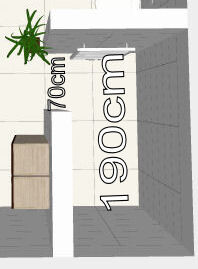
I am aware of the dimensions for the splash zone, but the question is what counts as the shower area here: the entire niche measuring 100x190cm (39x75 inches) or just the 100x120cm (39x47 inches) element?
Manu1976 schrieb:
... But from the showerhead to the towel warmer is almost 2 meters...Almost 2 meters is actually only 180 cm (71 inches).
One idea would be to place the electrical outlet for the electric towel warmer high up near the ceiling. From what I recall (I once saw a kind of splash diagram and it would also be logical), the splash zone in a shower is larger near the bottom than at the top, but I’m not certain.
Basically, I would tend to advise against using an electric towel warmer: it is rarely on when you actually need a warm towel. It also heats only a small area of the towel, so you don’t really feel it warm.
I don’t remember towels drying significantly faster with an electric warmer compared to normal bathroom air, which is usually warmer than the rest of the house anyway.
For the purchase price, you can probably get more stylish and larger towel warmers without electricity.
Thank you. Yes, you’re probably right that placing the radiator outside is better after all.
YPG: We don’t only use the radiator for towels but also to warm up the bathroom in the mornings during winter, controlled by a timer (the underfloor heating alone isn’t enough to make it comfortably warm). Yes, having an outlet higher up could be another option (above 2.25 meters (7 ft 5 in)), but unfortunately, I haven’t found a radiator with the connection at the top, and the cable is too short to route it upwards.
Doc: Our current opening is also 70 cm (28 inches), although some centimeters are lost due to a glass door. The door itself is only 65 cm (26 inches), and our corner shower has an opening of 60 cm (24 inches). When we get older, we can always redesign — they’re just drywall partitions after all. Although I’m not even sure if 200 m² (2150 sq ft) won’t be too much for me when I’m older.
YPG: We don’t only use the radiator for towels but also to warm up the bathroom in the mornings during winter, controlled by a timer (the underfloor heating alone isn’t enough to make it comfortably warm). Yes, having an outlet higher up could be another option (above 2.25 meters (7 ft 5 in)), but unfortunately, I haven’t found a radiator with the connection at the top, and the cable is too short to route it upwards.
Doc: Our current opening is also 70 cm (28 inches), although some centimeters are lost due to a glass door. The door itself is only 65 cm (26 inches), and our corner shower has an opening of 60 cm (24 inches). When we get older, we can always redesign — they’re just drywall partitions after all. Although I’m not even sure if 200 m² (2150 sq ft) won’t be too much for me when I’m older.
Similar topics