
ᐅ Screed Heating Protocol Using External Devices or Heat Pump?
Created on: 8 Jan 2026 08:42
F
Felix1117
Hi everyone,
I have a more general question and would like to hear your opinions.
I’m about to start with the screed and have two options for the drying process starting from calendar week 6 (so basically in mid-winter on paper):
1. Heating with the air-source heat pump iPUMP ALM 2-8
2. Heating with external devices (an additional cost of €675 net)
The area is about 270 m² (2900 sq ft) (basement, ground floor, upper floor).
Which option would you choose, considering the season, area, and performance of the heat pump?
Thanks and best regards
I have a more general question and would like to hear your opinions.
I’m about to start with the screed and have two options for the drying process starting from calendar week 6 (so basically in mid-winter on paper):
1. Heating with the air-source heat pump iPUMP ALM 2-8
2. Heating with external devices (an additional cost of €675 net)
The area is about 270 m² (2900 sq ft) (basement, ground floor, upper floor).
Which option would you choose, considering the season, area, and performance of the heat pump?
Thanks and best regards
N
nordanney8 Jan 2026 12:00Here is an example for lower temperatures
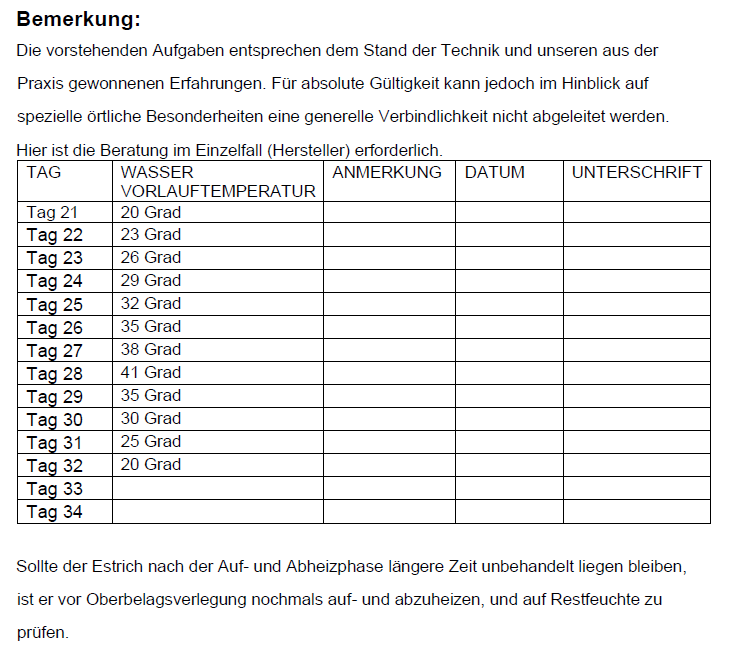
F
Felix11178 Jan 2026 12:06Ok, thanks. He was referring to the load on the compressor. Another issue is the indoor unit, which has to be installed in the boiler room – it will actually be placed directly on the screed, which won’t be finished at that point.
N
nordanney8 Jan 2026 12:11Felix1117 schrieb:
it’s actually supposed to rest directly on the screedIt should have its own base and should not stand on the floating screed. Is the electrical work already finished?

Regardless of the initial question (heating up with the air source heat pump or heating up with external devices):
the functional heating must be carried out in order to possibly detect that parts of the underfloor heating system are not working.
Apart from that, a heated screed does not necessarily require a "dry heating" process!
Especially with these low humidity levels, it is sufficient to keep the room temperature above 5°C (41°F) and to remove the moisture released from the screed mortar to the outside air through intermittent ventilation.
--------------------------------
KlaRa
the functional heating must be carried out in order to possibly detect that parts of the underfloor heating system are not working.
Apart from that, a heated screed does not necessarily require a "dry heating" process!
Especially with these low humidity levels, it is sufficient to keep the room temperature above 5°C (41°F) and to remove the moisture released from the screed mortar to the outside air through intermittent ventilation.
--------------------------------
KlaRa
F
Felix111712 Jan 2026 15:06Hi, sorry for the late reply. The electrical work is currently being completed, yes. The idea is that I can save some costs compared to the main power supply by using house electricity plus photovoltaic panels. The indoor unit of the heat pump will be installed on the screed floor, but with vibration isolation. The heating engineer is still not really enthusiastic because:
- The indoor unit is placed directly on the screed floor
- He says that every heat pump manufacturer advises against doing this.
N
nordanney12 Jan 2026 15:20Which heating-up protocol do you have to use – what is specified to you by the screed installer?
When is the heat pump actually ready for operation after the screed work?
Then ask him why heat pump manufacturers include a special program for this situation in the heat pumps themselves?
When is the heat pump actually ready for operation after the screed work?
Felix1117 schrieb:
He says that every heat pump manufacturer advises against doing it.
Then ask him why heat pump manufacturers include a special program for this situation in the heat pumps themselves?
Similar topics