
I would like to install laminate flooring in a room on the first floor. The subfloor consists of wooden planks and is uneven by up to 3 cm (1.2 inches). I plan to level the wooden plank floor using Fermacell leveling granulate and then lay a dry screed on top.
My concern is with the wooden plank subfloor. I have removed a section of the planks to inspect the area underneath. The joist beneath the planks is visible. However, I’m unsure if using the leveling granulate is appropriate because the surface under the planks raises doubts about my plan.
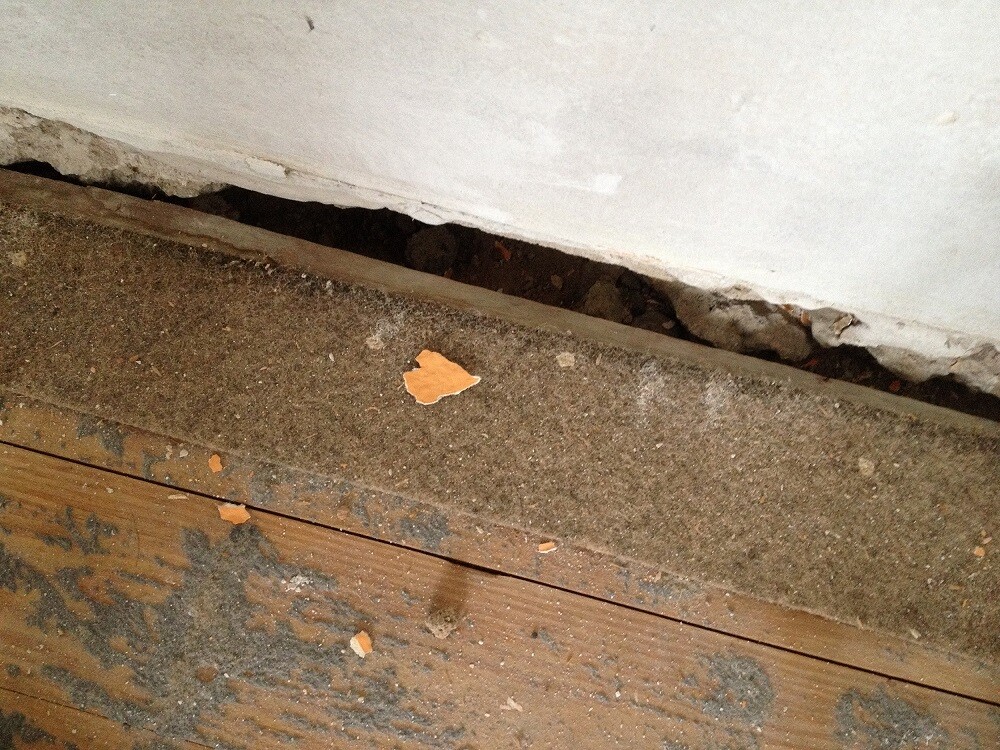
Another issue is the masonry, which has deep cracks near the lower part. The leveling granulate could flow into these cracks and cause unevenness. Would it be suitable to fill these cracks? Should I use filler or mortar?
I have taken photos of both the planks and the masonry cracks.
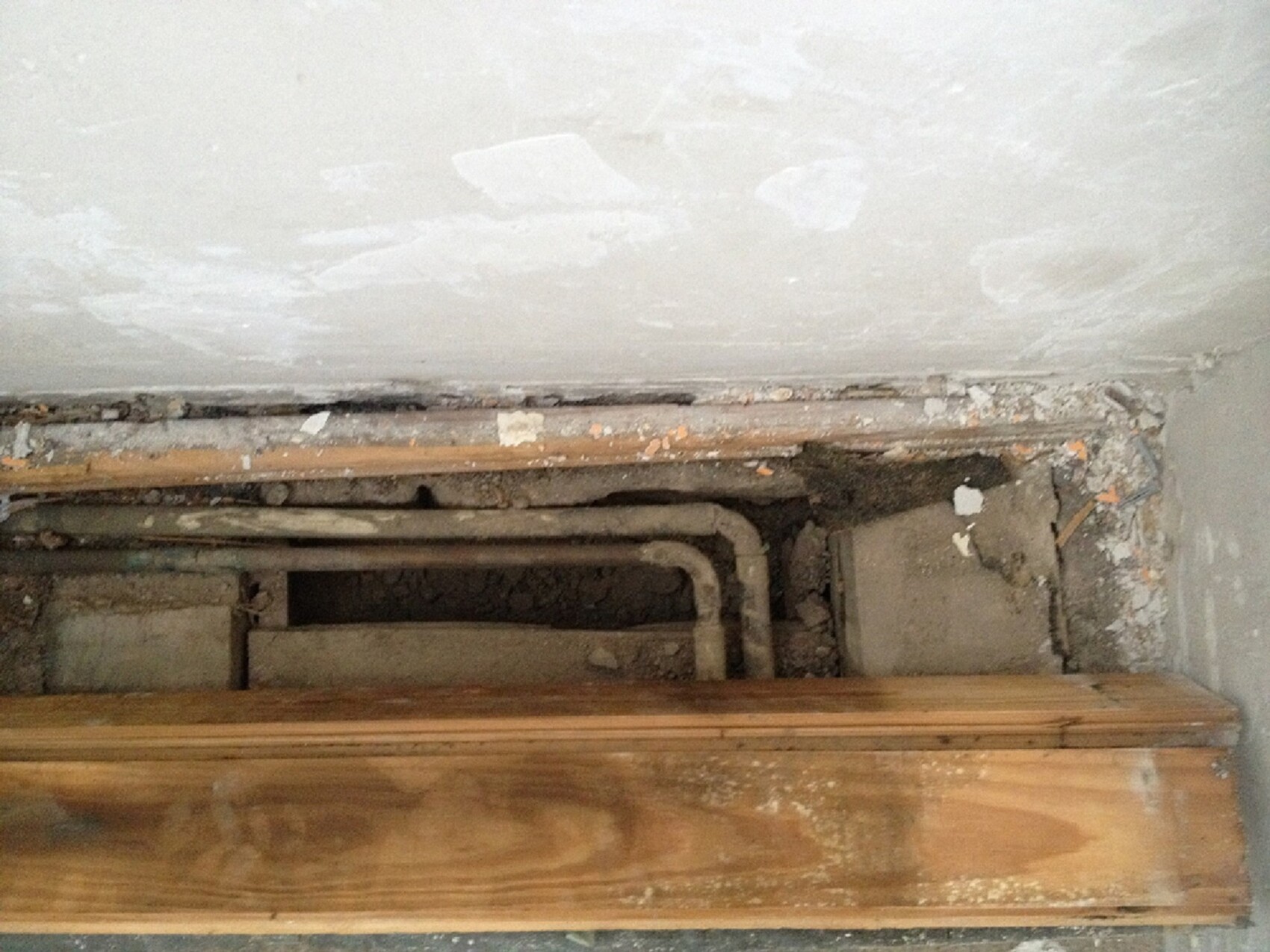
My concern is with the wooden plank subfloor. I have removed a section of the planks to inspect the area underneath. The joist beneath the planks is visible. However, I’m unsure if using the leveling granulate is appropriate because the surface under the planks raises doubts about my plan.
Another issue is the masonry, which has deep cracks near the lower part. The leveling granulate could flow into these cracks and cause unevenness. Would it be suitable to fill these cracks? Should I use filler or mortar?
I have taken photos of both the planks and the masonry cracks.

Hello "inexperienced".
As an expert (specialist), a professional hardwood flooring company (a master craftsman business!) would certainly be a good option. For this kind of assessment, public certification as an expert is not necessarily required.
For example, if the master hardwood flooring installer, after partially removing some floorboards, concludes that the supporting joists might not stay damage-free for the next 20 years, the next specialist to consult would be the carpenter.
However, this scenario is purely hypothetical here. I do not see my role as causing a worst-case scenario.
That means all possibly occurring problems can be resolved calmly.
Well-meaning advice:
Please involve only a master craftsman business for the assessment of the hardwood floor.
-----------------------
Regards, KlaRa
As an expert (specialist), a professional hardwood flooring company (a master craftsman business!) would certainly be a good option. For this kind of assessment, public certification as an expert is not necessarily required.
For example, if the master hardwood flooring installer, after partially removing some floorboards, concludes that the supporting joists might not stay damage-free for the next 20 years, the next specialist to consult would be the carpenter.
However, this scenario is purely hypothetical here. I do not see my role as causing a worst-case scenario.
That means all possibly occurring problems can be resolved calmly.
Well-meaning advice:
Please involve only a master craftsman business for the assessment of the hardwood floor.
-----------------------
Regards, KlaRa
G
garfunkel29 Jun 2016 18:06Why is a master craftsman business "essential"?
In response to your question:
Based on my experience, right now there are many sole proprietors working in various trades who neither know nor adhere to professional standards, and after causing damage, they leave the homeowner to deal with the consequences.
In contrast, the master craftsman qualification should never be underestimated or downplayed, as it represents a high level of expertise across all areas of flooring trades accumulated by those who hold it (both men and women).
A good master craftsman company will, if the issue is not structural, also be able to recognize special conditions related to the load-bearing beams and propose (and implement) a solution.
I do not mean to disparage so-called "handyman businesses," but professional expertise cannot always be assumed there. I could write a whole book about how such (refinished) parquet floors can look after being over-sanded...
With my comment, I just wanted to save you from that at least!
Best regards, KlaRa
Based on my experience, right now there are many sole proprietors working in various trades who neither know nor adhere to professional standards, and after causing damage, they leave the homeowner to deal with the consequences.
In contrast, the master craftsman qualification should never be underestimated or downplayed, as it represents a high level of expertise across all areas of flooring trades accumulated by those who hold it (both men and women).
A good master craftsman company will, if the issue is not structural, also be able to recognize special conditions related to the load-bearing beams and propose (and implement) a solution.
I do not mean to disparage so-called "handyman businesses," but professional expertise cannot always be assumed there. I could write a whole book about how such (refinished) parquet floors can look after being over-sanded...
With my comment, I just wanted to save you from that at least!
Best regards, KlaRa