
Hello everyone,
My wife and I bought a house last year – built in 1978 (so it’s older than we are ).
Now, of course, it’s time for some renovations and repairs.
Yesterday, I noticed that on the rear side of the house at the "base" – roughly at the level of the basement windows – the plaster is damaged. It is loose, and a piece about 5cm by 3cm (2 inches by 1 inch) can be removed. The areas around this removable piece are slightly cracked, and most likely the adhesion will not hold in the medium term.
My question is: How can I fix this myself if possible? I’m not a professional, but I’m reasonably handy. I just want to intervene as quickly as possible to protect the masonry from potential harmful effects (moisture).
I would be very grateful for any advice or tips.
My wife and I bought a house last year – built in 1978 (so it’s older than we are ).
Now, of course, it’s time for some renovations and repairs.
Yesterday, I noticed that on the rear side of the house at the "base" – roughly at the level of the basement windows – the plaster is damaged. It is loose, and a piece about 5cm by 3cm (2 inches by 1 inch) can be removed. The areas around this removable piece are slightly cracked, and most likely the adhesion will not hold in the medium term.
My question is: How can I fix this myself if possible? I’m not a professional, but I’m reasonably handy. I just want to intervene as quickly as possible to protect the masonry from potential harmful effects (moisture).
I would be very grateful for any advice or tips.
Hmm, I recently renovated the exterior plaster of our old house before repainting.
I knocked off all loose material and removed any areas that sounded hollow over a large surface.
Then, following the instructions on the repair plaster, I applied the appropriate primer, moistened the surface, and carried out the repairs.
Fine cracks can probably be left as they are.
However, I cannot guarantee this—I am also a non-professional.
Plaster usually detaches when the substrate is damp. It would be important to check the cause. Is the moisture coming from the inside or outside?!
Best regards, Yvonne
I knocked off all loose material and removed any areas that sounded hollow over a large surface.
Then, following the instructions on the repair plaster, I applied the appropriate primer, moistened the surface, and carried out the repairs.
Fine cracks can probably be left as they are.
However, I cannot guarantee this—I am also a non-professional.
Plaster usually detaches when the substrate is damp. It would be important to check the cause. Is the moisture coming from the inside or outside?!
Best regards, Yvonne
It is rising damp that is damaging the plaster. As ypg says, repair the plaster, but also remove the soil at the base and apply a bitumen waterproof coating. This will prevent moisture from reaching the masonry. Then, no soil directly against the foundation; instead, use gravel, coarse gravel that allows water to drain well. Karsten
Hello and thank you very much for your advice.
I have now repaired the damage with repair plaster. There is no soil at that spot; rather, it is a recess paved with concrete slabs in front of the window.
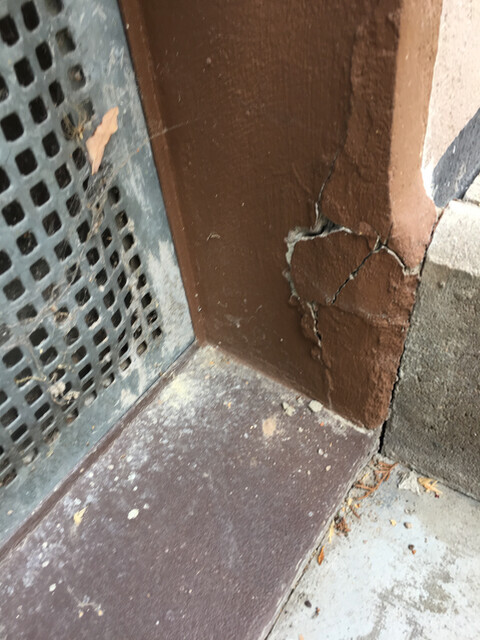
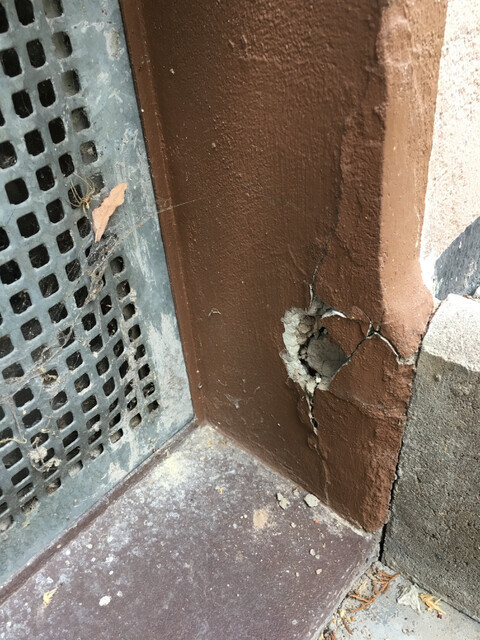
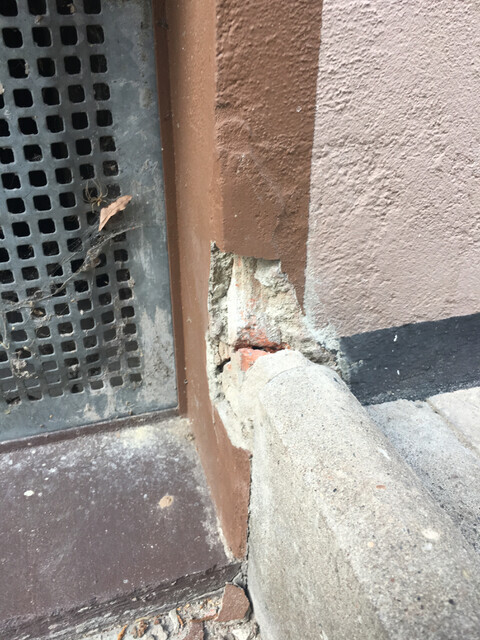
The damage looked as follows:
P.S. Unfortunately, the specialist store was out of base coat paint. At the DIY store, they wanted to sell me wood protective paint instead of base coat paint. I insisted on the base coat paint because I couldn’t imagine that wood and plaster have the same properties... Do you have any information about this?
I have now repaired the damage with repair plaster. There is no soil at that spot; rather, it is a recess paved with concrete slabs in front of the window.
The damage looked as follows:
P.S. Unfortunately, the specialist store was out of base coat paint. At the DIY store, they wanted to sell me wood protective paint instead of base coat paint. I insisted on the base coat paint because I couldn’t imagine that wood and plaster have the same properties... Do you have any information about this?
Similar topics