
ᐅ Cavity Wall Construction for a Basement in a Hillside Location – Any Experiences?
Created on: 5 May 2018 14:31
N
notard
Hello everyone,
We are currently planning the construction of an end terraced house on a sloped site and would appreciate your advice regarding the wall construction.
Our project has some specific features, namely:
Our original wall construction plan for the house was as follows:
Now, due to the sloped site, we want to include a residential basement, which creates challenges with the brick facing, as it is very difficult to align the base of the outer leaf of the brickwork with the slope of the ground while ensuring proper insulation and waterproofing.
Our architect has proposed the following solution:
However, we consciously decided against using EWI because
Therefore, we would like to gather more opinions on whether there might still be a solution for a continuous brick facade that does not become excessively expensive. Has anyone experienced how to solve this kind of issue?
Attachment: Sketch of the planned house with terrain
Thank you very much and best regards,
notard
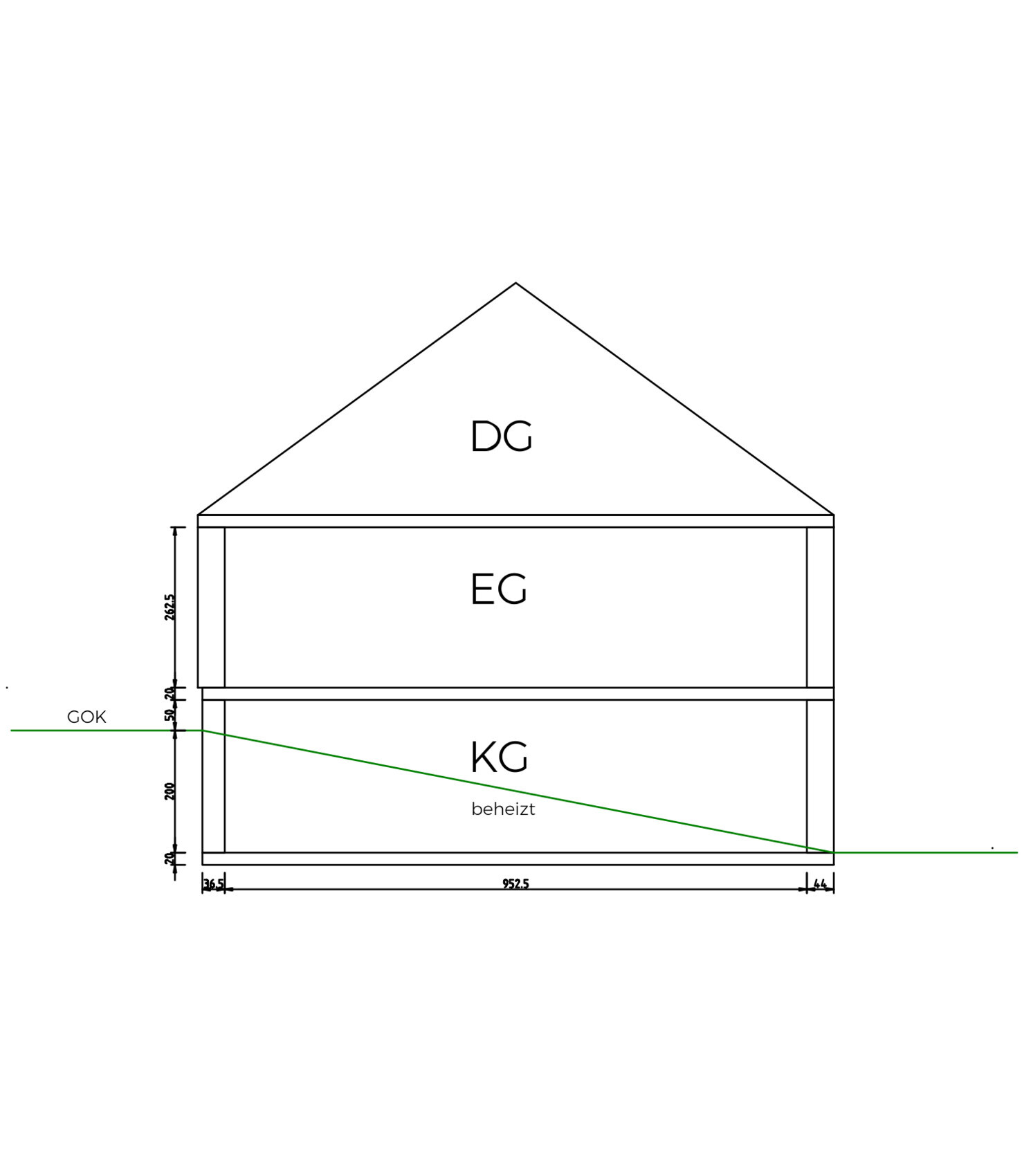
We are currently planning the construction of an end terraced house on a sloped site and would appreciate your advice regarding the wall construction.
Our project has some specific features, namely:
- Building plot on a slope (green line indicates the terrain)
- Extension attached to an existing terraced house (opposite side compared to the drawing)
- Foundation must be at the same level as the existing house
Our original wall construction plan for the house was as follows:
- 11.5cm (4.5 inches) facing brick / 15cm (6 inches) cavity insulation + cavity / 17.5cm (7 inches) calcium silicate solid blocks = 44cm (17 inches)
Now, due to the sloped site, we want to include a residential basement, which creates challenges with the brick facing, as it is very difficult to align the base of the outer leaf of the brickwork with the slope of the ground while ensuring proper insulation and waterproofing.
Our architect has proposed the following solution:
- Cladding the exposed basement exterior wall with external wall insulation system (EWI) up to the base
- From the ground floor upwards: cavity masonry
However, we consciously decided against using EWI because
- We are concerned about algae and mold issues, which we have already encountered in acquaintances’ buildings
- We value the durability and quality of a brick masonry facade
- We prefer a uniform (brick) appearance
Therefore, we would like to gather more opinions on whether there might still be a solution for a continuous brick facade that does not become excessively expensive. Has anyone experienced how to solve this kind of issue?
Attachment: Sketch of the planned house with terrain
Thank you very much and best regards,
notard
A basement made of concrete with cavity insulation is also feasible.
However, I would simply forget the “ETICS = bad” stories and follow the architect’s pragmatic approach. You can do something about mold if it ever occurs, and ultimately it is only an aesthetic issue. There is no point in going to extremes (internal insulation in new builds, stop it!) just because it might need repainting after 10 years. We are not talking about two floors but a small part of one floor, which is also very easily accessible.
Forget the dogmas, focus on practical solutions!
However, I would simply forget the “ETICS = bad” stories and follow the architect’s pragmatic approach. You can do something about mold if it ever occurs, and ultimately it is only an aesthetic issue. There is no point in going to extremes (internal insulation in new builds, stop it!) just because it might need repainting after 10 years. We are not talking about two floors but a small part of one floor, which is also very easily accessible.
Forget the dogmas, focus on practical solutions!
11ant schrieb:
In the worst case of lacking imagination, drawing it yourself might help: the support structure had to be built and fixed like stairs. I don’t lack imagination, but rather understanding of what exactly makes this so complicated. Please feel free to explain in detail. Does the masonry support really have to be exactly at the ground level? The terrain rises about 2.5m (8 feet) over 10m (33 feet) – couldn’t you just add 0.25m (10 inches) thicker masonry every meter (3.3 feet) underneath?
Alex85 schrieb:
I would just forget the “ETICS = bad” stories and follow the architect’s pragmatic approach. [...]
Forget dogmas, focus on practical solutions! Yes, I guess that’s what it will come down to. Simply because there are no better alternatives. Still, thanks for the encouragement!

notard schrieb:
Does the masonry need to sit exactly at the ground level? No, it does not need to.
notard schrieb:
The ground rises about 2.5m (8 feet) over 10m (33 feet) – could you then add 0.25m (10 inches) of thicker masonry for each meter (yard)? That would require a masonry basement or that it is arranged accordingly in concrete.
However, the cavity wall would then also start stepped – and how would the insulation be installed below this “line”?
I consider the architect’s suggestion to make a clean joint at the height between the basement and the ground floor to be appropriate. The painter will surely find a matching color for the plaster surface to the brickwork.
https://www.instagram.com/11antgmxde/
https://www.linkedin.com/company/bauen-jetzt/
11ant schrieb:
That would require a masonry basement, or designing the concrete accordingly. Would a masonry basement be very unusual for a house with a half-exposed basement? I had assumed that in this special case it is the most common option. Or how is it normally done in such situations?
11ant schrieb:
The double shell would then also start in a stepped fashion – and how is insulation supposed to be applied below this "line"? With perimeter insulation. I found something online (see attachment) – without knowing if it can also be used with stepped foundations.
Similar topics