
ᐅ Issue with the Inlet and Outlet Heights for 4Rain 5000-Liter Flat Tank
Created on: 16 Apr 2017 21:57
M
MKoni
Hello dear forum community,
I have an issue with the inlet and outlet heights for my 4Rain flat tank with a capacity of 5000 liters (1320 gallons). The outlet to the rainwater shaft is approximately 12 cm (5 inches) lower than the inlet when viewed centrally. The problem lies with the tank itself. The inlet is located in the dome, and the overflow is positioned about 27 cm (11 inches) apart from the inlet in the middle of the tank.
Since I have to accept the height of the inlet, my question is how I can ensure that the overflow functions correctly. I have attached a small drawing for easier understanding.
I have an issue with the inlet and outlet heights for my 4Rain flat tank with a capacity of 5000 liters (1320 gallons). The outlet to the rainwater shaft is approximately 12 cm (5 inches) lower than the inlet when viewed centrally. The problem lies with the tank itself. The inlet is located in the dome, and the overflow is positioned about 27 cm (11 inches) apart from the inlet in the middle of the tank.
Since I have to accept the height of the inlet, my question is how I can ensure that the overflow functions correctly. I have attached a small drawing for easier understanding.
G
Gartenfreund18 Apr 2017 16:06Hello MKoni
I did it this way after consulting with the relevant authority and to save on the corresponding fee (several hundred euros per year).
Inside the tank, there is a simple wastewater pump bought from a hardware store for about €40. It was installed fairly high up to prevent the water level from getting too high. I quickly took some pictures.
Picture 1 shows the pump and connection that ensure the water level does not rise too much. In the foreground, you can see a pipe leading to a pump located at the bottom of the tank (same type of pump as above), which is used for watering the garden. However, I avoid using a sprinkler nozzle out of caution, because I fear the nozzles would clog since I haven’t installed any filter anywhere.
At other times, this second pump is also used when the inflow exceeds what the first pump can handle or if pump 1 fails. Then, the second pump removes water from the tank until it is almost empty (controlled by a float switch).
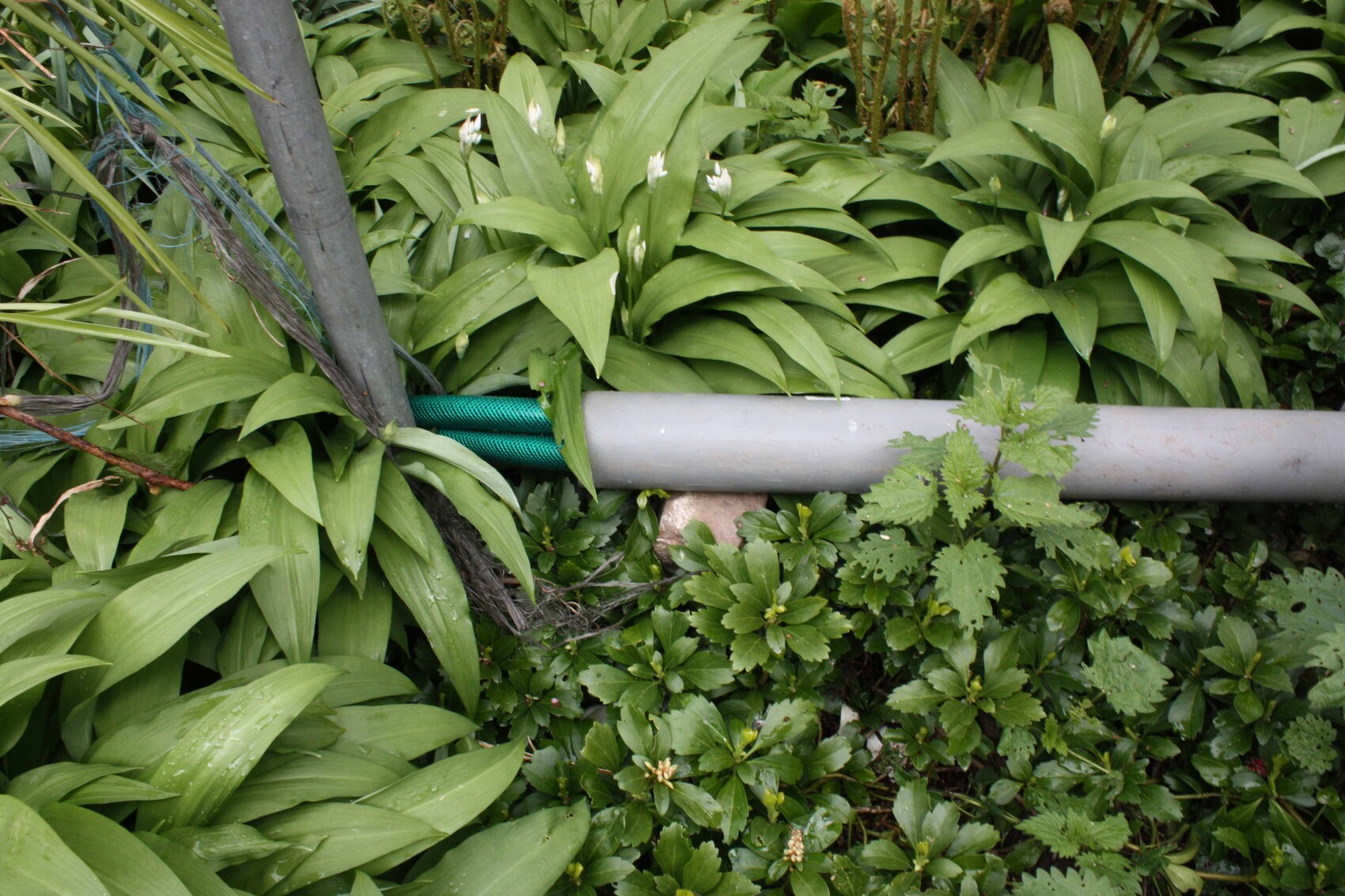
Picture 2 shows the hoses entering the 75mm (3-inch) wastewater pipe I installed. This pipe is laid above ground in the garden. One side was cut with a circular saw (picture 3). I connected the 2-meter (6.5-foot) pipe sections without the sealing gaskets so that the individual pieces can be easily rotated, allowing you to partially control how much water exits at each point. Since this pipe is located in an area where wild garlic grows, it is hardly visible, as shown in pictures 3 and 4. This means you can cleverly hide these pipes with suitable planting.
Regarding sealing the dome in place, I would not recommend it because you cannot be sure it will be watertight. If you need to replace the dome later, removing it will be difficult. So I wouldn’t do it. You could try silicone, but I doubt it would make much difference.
Question: Is the dome simply placed on top? I ask because our dome was screwed onto the tank and included a corresponding seal.
Since water hardly flows uphill, connecting the overflow to a higher-lying sewer will not work. Water will only flow into the sewer when the water level in the tank is as high as the sewer connection and therefore above the tank/dome joint. If that joint leaks, you could have problems. As I said before, either lower the sewer connection overall or use a pump. I can't think of any other solution.
One more note: I once read that in winter, flat tanks should ideally be kept with only a small amount of water inside to avoid damage from ice formation. But as I said, I only read this somewhere and cannot confirm its accuracy.



I did it this way after consulting with the relevant authority and to save on the corresponding fee (several hundred euros per year).
Inside the tank, there is a simple wastewater pump bought from a hardware store for about €40. It was installed fairly high up to prevent the water level from getting too high. I quickly took some pictures.
Picture 1 shows the pump and connection that ensure the water level does not rise too much. In the foreground, you can see a pipe leading to a pump located at the bottom of the tank (same type of pump as above), which is used for watering the garden. However, I avoid using a sprinkler nozzle out of caution, because I fear the nozzles would clog since I haven’t installed any filter anywhere.
At other times, this second pump is also used when the inflow exceeds what the first pump can handle or if pump 1 fails. Then, the second pump removes water from the tank until it is almost empty (controlled by a float switch).
Picture 2 shows the hoses entering the 75mm (3-inch) wastewater pipe I installed. This pipe is laid above ground in the garden. One side was cut with a circular saw (picture 3). I connected the 2-meter (6.5-foot) pipe sections without the sealing gaskets so that the individual pieces can be easily rotated, allowing you to partially control how much water exits at each point. Since this pipe is located in an area where wild garlic grows, it is hardly visible, as shown in pictures 3 and 4. This means you can cleverly hide these pipes with suitable planting.
Regarding sealing the dome in place, I would not recommend it because you cannot be sure it will be watertight. If you need to replace the dome later, removing it will be difficult. So I wouldn’t do it. You could try silicone, but I doubt it would make much difference.
Question: Is the dome simply placed on top? I ask because our dome was screwed onto the tank and included a corresponding seal.
Since water hardly flows uphill, connecting the overflow to a higher-lying sewer will not work. Water will only flow into the sewer when the water level in the tank is as high as the sewer connection and therefore above the tank/dome joint. If that joint leaks, you could have problems. As I said before, either lower the sewer connection overall or use a pump. I can't think of any other solution.
One more note: I once read that in winter, flat tanks should ideally be kept with only a small amount of water inside to avoid damage from ice formation. But as I said, I only read this somewhere and cannot confirm its accuracy.

Thanks for your effort!
I plan to use the tank to irrigate the entire property, which means I will also use pop-up sprinklers (retractable in the lawn) as well as several hose connection outlets. I used a similar system at our previous house for over five years, and it worked perfectly. I specifically purchased a powerful submersible pump that can operate up to five sprinklers simultaneously at a distance of 20m (65 feet). Additionally, there is a supply line from the household water system to bypass and supply water when the tank is empty.
I’m still considering options because I want to avoid installing another pump.
The tank offers the possibility of drilling a hole on the side to connect an additional tank. If I run the supply line here, it would be outside the DOMS, and I would have an inlet at the same level inside the tank. I would need to figure out how to install the filter since the basket filter won’t work in this case. I could use one that works without any slope.
I plan to use the tank to irrigate the entire property, which means I will also use pop-up sprinklers (retractable in the lawn) as well as several hose connection outlets. I used a similar system at our previous house for over five years, and it worked perfectly. I specifically purchased a powerful submersible pump that can operate up to five sprinklers simultaneously at a distance of 20m (65 feet). Additionally, there is a supply line from the household water system to bypass and supply water when the tank is empty.
I’m still considering options because I want to avoid installing another pump.
The tank offers the possibility of drilling a hole on the side to connect an additional tank. If I run the supply line here, it would be outside the DOMS, and I would have an inlet at the same level inside the tank. I would need to figure out how to install the filter since the basket filter won’t work in this case. I could use one that works without any slope.
G
Gartenfreund20 Apr 2017 07:46How about operating the pump using a water differential switch? Then, a single pump would be sufficient. It might look a bit odd if the sprinkler suddenly starts running when it rains, but that could still be an option.
Such a device costs around €46, depending on the supplier.
I would like to send you the exact product name by email, but at the moment I don’t see a way to do that here.
Such a device costs around €46, depending on the supplier.
I would like to send you the exact product name by email, but at the moment I don’t see a way to do that here.
That’s a good idea for my drainage shaft as well, in case not everything seeps away.
I think you mean something like the H-Tronic level controller for filling and emptying 10 m 1114455.
Yesterday, I took another look at the base unit. The overflow connection is on one side of the tank, and directly opposite is the same flat spot suitable for drilling. I could easily position this 5–8 cm (2–3 inches) lower than the connection on the other side; the respective seals are available separately. This would create a slope, all within the tank without involving the access dome. I would only need to get the right filter, as it wouldn’t work through the filter basket.
I think you mean something like the H-Tronic level controller for filling and emptying 10 m 1114455.
Yesterday, I took another look at the base unit. The overflow connection is on one side of the tank, and directly opposite is the same flat spot suitable for drilling. I could easily position this 5–8 cm (2–3 inches) lower than the connection on the other side; the respective seals are available separately. This would create a slope, all within the tank without involving the access dome. I would only need to get the right filter, as it wouldn’t work through the filter basket.
G
Gartenfreund20 Apr 2017 14:56Yes, exactly that kind. I use the 3000 Plus just in case.
Regarding the filter, I can’t really comment because it was deliberately omitted here. Maybe you could bury a small barrel or build a chamber before the tank where the inlet and filter are installed, and then the water continues to the tank, allowing you to use the inlet connection at the tank. Of course, you could also install the tank deeper. It’s not visible in my photo, but I had to set the tank deeper due to the height of the inlet pipe, and then there were two options: either buy a rather expensive riser or build a chamber. I chose to build the chamber.
For your first home, did you already have a tank? I ask because I’m not sure whether your reference is to the tank or to the irrigation system.
Maybe you could also upload some pictures with markings showing where you plan the connections. That would possibly make it easier for me to offer suggestions or to understand exactly what you have planned.
Regarding the filter, I can’t really comment because it was deliberately omitted here. Maybe you could bury a small barrel or build a chamber before the tank where the inlet and filter are installed, and then the water continues to the tank, allowing you to use the inlet connection at the tank. Of course, you could also install the tank deeper. It’s not visible in my photo, but I had to set the tank deeper due to the height of the inlet pipe, and then there were two options: either buy a rather expensive riser or build a chamber. I chose to build the chamber.
For your first home, did you already have a tank? I ask because I’m not sure whether your reference is to the tank or to the irrigation system.
Maybe you could also upload some pictures with markings showing where you plan the connections. That would possibly make it easier for me to offer suggestions or to understand exactly what you have planned.
Similar topics