
ᐅ Issue with the Inlet and Outlet Heights for 4Rain 5000-Liter Flat Tank
Created on: 16 Apr 2017 21:57
M
MKoni
Hello dear forum community,
I have an issue with the inlet and outlet heights for my 4Rain flat tank with a capacity of 5000 liters (1320 gallons). The outlet to the rainwater shaft is approximately 12 cm (5 inches) lower than the inlet when viewed centrally. The problem lies with the tank itself. The inlet is located in the dome, and the overflow is positioned about 27 cm (11 inches) apart from the inlet in the middle of the tank.
Since I have to accept the height of the inlet, my question is how I can ensure that the overflow functions correctly. I have attached a small drawing for easier understanding.
I have an issue with the inlet and outlet heights for my 4Rain flat tank with a capacity of 5000 liters (1320 gallons). The outlet to the rainwater shaft is approximately 12 cm (5 inches) lower than the inlet when viewed centrally. The problem lies with the tank itself. The inlet is located in the dome, and the overflow is positioned about 27 cm (11 inches) apart from the inlet in the middle of the tank.
Since I have to accept the height of the inlet, my question is how I can ensure that the overflow functions correctly. I have attached a small drawing for easier understanding.
Here is the installation.
The riser shaft is simply placed on top of the tank and is held in place by filling it with sand. Since the rainwater inlet and outlet are fixed as shown (installed under the garage and paving stones), I cannot change this. I am now wondering whether the connection of the overflow would still work (due to the pressure from the height difference) or if I should connect the inlet to option 1 and the outlet to option 2. But what about filtration then? Also, the riser shaft on top of the tank is not sealed properly since it is only placed on it.....
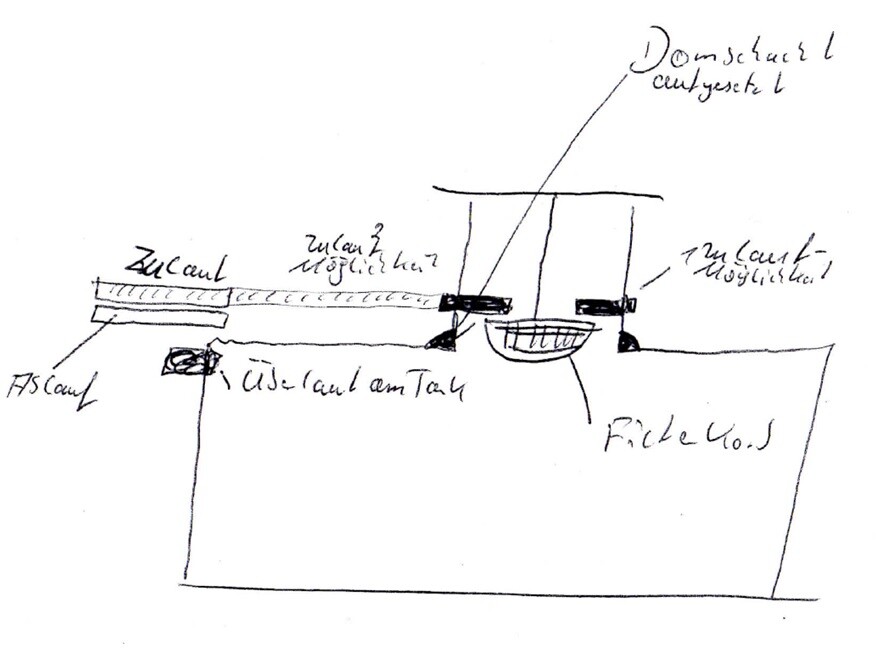
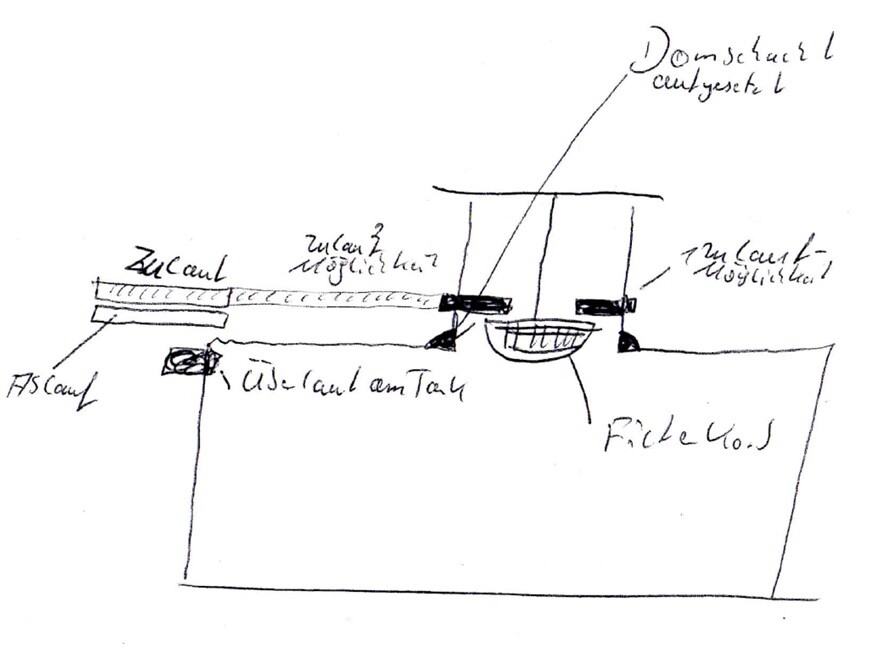
The riser shaft is simply placed on top of the tank and is held in place by filling it with sand. Since the rainwater inlet and outlet are fixed as shown (installed under the garage and paving stones), I cannot change this. I am now wondering whether the connection of the overflow would still work (due to the pressure from the height difference) or if I should connect the inlet to option 1 and the outlet to option 2. But what about filtration then? Also, the riser shaft on top of the tank is not sealed properly since it is only placed on it.....
G
Gartenfreund17 Apr 2017 08:35Water enters the dome from one side, for example from the roof, while on the other side the pipe (tube, hose) runs from the pump to the tap point. The overflow is located at the tank, not at the dome, and this pipe leads to the sewer or an infiltration unit.
If in your case the connection, for example to the sewer, is higher than the overflow at the tank, it will not work. You will then need a pump that pushes a certain amount of water into the higher-lying sewer or infiltration system once a specific level is reached.
If in your case the connection, for example to the sewer, is higher than the overflow at the tank, it will not work. You will then need a pump that pushes a certain amount of water into the higher-lying sewer or infiltration system once a specific level is reached.
G
Gartenfreund18 Apr 2017 08:23You mention overflow, inlet pipe, and inflow, which makes it a bit difficult for me to follow.
Perhaps we should agree on the following, considering the pipes or connections in your sketch from top to bottom:
Inlet (roof, drainage channel, etc.)
Sewer connection
Overflow on the tank
As I already mentioned, if the sewer connection is higher than the overflow and this pipe cannot be installed any lower (as I understood it), then you need to install a pump to keep the water level in the tank at a maximum height. I did the same, but with the difference that I let the water infiltrate into the garden instead of pumping it into the sewer.
As an alternative to a pump, if possible, you could also install a soakaway system.
Perhaps we should agree on the following, considering the pipes or connections in your sketch from top to bottom:
Inlet (roof, drainage channel, etc.)
Sewer connection
Overflow on the tank
As I already mentioned, if the sewer connection is higher than the overflow and this pipe cannot be installed any lower (as I understood it), then you need to install a pump to keep the water level in the tank at a maximum height. I did the same, but with the difference that I let the water infiltrate into the garden instead of pumping it into the sewer.
As an alternative to a pump, if possible, you could also install a soakaway system.
Yes, this is the correct connection sequence.
What type of pump could or should this be? Unfortunately, infiltration is not allowed as an overflow; the discharge must go into the sewer system.
I have considered the following solutions:
1. Idea: Permanently bond the access shaft to the tank and use the second inlet as an overflow. The second option is a normal access for the inlet electrical line to the pump plus the pump’s pressure line, but this could also be installed higher in the shaft (make the hole yourself). The problem here is, for example, filtration.
2. Idea: Connect the tank overflow to the sewer inlet with a kind of trap (like a sink) or directly, since water should actually be pushed out because the inlet is higher than the outlet.
What type of pump could or should this be? Unfortunately, infiltration is not allowed as an overflow; the discharge must go into the sewer system.
I have considered the following solutions:
1. Idea: Permanently bond the access shaft to the tank and use the second inlet as an overflow. The second option is a normal access for the inlet electrical line to the pump plus the pump’s pressure line, but this could also be installed higher in the shaft (make the hole yourself). The problem here is, for example, filtration.
2. Idea: Connect the tank overflow to the sewer inlet with a kind of trap (like a sink) or directly, since water should actually be pushed out because the inlet is higher than the outlet.
Similar topics