
ᐅ Planning a discreet, automatic garden irrigation system – underground?
Created on: 5 May 2024 16:25
H
HausbaufaehigH
Hausbaufaehig5 May 2024 16:25Hello everyone,
or rather: hello @rick2018, since this is probably mainly a topic for you.
You already gave me valuable advice almost two years ago during the planning phase of my construction project (see this post),
and now the time has finally come to plant the garden and finalize the irrigation system.
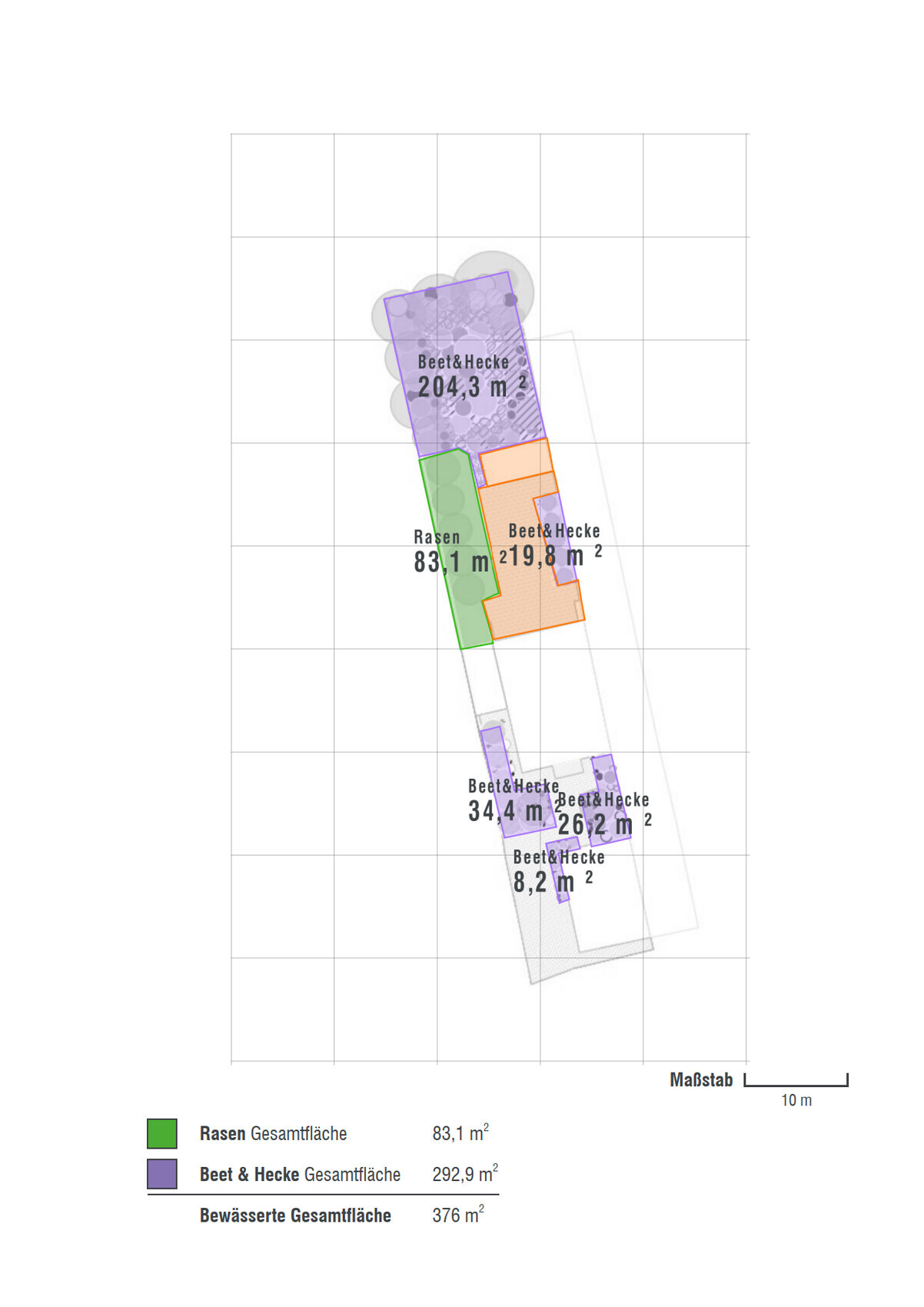
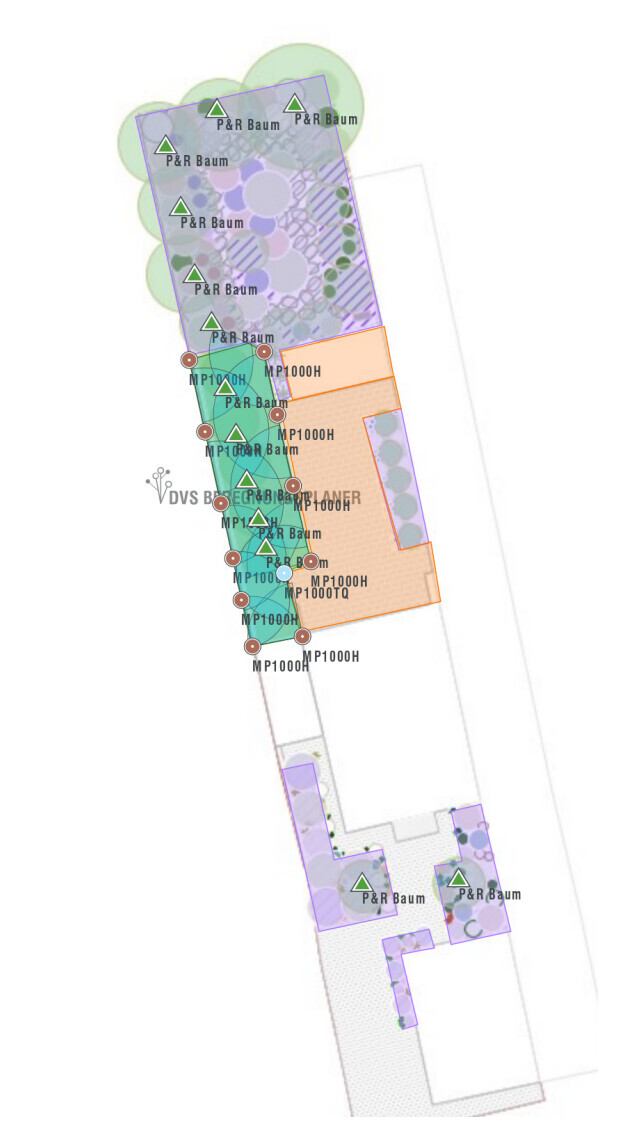
Current status: Our landscape gardener has created an irrigation plan for the property through DVS, see attached pictures (orientation: bottom south, top north).
In the southern area (front garden), three beds are planned between the paved areas, each with larger shrubs (lilac, viburnum, etc.) plus perennials/grasses/groundcovers,
as well as two spherical maples.
In the northern area (main garden), there is an 80m² (860 sq ft) lawn with five globe locust trees in the middle.
Otherwise, almost everything apart from the patio areas is densely planted with shrubs, mixed perennials, and groundcovers, with only stepping stones passing through the groundcovers.
Along the property boundaries are evergreen hedges as well as a bunch of other trees (willows, chestnuts, apple, cherry, etc., trunk diameter >= 25cm (10 inches)) planned;
The trees are underplanted with shrubs and perennials, so overall quite lush.
As you can see, root zone irrigation is planned for most of the trees ("P & R tree"), and everything else will probably be supplied by drip tubing (XFS, 2.3 l/h (0.6 gal/hr)).
I’m not exactly sure how many zones are planned, probably about 5 in the north, 3 in the south. There will be one valve box each in the north and south plus one with the main valve and filter. Controlled via Pro-HC.
Now to the actual problem: my wife wants the irrigation to be as discreet, ideally "invisible," as possible (natural look).
In particular, the 12cm (5 inch) plastic caps of the root zone irrigation on the lawn are unsightly; the exposed drip tubing is also bothersome.
It might be that these become less visible once the vegetation grows denser, but I find that hard to judge at this point.
Also, the rotors spraying the trunks of the trees on the lawn might not be ideal?
My current idea is to change everything completely to underground / subsurface drip tubing. However, I have the following questions / concerns:
Alternatively, I have also looked into so-called “micro-sprinklers,” where the supply lines could possibly be buried a few centimeters underground, and the spray heads are relatively discreet.
However, this is not a solution for the trees on the lawn, and I’m struggling to find much information on planning such a system.
Has anyone gained experience with underground drip tubing and can recommend this approach? Or can someone advise me against it before it’s too late? 😉 Alternative suggestions are always welcome.
P.S. The gardener planned everything with 24mm (1 inch) BluLock pipes/fittings. What do you think of this system?
Originally, I wanted to run DN32 (about 1¼ inch) pipes in the zones, the lines to the valve boxes are DN40 (about 1½ inch) after complaints and replacement.
If 24/25mm (1 inch) PE tubing is sufficient for our project and possibly easier to install, I don’t want to make a fuss about it...
Many thanks in advance and best regards,
Hausbaufaehig
or rather: hello @rick2018, since this is probably mainly a topic for you.
You already gave me valuable advice almost two years ago during the planning phase of my construction project (see this post),
and now the time has finally come to plant the garden and finalize the irrigation system.
Current status: Our landscape gardener has created an irrigation plan for the property through DVS, see attached pictures (orientation: bottom south, top north).
In the southern area (front garden), three beds are planned between the paved areas, each with larger shrubs (lilac, viburnum, etc.) plus perennials/grasses/groundcovers,
as well as two spherical maples.
In the northern area (main garden), there is an 80m² (860 sq ft) lawn with five globe locust trees in the middle.
Otherwise, almost everything apart from the patio areas is densely planted with shrubs, mixed perennials, and groundcovers, with only stepping stones passing through the groundcovers.
Along the property boundaries are evergreen hedges as well as a bunch of other trees (willows, chestnuts, apple, cherry, etc., trunk diameter >= 25cm (10 inches)) planned;
The trees are underplanted with shrubs and perennials, so overall quite lush.
As you can see, root zone irrigation is planned for most of the trees ("P & R tree"), and everything else will probably be supplied by drip tubing (XFS, 2.3 l/h (0.6 gal/hr)).
I’m not exactly sure how many zones are planned, probably about 5 in the north, 3 in the south. There will be one valve box each in the north and south plus one with the main valve and filter. Controlled via Pro-HC.
Now to the actual problem: my wife wants the irrigation to be as discreet, ideally "invisible," as possible (natural look).
In particular, the 12cm (5 inch) plastic caps of the root zone irrigation on the lawn are unsightly; the exposed drip tubing is also bothersome.
It might be that these become less visible once the vegetation grows denser, but I find that hard to judge at this point.
Also, the rotors spraying the trunks of the trees on the lawn might not be ideal?
My current idea is to change everything completely to underground / subsurface drip tubing. However, I have the following questions / concerns:
- Is underground installation a maintenance nightmare? You don’t notice when something goes wrong and would have to dig up the garden to find leaks or clogs. Roots can grow in at any time?
- Will (per zone??) an air release valve be needed? These boxes also need to be hidden somewhere. Is a flush valve required as well?
- Drip tubing for trees is probably not ideal but better than surface irrigation?
- Do trees need their own zone, or can you simply run multiple loops of tubing around the trees to achieve a reasonable watering ratio between shrubs and trees? The installation documents for the XFS tubing mainly deal with lawns and beds.
- Cost factor: digging trenches will certainly not be cheap.
Alternatively, I have also looked into so-called “micro-sprinklers,” where the supply lines could possibly be buried a few centimeters underground, and the spray heads are relatively discreet.
However, this is not a solution for the trees on the lawn, and I’m struggling to find much information on planning such a system.
Has anyone gained experience with underground drip tubing and can recommend this approach? Or can someone advise me against it before it’s too late? 😉 Alternative suggestions are always welcome.
P.S. The gardener planned everything with 24mm (1 inch) BluLock pipes/fittings. What do you think of this system?
Originally, I wanted to run DN32 (about 1¼ inch) pipes in the zones, the lines to the valve boxes are DN40 (about 1½ inch) after complaints and replacement.
If 24/25mm (1 inch) PE tubing is sufficient for our project and possibly easier to install, I don’t want to make a fuss about it...
Many thanks in advance and best regards,
Hausbaufaehig

The drip pipes and covers are no longer visible after one year. Otherwise, cover them with bark mulch.
Underground irrigation would be much more expensive, you can’t monitor it easily, and it’s not simple to make changes in the garden.
I considered it as well.
Whether a 24mm (about 1 inch) pipe in a loop is sufficient depends on the length of the pipe in the loop, the consumers, and the pump.
Ask your landscape gardener how many cubic meters each irrigation zone requires per hour and what specifications the pump has.
The 40mm (about 1.5 inches) supply line to the irrigation boxes is great.
Overall, it looks like good planning.
Trees also get wet when it rains. If the rotors spray for a few minutes at a time, it won’t cause any issues.
Just convince your wife to be a bit patient, and then the irrigation system won’t be noticeable at all…
Underground irrigation would be much more expensive, you can’t monitor it easily, and it’s not simple to make changes in the garden.
I considered it as well.
Whether a 24mm (about 1 inch) pipe in a loop is sufficient depends on the length of the pipe in the loop, the consumers, and the pump.
Ask your landscape gardener how many cubic meters each irrigation zone requires per hour and what specifications the pump has.
The 40mm (about 1.5 inches) supply line to the irrigation boxes is great.
Overall, it looks like good planning.
Trees also get wet when it rains. If the rotors spray for a few minutes at a time, it won’t cause any issues.
Just convince your wife to be a bit patient, and then the irrigation system won’t be noticeable at all…
H
Hausbaufaehig5 May 2024 20:19Thank you very much for the extremely quick response!
I feared that the underground irrigation system might not perform well 🙁
The additional costs are also a concern for me; we are already approaching nearly a five-figure amount (half material costs, half installation).
I am trying to persuade others to go for drip tubing plus root zone irrigation. If you can still clearly see the drip tubing after one year, something has definitely gone wrong. The perennials, ground covers, and grasses should actually grow over everything (=> suppressing weeds).
Another challenge for us: mulch is not desired, but perhaps at least parts of the drip tubing could be covered with a loose layer of soil without immediately requiring a pressure-compensating valve.
For the lawn area, I would use only rotator sprinklers, since the locust trees (Robinia) generally need less water, especially as they mature.
Regarding the division of the irrigation zones, I will ask again. Based on your recommendation, I have requested a submersible pump with 6 bar (87 psi) / 6000 l/h (1585 US gallons per hour); let’s see what is available here.
If anyone has an opinion on alternatives like bubbler nozzles or micro-sprayers, please feel free to share! 😉
Good luck,
Hausbaufaehig
I feared that the underground irrigation system might not perform well 🙁
The additional costs are also a concern for me; we are already approaching nearly a five-figure amount (half material costs, half installation).
I am trying to persuade others to go for drip tubing plus root zone irrigation. If you can still clearly see the drip tubing after one year, something has definitely gone wrong. The perennials, ground covers, and grasses should actually grow over everything (=> suppressing weeds).
Another challenge for us: mulch is not desired, but perhaps at least parts of the drip tubing could be covered with a loose layer of soil without immediately requiring a pressure-compensating valve.
For the lawn area, I would use only rotator sprinklers, since the locust trees (Robinia) generally need less water, especially as they mature.
Regarding the division of the irrigation zones, I will ask again. Based on your recommendation, I have requested a submersible pump with 6 bar (87 psi) / 6000 l/h (1585 US gallons per hour); let’s see what is available here.
If anyone has an opinion on alternatives like bubbler nozzles or micro-sprayers, please feel free to share! 😉
Good luck,
Hausbaufaehig
Similar topics