
Hello everyone,
We are in the process of buying an older building that has so far been heated only with electric radiators. Since this is absolutely not economical, we need a new solution.
The house was built in 1890. It has a living area of 170m² (1830 sq ft), which will be divided into two units (50 + 120m² / 540 + 1290 sq ft). These will be occupied by my sister and me, so the consumption should be separately metered for each unit. The house has no basement, and due to space constraints, the boiler will be installed on the upper floor. The attic is currently not insulated, but this will be done first since it will be used as living space. The ground floor, upper floor, and attic are all to be heated. Bathrooms will be installed on each floor.
We are considering a gas combi boiler without a hot water storage tank, along with aluminum composite pipes. Everything will need to be newly installed and laid from scratch. The gas connection still needs to be provided by the city (approx. 2000€), and we will of course have a certified professional handle the connection to the boiler.
I’m not worried about the craftsmanship, as we are quite skilled in that area. However, I wanted to hear your opinions, as I have not installed a new heating system before. It would be great if you could recommend some options.
Best regards
Masabidi
We are in the process of buying an older building that has so far been heated only with electric radiators. Since this is absolutely not economical, we need a new solution.
The house was built in 1890. It has a living area of 170m² (1830 sq ft), which will be divided into two units (50 + 120m² / 540 + 1290 sq ft). These will be occupied by my sister and me, so the consumption should be separately metered for each unit. The house has no basement, and due to space constraints, the boiler will be installed on the upper floor. The attic is currently not insulated, but this will be done first since it will be used as living space. The ground floor, upper floor, and attic are all to be heated. Bathrooms will be installed on each floor.
We are considering a gas combi boiler without a hot water storage tank, along with aluminum composite pipes. Everything will need to be newly installed and laid from scratch. The gas connection still needs to be provided by the city (approx. 2000€), and we will of course have a certified professional handle the connection to the boiler.
I’m not worried about the craftsmanship, as we are quite skilled in that area. However, I wanted to hear your opinions, as I have not installed a new heating system before. It would be great if you could recommend some options.
Best regards
Masabidi
Does a gas combination boiler mean it includes an instantaneous water heater?
I wouldn’t recommend that, as it’s better to have the instantaneous water heater installed directly at the point of use to avoid long runs of hot water pipes.
I would suggest using a standard condensing boiler and then installing instantaneous water heaters right next to the shower(s).
That way, the boiler doesn’t need to run during the summer either.
You have to request the instantaneous water heaters from the utility company. We have two with 22kW, which was only possible with a load-shedding relay (when one is running, the other cannot run).
For more distant outlets, like the kitchen, a small under-sink instantaneous water heater with about 3.5 kW or similar can be used, which is sufficient.
An alternative to the instantaneous water heater is a domestic hot water heat pump, for example a very affordable wall-mounted unit with 80 or 100 liters (we also considered this back then but stayed with the instantaneous water heater due to the lower running costs).
I wouldn’t recommend that, as it’s better to have the instantaneous water heater installed directly at the point of use to avoid long runs of hot water pipes.
I would suggest using a standard condensing boiler and then installing instantaneous water heaters right next to the shower(s).
That way, the boiler doesn’t need to run during the summer either.
You have to request the instantaneous water heaters from the utility company. We have two with 22kW, which was only possible with a load-shedding relay (when one is running, the other cannot run).
For more distant outlets, like the kitchen, a small under-sink instantaneous water heater with about 3.5 kW or similar can be used, which is sufficient.
An alternative to the instantaneous water heater is a domestic hot water heat pump, for example a very affordable wall-mounted unit with 80 or 100 liters (we also considered this back then but stayed with the instantaneous water heater due to the lower running costs).
When the bathrooms are being newly installed and the gas heating is also being replaced, choose a boiler with a sufficiently large hot water storage tank (120–180 liters) and avoid instant water heaters or similar.
With three bathrooms and two kitchens, combination boilers with small or no storage tanks are no longer sufficient. It's better to have a heating system with some storage capacity and lower output. If possible, place the heating system in the attic and arrange the three bathrooms vertically above each other.
With three bathrooms and two kitchens, combination boilers with small or no storage tanks are no longer sufficient. It's better to have a heating system with some storage capacity and lower output. If possible, place the heating system in the attic and arrange the three bathrooms vertically above each other.
Thank you first of all for the many responses. I originally did not want to install an instantaneous water heater. I was told that modern combination boilers can handle it without any problems, but it’s good that I’m asking here. It shows that you shouldn’t always rely on the statements of just a few individuals.
Unfortunately, the boiler can’t be installed in the attic due to space restrictions. For the kitchens, I could imagine using an instantaneous water heater there. If it’s really better or more efficient, a hot water storage tank could be installed.
The apartment will be rented out to my sister, so it needs separate meters.
I quickly made a sketch of how I actually plan to set it up.
It would be great if you could even recommend suitable boilers or tell me which manufacturers are advisable and which are not.
Have a nice Sunday
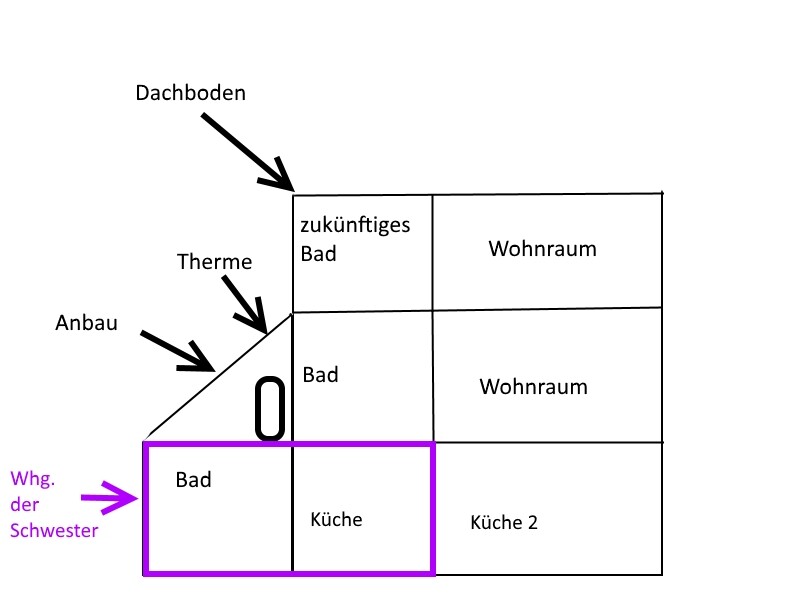
Unfortunately, the boiler can’t be installed in the attic due to space restrictions. For the kitchens, I could imagine using an instantaneous water heater there. If it’s really better or more efficient, a hot water storage tank could be installed.
The apartment will be rented out to my sister, so it needs separate meters.
I quickly made a sketch of how I actually plan to set it up.
It would be great if you could even recommend suitable boilers or tell me which manufacturers are advisable and which are not.
Have a nice Sunday
Similar topics