
ᐅ Insulating a roof when the wall plate rests on the ceiling joists
Created on: 5 Apr 2016 11:00
J
JanuaryWI am currently renovating my old house, which is about 100 years old. We have already installed a new roof covering with a modern underlay membrane, and now we want to renew the floor in the attic and properly insulate the roof and attic space.
The problem is that the collar beams rest on the ceiling joists (see image 1). This is due to the roof design: the roof has a slight inward bend (similar to a mansard roof, but concave rather than convex).
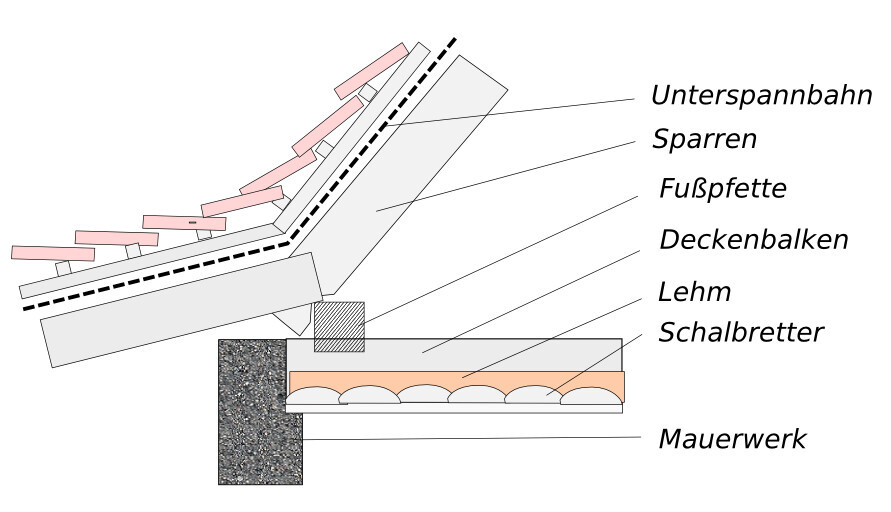
The attic floor is an old beam construction with clay on boarded formwork. Basically, we see no reason not to keep it—the ceiling beneath is still in good condition, and clay is said to provide good sound insulation. Both the lower floor and the attic are occupied and heated. We want to remove the old and quite worn floorboards and replace them with OSB panels (19mm (3/4 inch) or 25mm (1 inch)). Later, the OSB panels will be covered with laminate flooring.
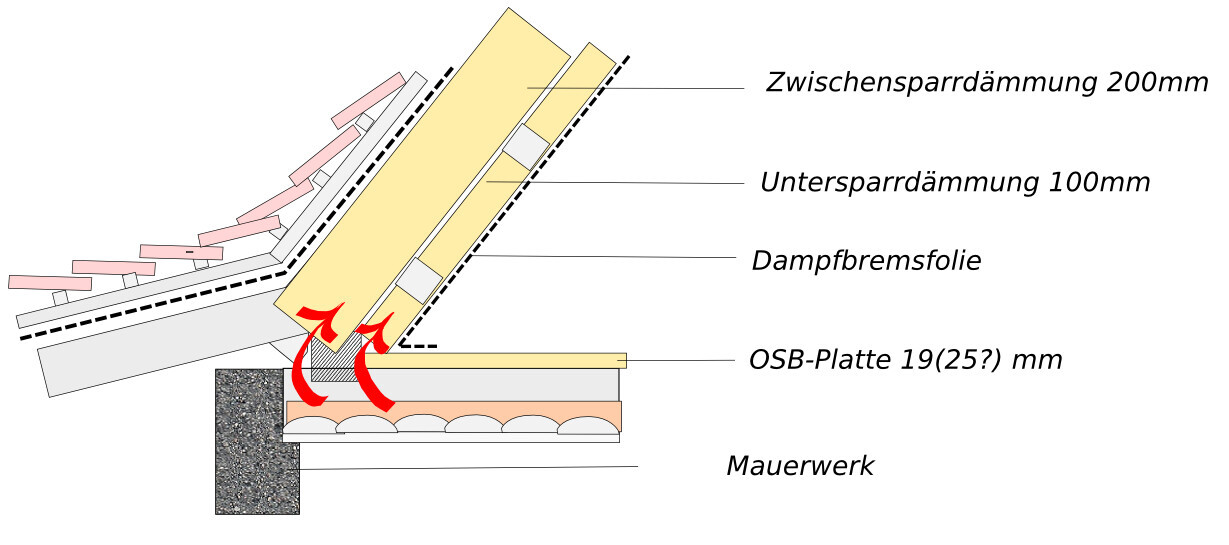
I plan to install 20cm (8 inches) of insulation between the rafters and an additional 10cm (4 inches) of insulation below the rafters. On top of that, there will be a vapor retarder and drywall panels.
However, because of the gap between the masonry and the collar beam, warm air will escape from the beam structure and penetrate directly into the insulation, which is obviously undesirable.
Can I seal this area with expanding foam, as shown below?
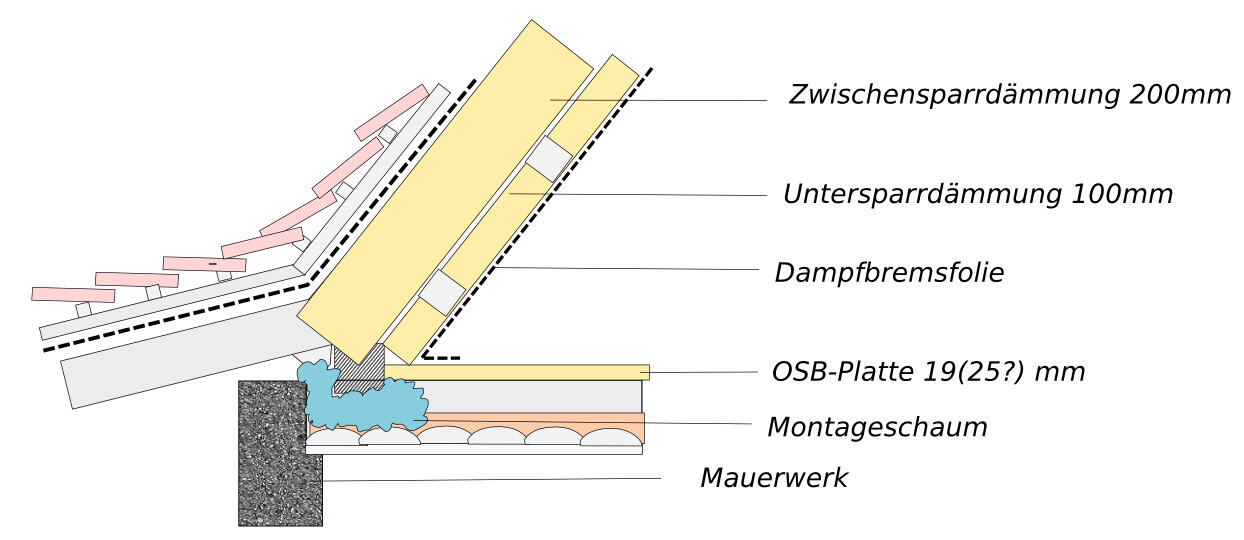
Expanding foam is elastic, airtight, and adheres well. If this is not a good idea, what else should I do?
Regards,
January
The problem is that the collar beams rest on the ceiling joists (see image 1). This is due to the roof design: the roof has a slight inward bend (similar to a mansard roof, but concave rather than convex).
The attic floor is an old beam construction with clay on boarded formwork. Basically, we see no reason not to keep it—the ceiling beneath is still in good condition, and clay is said to provide good sound insulation. Both the lower floor and the attic are occupied and heated. We want to remove the old and quite worn floorboards and replace them with OSB panels (19mm (3/4 inch) or 25mm (1 inch)). Later, the OSB panels will be covered with laminate flooring.
I plan to install 20cm (8 inches) of insulation between the rafters and an additional 10cm (4 inches) of insulation below the rafters. On top of that, there will be a vapor retarder and drywall panels.
However, because of the gap between the masonry and the collar beam, warm air will escape from the beam structure and penetrate directly into the insulation, which is obviously undesirable.
Can I seal this area with expanding foam, as shown below?
Expanding foam is elastic, airtight, and adheres well. If this is not a good idea, what else should I do?
Regards,
January
S
Sebastian795 Apr 2016 14:42Expanding foam is not airtight... unfortunately, I can't help you any further.
Hello
I would also recommend keeping the clay. If the surface is reasonably even, I would seal the vapor retarder directly onto the clay surface using cartridge adhesive (e.g., Orcon F). This might be a bit tricky around the ceiling joists... Then place the OSB board on top.
You don’t need to worry about warm air penetrating the insulation since the insulation is well ventilated from below (at least as shown in the sketches).
Regards, Nick
I would also recommend keeping the clay. If the surface is reasonably even, I would seal the vapor retarder directly onto the clay surface using cartridge adhesive (e.g., Orcon F). This might be a bit tricky around the ceiling joists... Then place the OSB board on top.
You don’t need to worry about warm air penetrating the insulation since the insulation is well ventilated from below (at least as shown in the sketches).
Regards, Nick
Similar topics