
Hello everyone,
I would like to introduce myself briefly. We started building a new single-family house five years ago. We moved in about 2.5 years ago.
Unfortunately, after the first few weeks, we had to part ways with the architect and construction management, as their services (planning, etc.) were a disaster, and some of the craftsmen were far from professional (just my personal opinion).
But this is not meant to be a story about our struggles; by now, we are living very satisfactorily in our home.
However, we plan to build again in the near future. To avoid going through the same issues, we want to form our own opinion as thoroughly as possible beforehand.
Now, onto the topic:
Heat pump
Water-circulating stove (to provide support during cold temperatures)
No solar panels (energy saving regulations are met)
Heating load approximately 7000 kWh per year excluding hot water
Flow temperature 26-32°C (79-90°F), temperature spread is 5°C (9°F)
Room volume approximately 600 m³ (21,200 ft³)
These values are based on our current house; the new house will be built almost the same but possibly with better insulation. So I think it can be used as a reference.
Example: At 0°C (32°F) outside and 23°C (73°F) inside, we have a flow temperature of 30°C (86°F) and a return temperature of 25°C (77°F), which equals a 5°C (9°F) spread.
In summary:
- The heat pump should be able to heat and cool the house independently.
- The concrete ceiling should be actively cooled (down to the dew point), possibly also the floor heating.
- The water-circulating stove is intended to provide supplementary heating and create a cozy atmosphere.
- Solar panels are not to be installed (optional).
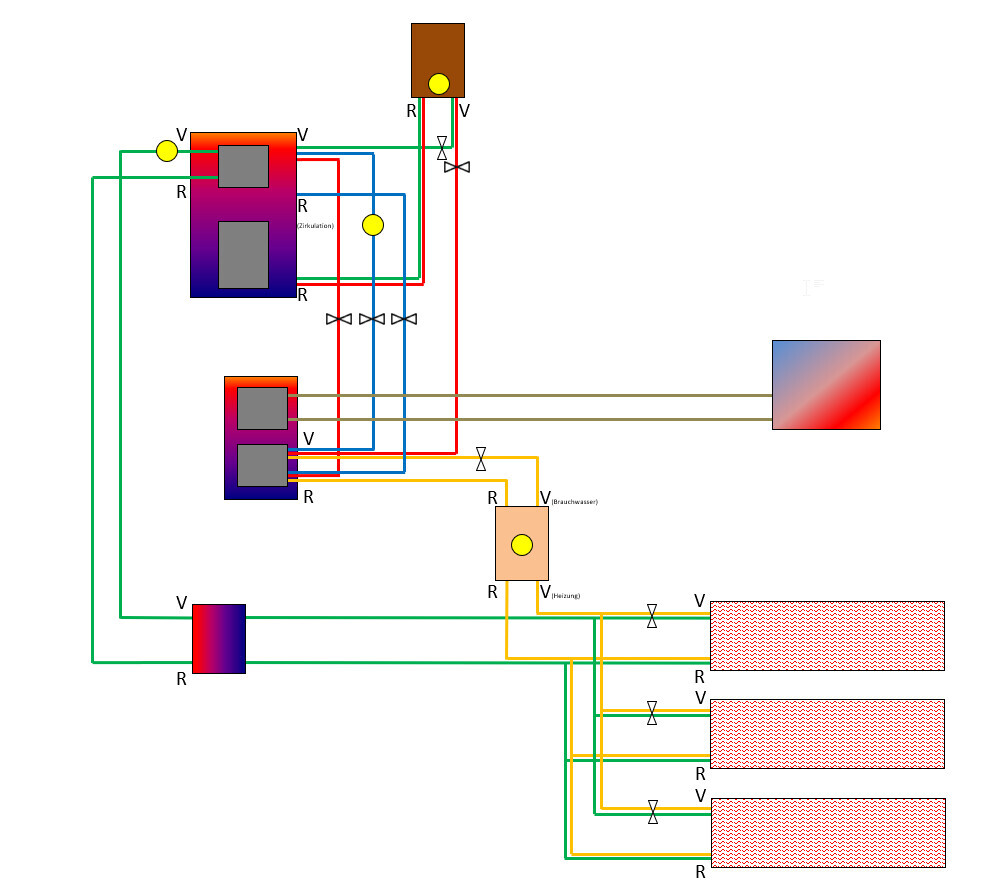
I have drawn a simple schematic with two storage tanks (1000-liter buffer / 300-liter domestic hot water tank).
How it works:
- Normally / summer, the heat pump heats the domestic hot water tank to 50°C (122°F), starting at a certain time (yellow).
- When the stove is turned on, it first heats the domestic hot water tank via the lower heat exchanger and then cools down the buffer tank (red).
- When the stove is off, water from the buffer tank is circulated until the domestic hot water tank reaches 60°C (140°F) or the same temperature as the buffer (blue).
- Solar panels could possibly be connected to the upper heat exchanger of the domestic hot water tank (brown). Additionally, the buffer tank might also be heated via the lower heat exchanger.
- If the domestic hot water tank is cold, the stove is off, and hot water is needed quickly, the heat pump switches on and an electric heating element in the domestic hot water tank supports heating. Otherwise, heating is controlled normally by the heat pump according to the schedule.
- The underfloor heating and ceiling heating are supplied by the heat pump or via the buffer tank.
The control system is very simple and would be managed by a programmable controller. Also, there are few components, which reduces potential failures or troubleshooting complexities.
I do not want a combined unit / combined storage tank, as I consider them relatively expensive, and they always require a service technician if something goes wrong.
If problems do occur, the valves can be switched manually, and the heat pump will operate independently.
This is very important to me.
The domestic (fresh) water is not connected to the heating circuit.
Please do not discuss the type of heat source (heat pump, solar, etc.) at this time. I would like to do that later, unless it’s related to the system’s function. Thank you.
The control system for underfloor and ceiling heating needs to be discussed in a second step, but that can only happen after the system is installed.
Thank you very much for the support.
I would like to introduce myself briefly. We started building a new single-family house five years ago. We moved in about 2.5 years ago.
Unfortunately, after the first few weeks, we had to part ways with the architect and construction management, as their services (planning, etc.) were a disaster, and some of the craftsmen were far from professional (just my personal opinion).
But this is not meant to be a story about our struggles; by now, we are living very satisfactorily in our home.
However, we plan to build again in the near future. To avoid going through the same issues, we want to form our own opinion as thoroughly as possible beforehand.
Now, onto the topic:
Heat pump
Water-circulating stove (to provide support during cold temperatures)
No solar panels (energy saving regulations are met)
Heating load approximately 7000 kWh per year excluding hot water
Flow temperature 26-32°C (79-90°F), temperature spread is 5°C (9°F)
Room volume approximately 600 m³ (21,200 ft³)
These values are based on our current house; the new house will be built almost the same but possibly with better insulation. So I think it can be used as a reference.
Example: At 0°C (32°F) outside and 23°C (73°F) inside, we have a flow temperature of 30°C (86°F) and a return temperature of 25°C (77°F), which equals a 5°C (9°F) spread.
In summary:
- The heat pump should be able to heat and cool the house independently.
- The concrete ceiling should be actively cooled (down to the dew point), possibly also the floor heating.
- The water-circulating stove is intended to provide supplementary heating and create a cozy atmosphere.
- Solar panels are not to be installed (optional).
I have drawn a simple schematic with two storage tanks (1000-liter buffer / 300-liter domestic hot water tank).
How it works:
- Normally / summer, the heat pump heats the domestic hot water tank to 50°C (122°F), starting at a certain time (yellow).
- When the stove is turned on, it first heats the domestic hot water tank via the lower heat exchanger and then cools down the buffer tank (red).
- When the stove is off, water from the buffer tank is circulated until the domestic hot water tank reaches 60°C (140°F) or the same temperature as the buffer (blue).
- Solar panels could possibly be connected to the upper heat exchanger of the domestic hot water tank (brown). Additionally, the buffer tank might also be heated via the lower heat exchanger.
- If the domestic hot water tank is cold, the stove is off, and hot water is needed quickly, the heat pump switches on and an electric heating element in the domestic hot water tank supports heating. Otherwise, heating is controlled normally by the heat pump according to the schedule.
- The underfloor heating and ceiling heating are supplied by the heat pump or via the buffer tank.
The control system is very simple and would be managed by a programmable controller. Also, there are few components, which reduces potential failures or troubleshooting complexities.
I do not want a combined unit / combined storage tank, as I consider them relatively expensive, and they always require a service technician if something goes wrong.
If problems do occur, the valves can be switched manually, and the heat pump will operate independently.
This is very important to me.
The domestic (fresh) water is not connected to the heating circuit.
Please do not discuss the type of heat source (heat pump, solar, etc.) at this time. I would like to do that later, unless it’s related to the system’s function. Thank you.
The control system for underfloor and ceiling heating needs to be discussed in a second step, but that can only happen after the system is installed.
Thank you very much for the support.
Hello.
I don’t want to jump to conclusions, but oil tanks are allowed in garages, for example. As long as it’s ensured that in case of a leak the oil cannot enter the soil, for example by building a containment wall and sealing it. I’m not sure if double-walled tanks are already sufficient for this. But regulations in Bavaria might be different from where I am 🙂
I didn’t say that liquefied petroleum gas (LPG) has no place in new buildings, only that I personally would never choose it. The costs are too high. Above all, there are few suppliers, so LPG is correspondingly expensive to purchase.
I’m not a fan of heat pumps either, but our government is managing things so that, in the long term, there are no alternatives. Even though the electricity for the heat pump is first generated in a gas power plant and then arrives at the houses with losses. Our neighbor has a heat pump and a 140 m² (1,507 ft²) living area, consumed 14,000 kWh, and achieved KfW 30 efficiency. I have gas heating, consume 8,000 kWh (on average) with 180 m² (1,937 ft²) and 3-meter (10-foot) high ceilings, and have only just reached KfW 70 (without solar). But the neighbor is doing it for the future of their children and drives an SUV (German diesel) to go shopping. Sorry, but...
However, this is not really related to the topic.
I don’t want to jump to conclusions, but oil tanks are allowed in garages, for example. As long as it’s ensured that in case of a leak the oil cannot enter the soil, for example by building a containment wall and sealing it. I’m not sure if double-walled tanks are already sufficient for this. But regulations in Bavaria might be different from where I am 🙂
I didn’t say that liquefied petroleum gas (LPG) has no place in new buildings, only that I personally would never choose it. The costs are too high. Above all, there are few suppliers, so LPG is correspondingly expensive to purchase.
I’m not a fan of heat pumps either, but our government is managing things so that, in the long term, there are no alternatives. Even though the electricity for the heat pump is first generated in a gas power plant and then arrives at the houses with losses. Our neighbor has a heat pump and a 140 m² (1,507 ft²) living area, consumed 14,000 kWh, and achieved KfW 30 efficiency. I have gas heating, consume 8,000 kWh (on average) with 180 m² (1,937 ft²) and 3-meter (10-foot) high ceilings, and have only just reached KfW 70 (without solar). But the neighbor is doing it for the future of their children and drives an SUV (German diesel) to go shopping. Sorry, but...
However, this is not really related to the topic.
He was referring to me. I believe this has no place in new construction.
I find the overall costs too high.
Oil is more or less outdated and technically not quite up to the standards compared to other options.
It takes up storage space, often smells, and you have to pay for tanks. Additionally, there may be insurance costs and regular inspections, such as safety certificates.
With liquefied petroleum gas (LPG), it’s similar, except the heating systems there can modulate reasonably well. The price is comparable to heating oil. You either buy a tank or rent one, which makes you dependent on the company providing it.
Unfortunately, and I have to admit this is often due to a lack of good alternatives, the general contractor adds hefty markups if you choose a heat pump.
Moreover, a really good design is necessary for effective heat pump operation.
However, this eliminates the chimney and associated cleaning services, maintenance is simpler, and it can be efficiently supported with photovoltaic (solar) systems.
I find the overall costs too high.
Oil is more or less outdated and technically not quite up to the standards compared to other options.
It takes up storage space, often smells, and you have to pay for tanks. Additionally, there may be insurance costs and regular inspections, such as safety certificates.
With liquefied petroleum gas (LPG), it’s similar, except the heating systems there can modulate reasonably well. The price is comparable to heating oil. You either buy a tank or rent one, which makes you dependent on the company providing it.
Unfortunately, and I have to admit this is often due to a lack of good alternatives, the general contractor adds hefty markups if you choose a heat pump.
Moreover, a really good design is necessary for effective heat pump operation.
However, this eliminates the chimney and associated cleaning services, maintenance is simpler, and it can be efficiently supported with photovoltaic (solar) systems.
 markus270329 Dec 2017 14:11
Ok, I completely agree with you about oil. It’s really outdated now, especially because of the smell and the space it requires.
With gas, a chimney is no longer needed either; it vents through a plastic pipe (costing around 100€ (about $110) max.) to the outside. Installing a gas tank costs 4,000€ (about $4,400), so it’s true that the initial investment is higher than for a heat pump. However, the heat pump itself is more expensive than the gas heating system, although I don’t have the exact difference for you.
Effectively, the price advantage should be somewhere around 1,000 - 1,500€ (about $1,100 - $1,650) for the heat pump. If you’re building with a general contractor, the difference is probably more in favor of the gas heating system.
The most important point for us was reliability. Gas heating is a well-established technology, while heat pumps have only been widely installed for about a decade. They are definitely more prone to defects, and the operating costs are mostly based on the manufacturers’ estimates. Actual consumption tends to be significantly higher.
Last year, we heated our house and generated hot water with 560€ (about $615) worth of liquefied gas (129m2 (1,389 sq ft), 4 people).
Assuming electricity costs only 22 cents per kWh, that gets me 2,545 kWh. The heat pump can’t really achieve that, can it? Or can someone provide concrete numbers here?
With gas, a chimney is no longer needed either; it vents through a plastic pipe (costing around 100€ (about $110) max.) to the outside. Installing a gas tank costs 4,000€ (about $4,400), so it’s true that the initial investment is higher than for a heat pump. However, the heat pump itself is more expensive than the gas heating system, although I don’t have the exact difference for you.
Effectively, the price advantage should be somewhere around 1,000 - 1,500€ (about $1,100 - $1,650) for the heat pump. If you’re building with a general contractor, the difference is probably more in favor of the gas heating system.
The most important point for us was reliability. Gas heating is a well-established technology, while heat pumps have only been widely installed for about a decade. They are definitely more prone to defects, and the operating costs are mostly based on the manufacturers’ estimates. Actual consumption tends to be significantly higher.
Last year, we heated our house and generated hot water with 560€ (about $615) worth of liquefied gas (129m2 (1,389 sq ft), 4 people).
Assuming electricity costs only 22 cents per kWh, that gets me 2,545 kWh. The heat pump can’t really achieve that, can it? Or can someone provide concrete numbers here?
So, I have serious doubts about the plastic pipe and the 100€ cost. However, that is often included anyway. If that’s sufficient, the costs for the chimney are also eliminated. The chimney sweep still comes every 2-3 years. Plus, there is the regular inspection of the tank, admittedly every 10 years.
By the way, heat pumps are also a proven technology, just not as widespread. High maintenance costs only arise if the system is poorly planned, which unfortunately happens quite often. On the other hand, there is no annual maintenance for the heat pump costing around 150€.
Condensing boilers (whether oil or gas) are quite sensitive but are more forgiving when it comes to planning errors.
I buy electricity at 21.5 cents per kWh. But let’s go with your 22 cents. Your calculation is correct up to that point. However, with proper planning, the heat pump converts that into 4 times (air-source heat pump) or 5 times (ground-source heat pump) the amount of heat. So, you get about 12,000 kWh (41,000,000 BTU) of heat output.
But, as I admitted at the beginning, general contractors often take advantage of subsidies to make a profit from the heat pump installation. That’s why it is unfortunately often skipped.
By the way, heat pumps are also a proven technology, just not as widespread. High maintenance costs only arise if the system is poorly planned, which unfortunately happens quite often. On the other hand, there is no annual maintenance for the heat pump costing around 150€.
Condensing boilers (whether oil or gas) are quite sensitive but are more forgiving when it comes to planning errors.
I buy electricity at 21.5 cents per kWh. But let’s go with your 22 cents. Your calculation is correct up to that point. However, with proper planning, the heat pump converts that into 4 times (air-source heat pump) or 5 times (ground-source heat pump) the amount of heat. So, you get about 12,000 kWh (41,000,000 BTU) of heat output.
But, as I admitted at the beginning, general contractors often take advantage of subsidies to make a profit from the heat pump installation. That’s why it is unfortunately often skipped.
So, we have gas in our current house. A chimney sweep is required every three years.
In the other house, we have a ground source heat pump, so of course no chimney sweep is needed.
My parents have oil heating since three years ago, and they do have a chimney sweep.
Overall, all systems were almost the same cost, plus or minus 1000 euros. For gas, the connection fee was added, so the total was about the same.
In terms of operating costs, I have to say oil is the cheapest, although the technician charges the most for maintenance.
We also had gas with a tank, but heating with that was the most expensive so far. All the houses consumed around 8000 to 10000 kW of energy, so I can compare them fairly well.
What I don’t like about heat pumps is that electricity will soon become too expensive for us. Installing solar panels on the roof doesn’t really make sense with a heat pump either, because the sun isn’t shining when I need heating.
In short, the goal should be to use as little energy as possible. That helps the environment, the wallet, and the government avoids excessive eco taxes. But somehow the government has to finance all its civil servants for new environmental laws. That’s just my opinion.
In the other house, we have a ground source heat pump, so of course no chimney sweep is needed.
My parents have oil heating since three years ago, and they do have a chimney sweep.
Overall, all systems were almost the same cost, plus or minus 1000 euros. For gas, the connection fee was added, so the total was about the same.
In terms of operating costs, I have to say oil is the cheapest, although the technician charges the most for maintenance.
We also had gas with a tank, but heating with that was the most expensive so far. All the houses consumed around 8000 to 10000 kW of energy, so I can compare them fairly well.
What I don’t like about heat pumps is that electricity will soon become too expensive for us. Installing solar panels on the roof doesn’t really make sense with a heat pump either, because the sun isn’t shining when I need heating.
In short, the goal should be to use as little energy as possible. That helps the environment, the wallet, and the government avoids excessive eco taxes. But somehow the government has to finance all its civil servants for new environmental laws. That’s just my opinion.
Similar topics