
ᐅ CO2 Footprint of Gas Heating vs. Heat Pumps in New Construction
Created on: 17 Nov 2024 16:30
K
Konsument4
Recently, there was a discussion among acquaintances about the idea of installing a gas heating system in a new single-family house in 2025 (according to my source/Statista, about 10% still did this in 2023). I researched this topic somewhat (including with the help of ChatGPT, o1-preview) and came across results that seem somewhat out of step with the current general attitude.
- In a 300 sqm (3,230 sq ft) KfW-55 house (minimum standard for 2024, energy efficiency class A with 40 kWh/m2/year), the additional CO2 emissions from a gas heating system compared to a heat pump amount to about 1.6 tons of CO2 per year. (Calculation: Gas: 300 m2 × 40 kWh/m2/year = 12,000 kWh/year; 12,000 kWh × 0.202 kg CO2/kWh = 2,424 kg CO2/year; Heat pump - annual performance factor 4.5, German electricity mix 300 g CO2/kWh: 12,000 kWh ÷ 4.5 = 3,429 kWh/year; 3,429 kWh × 0.3 kg CO2/kWh = 1,028.7 kg CO2/year => 2,424 kg CO2/year − 1,028.7 kg CO2/year = 1,395.3 kg CO2/year)
- Compensating 1.6 tons of CO2 costs about 40 euros on atmosfair. Two tons cost 50 euros.
- In 2024, a heat pump costs roughly 35,000 euros, while a gas heating system costs around 15,000 euros. (There is no direct subsidy for heat pumps in new builds.)
That means, if I compensate the additional CO2 emissions from a gas heating system over 20 years, it costs me about 800 euros. If I pay 1,000 euros, I have still done something positive for the environment overall. On the other hand, there is an upfront cost difference of about 20,000 euros for the heat pump. Spending 20,000 euros for an outcome I can achieve with 1,000 euros seems disproportionate to me.
Currently, the price per ton of CO2 is about 30 euros; even if this price rises to 400 euros by 2045 (allegedly a worst-case scenario), I would still come out cheaper with gas (1.6 tons × 400 euros/ton = 640 euros per year in 2045, and likely significantly less before that).
Of course, my calculation is based on various average values, but unless I am seriously wrong in at least one area, the result seems quite clear: If I install a gas heating system in a new single-family home and at least compensate for the CO2 emissions, it appears I come out cheaper and could still do something good for the environment with the savings.
Am I missing something? What else should be considered? Does the calculation contain a major incorrect assumption or wrong average value?
PS: I have seen the thread about gas heating systems 23/24, but in my opinion, the topic of the CO2 footprint was not discussed there, and towards the end, the thread went off-topic anyway.
- In a 300 sqm (3,230 sq ft) KfW-55 house (minimum standard for 2024, energy efficiency class A with 40 kWh/m2/year), the additional CO2 emissions from a gas heating system compared to a heat pump amount to about 1.6 tons of CO2 per year. (Calculation: Gas: 300 m2 × 40 kWh/m2/year = 12,000 kWh/year; 12,000 kWh × 0.202 kg CO2/kWh = 2,424 kg CO2/year; Heat pump - annual performance factor 4.5, German electricity mix 300 g CO2/kWh: 12,000 kWh ÷ 4.5 = 3,429 kWh/year; 3,429 kWh × 0.3 kg CO2/kWh = 1,028.7 kg CO2/year => 2,424 kg CO2/year − 1,028.7 kg CO2/year = 1,395.3 kg CO2/year)
- Compensating 1.6 tons of CO2 costs about 40 euros on atmosfair. Two tons cost 50 euros.
- In 2024, a heat pump costs roughly 35,000 euros, while a gas heating system costs around 15,000 euros. (There is no direct subsidy for heat pumps in new builds.)
That means, if I compensate the additional CO2 emissions from a gas heating system over 20 years, it costs me about 800 euros. If I pay 1,000 euros, I have still done something positive for the environment overall. On the other hand, there is an upfront cost difference of about 20,000 euros for the heat pump. Spending 20,000 euros for an outcome I can achieve with 1,000 euros seems disproportionate to me.
Currently, the price per ton of CO2 is about 30 euros; even if this price rises to 400 euros by 2045 (allegedly a worst-case scenario), I would still come out cheaper with gas (1.6 tons × 400 euros/ton = 640 euros per year in 2045, and likely significantly less before that).
Of course, my calculation is based on various average values, but unless I am seriously wrong in at least one area, the result seems quite clear: If I install a gas heating system in a new single-family home and at least compensate for the CO2 emissions, it appears I come out cheaper and could still do something good for the environment with the savings.
Am I missing something? What else should be considered? Does the calculation contain a major incorrect assumption or wrong average value?
PS: I have seen the thread about gas heating systems 23/24, but in my opinion, the topic of the CO2 footprint was not discussed there, and towards the end, the thread went off-topic anyway.
R
RotorMotor18 Nov 2024 08:44Konsument4 schrieb:
The €35,000 for the heat pump versus the €15,000 for a gas heating system (both including installation) I got from a more recent YouTube video. And in another video, it is explained in detail that installing a heat pump in Germany doesn’t cost less than €30,000. I’m no expert, but if this is actually a false assumption, then the matter is settled. Can you provide a source for that? As you probably know, sources can’t be provided here, otherwise you would surely have done so.
Otherwise, you can simply check prices yourself using the price comparison tool of your choice.
But let’s do a calculation ourselves:
| Item | Gas heating | Air-to-water heat pump |
| Heat generator | €3,000 | €5,050 |
| Expansion vessel | €200 | €200 |
| Hot water tank | €1,500 | €1,500 |
| Base/foundation | €0 | €1,000? |
| Connection materials | €600 | €400 |
| Gas connection installation | €2,000 | €0 |
| Labor | €2,000 | €2,000 |
| Total | €9,300 | €10,150 |
| + Profit margin?</TD] | €5,000 | €5,000 |
| + Solar thermal system (you probably shouldn’t install gas without it) | €6,000 | €0 |
| FINAL TOTAL | €20,300 | €15,150 |
Of course, these figures can be adjusted in either direction.
For example, by choosing a Korean rather than a German air-to-water heat pump.
Or by excluding solar thermal from the calculation, as is often done with photovoltaics initially.
Or by arguing that heating installers aim for higher profits with heat pumps and might add extra costs, etc.
But it clearly shows the overall trend: there is no real reason why installing an air-to-water heat pump should be more expensive than a gas heating system.
Konsument4 schrieb:
Google tells me that maintenance costs for a heat pump are about €300 per year. I have no personal experience with either gas or heat pumps. A heat pump is essentially maintenance-free.
A gas heating system, however, is not. Wherever there is combustion, ash, acids, and other residues are produced that need to be cleaned.
That said, maintenance contracts for heat pumps are available and often necessary to keep the warranty valid.
But even if you exclude maintenance from the equation, gas heating is still €316/year more expensive than the air-to-water heat pump!
Konsument4 schrieb:
Are you calculating the €1,400 as the annual cost to offset the CO2 footprint? Yes, exactly, those are the current costs for DAC—Direct Air Capture—i.e., the actual removal of CO2.
Konsument4 schrieb:
Okay, so my entire comparison is based on the assumption that CO2 compensation isn’t fraudulent and actually makes an impact — meaning the total additional CO2 emissions are already compensated at the start of the lifespan for €800.
I will look into what to make of CO2 compensation schemes like atmosfair. The whole comparison stands or falls on this. Your comparison “is based” on two things:
1. Inflated prices for heat pumps
2. The assumption that carbon trading actually removes CO2.
Both can be disproven with a brief online search.
N
nordanney18 Nov 2024 09:02RotorMotor schrieb:
But we can also do a calculation ourselves:Keep in mind that you also need a chimney for the gas heating system. Or rather, it’s now called a flue pipe – but you will still need a structural solution for it, which can cost in the four-figure range.B
Buchsbaum06618 Nov 2024 09:39Nowadays, building a house without a chimney is no longer advisable. If you are investing this much money, you should always plan for at least one, preferably two chimneys. This keeps your options open and allows for quick adjustments. And if you don’t connect anything, you can, for example, comfortably route your photovoltaic cables from the roof to the basement.
There are plenty of know-it-alls who, after a few years, have just attached a stainless steel flue to the outside wall and now heat their garden with it. These visual features are becoming very common.
Once again, a chimney is an essential part of every house!
There are plenty of know-it-alls who, after a few years, have just attached a stainless steel flue to the outside wall and now heat their garden with it. These visual features are becoming very common.
Once again, a chimney is an essential part of every house!
A
Aloha_Lars18 Nov 2024 09:41Buchsbaum066 schrieb:
Nowadays, if you build a house without a chimney, there’s not much you can do about it. When investing so much money, you should always plan for at least one, preferably two chimneys. This keeps your options open and allows you to adapt quickly. And if you don’t end up connecting anything, you can, for example, easily run your photovoltaic cables from the roof down to the basement.
There are plenty of know-it-alls who, after years, have just attached a stainless steel flue to their exterior wall and are now heating their garden with it.
Again, a chimney is an essential part of every home!Exactly, let’s build two chimneys just to use them as cable ducts. OMG, you’re really getting more ridiculous.
PS: I don’t have a chimney!

My final invoice from 2022:
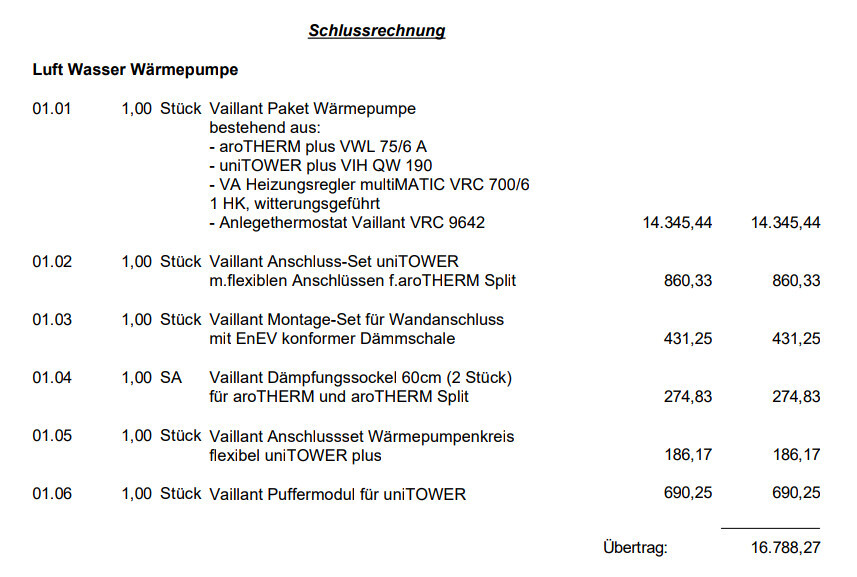
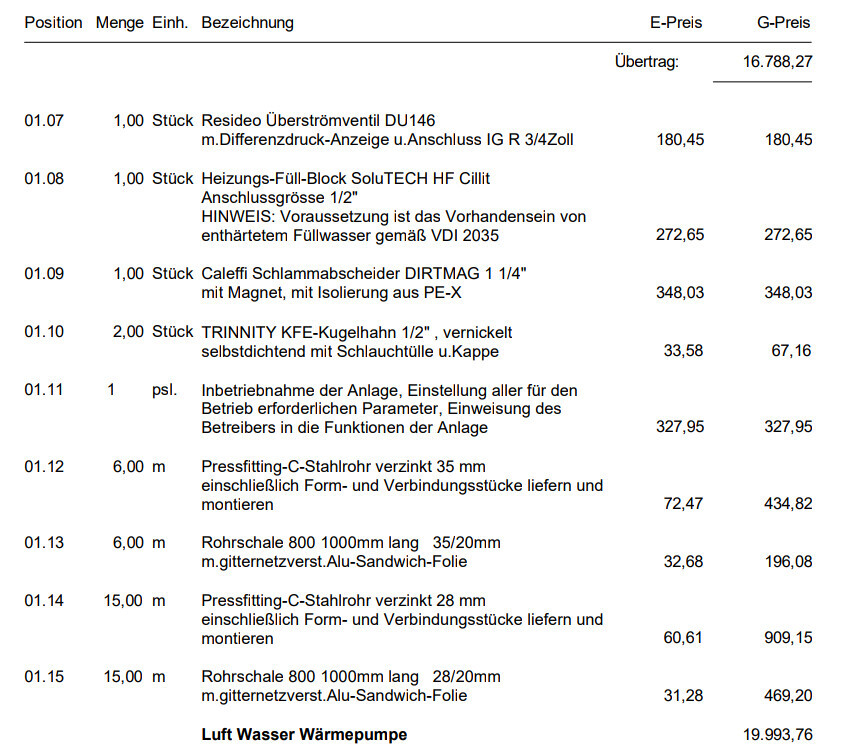
VAT will be added on top, but the subsidy (back then 35%) was deducted. Installation costs are not separate, but the materials were basically charged at list prices without a discount.
Most of the items on page 2 would also be present in a gas heating system.
Vaillant is not the most expensive brand, but it could definitely be cheaper.
In 2022, there was a heat pump boom and a major supply shortage. So now, after production peaked in 2022 and 2023, there should be a good supply because these units are generally kept in stock, and construction activity for single-family homes has already decreased.
The costs shown in the video might be from that time and possibly related to renovations, where additional measures might be needed (larger radiators). With renovations, however, larger subsidies are possible, and such additional measures were also eligible for funding (I’m not sure if that is still the case, but I believe so).
Regarding carbon offsetting, there have been recent revelations that some of the largest providers, for example with reforestation programs, received subsidies initially, but then left the projects unmanaged, resulting in half or more of the trees not surviving. Nevertheless, the full CO2 amount was still booked, which is questionable since a tree needs to grow for 30-40 years (if that is even sufficient) to have an effect. Others basically just trade certificates by buying from companies and countries that already emit very little CO2. This actually achieves nothing. It’s like a pub having a urinal where anyone could pee freely. Everyone gets one free use, afterwards it costs five euros. Now you could go and buy others’ included pee turns for 2.50 euros each, but in the end, the urinal is still full...
VAT will be added on top, but the subsidy (back then 35%) was deducted. Installation costs are not separate, but the materials were basically charged at list prices without a discount.
Most of the items on page 2 would also be present in a gas heating system.
Vaillant is not the most expensive brand, but it could definitely be cheaper.
In 2022, there was a heat pump boom and a major supply shortage. So now, after production peaked in 2022 and 2023, there should be a good supply because these units are generally kept in stock, and construction activity for single-family homes has already decreased.
The costs shown in the video might be from that time and possibly related to renovations, where additional measures might be needed (larger radiators). With renovations, however, larger subsidies are possible, and such additional measures were also eligible for funding (I’m not sure if that is still the case, but I believe so).
Regarding carbon offsetting, there have been recent revelations that some of the largest providers, for example with reforestation programs, received subsidies initially, but then left the projects unmanaged, resulting in half or more of the trees not surviving. Nevertheless, the full CO2 amount was still booked, which is questionable since a tree needs to grow for 30-40 years (if that is even sufficient) to have an effect. Others basically just trade certificates by buying from companies and countries that already emit very little CO2. This actually achieves nothing. It’s like a pub having a urinal where anyone could pee freely. Everyone gets one free use, afterwards it costs five euros. Now you could go and buy others’ included pee turns for 2.50 euros each, but in the end, the urinal is still full...
N
nordanney18 Nov 2024 10:44Buchsbaum066 schrieb:
Those who build a house without a chimney nowadays,... might not want a wood-burning stove and instead use conduit pipes for a possible photovoltaic system. That’s actually smart planning during construction.Similar topics