
Hello everyone!
We are currently having a row end house built by a developer using passive house standards and, of course, we are documenting everything with plenty of photos. I am also keeping a small construction diary online (I’m not sure if I’m allowed to link to it here), and regarding the photos, I received a comment suggesting that the grounding might not have been installed correctly.
I would like to open this up for discussion here and am uploading three photos.


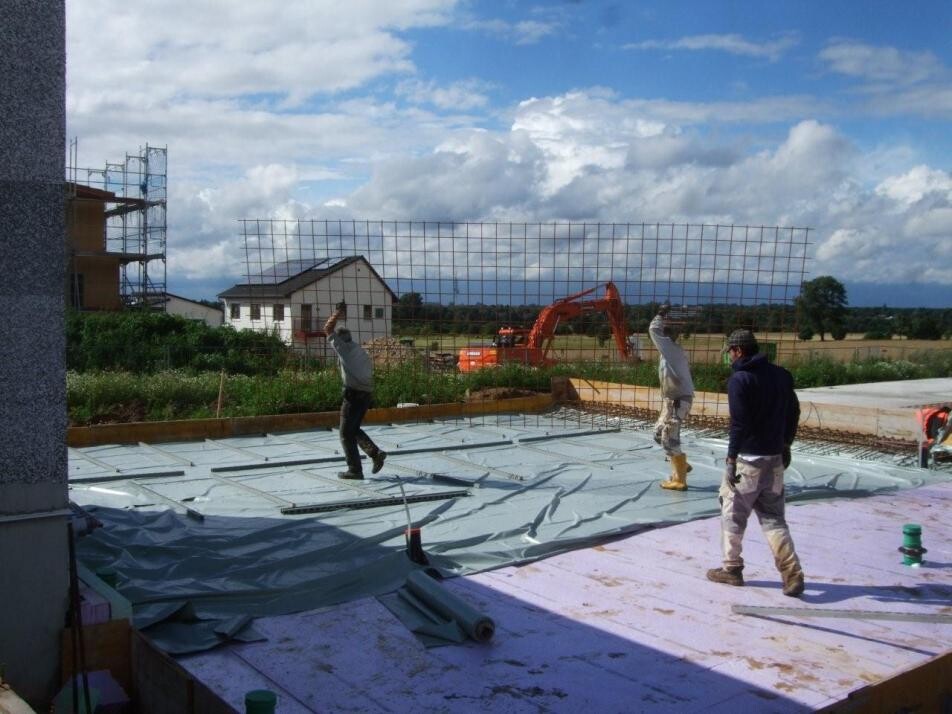
The first picture shows the area after the clean concrete layer was poured. At this stage, only the black conduit is visible at the spot in question. In the second picture (shortly after the installation of the perimeter insulation and while placing the reinforcing steel for the concrete slab), you can see that a grounding strip has now been installed there, which is also visible on the third picture after the concrete was poured.
My question to the experts is: Does anything here indicate improper installation? Should the grounding strip have already been visible before pouring the clean concrete layer?
I’ve cautiously asked the developer, and after consulting the structural contractor, this brief response was given: “The foundation grounding conductor was routed through the base insulation.”
What do you think? Is it possible to verify with a device whether this is installed correctly?


We are currently having a row end house built by a developer using passive house standards and, of course, we are documenting everything with plenty of photos. I am also keeping a small construction diary online (I’m not sure if I’m allowed to link to it here), and regarding the photos, I received a comment suggesting that the grounding might not have been installed correctly.
I would like to open this up for discussion here and am uploading three photos.
The first picture shows the area after the clean concrete layer was poured. At this stage, only the black conduit is visible at the spot in question. In the second picture (shortly after the installation of the perimeter insulation and while placing the reinforcing steel for the concrete slab), you can see that a grounding strip has now been installed there, which is also visible on the third picture after the concrete was poured.
My question to the experts is: Does anything here indicate improper installation? Should the grounding strip have already been visible before pouring the clean concrete layer?
I’ve cautiously asked the developer, and after consulting the structural contractor, this brief response was given: “The foundation grounding conductor was routed through the base insulation.”
What do you think? Is it possible to verify with a device whether this is installed correctly?
Your post is a bit older, but I’d still like to share my thoughts since I’m working on something similar right now.
You’re correct that the insulation prevents the "electrical ground" from connecting the concrete slab to the house. There are two options: either embed a large-area conductive reinforcement mesh in the screed layer or install a ring earth conductor made of V4A stainless steel around the house. In any case, I would not recommend penetrating the insulation layer. Instead, you should create a dedicated contact point within the wall. These contact points are also available with a waterproof seal suitable for waterproof concrete structures (white tanks).
In the worst case, your utility provider may test the ground conductivity and deny your power connection.
Best regards
You’re correct that the insulation prevents the "electrical ground" from connecting the concrete slab to the house. There are two options: either embed a large-area conductive reinforcement mesh in the screed layer or install a ring earth conductor made of V4A stainless steel around the house. In any case, I would not recommend penetrating the insulation layer. Instead, you should create a dedicated contact point within the wall. These contact points are also available with a waterproof seal suitable for waterproof concrete structures (white tanks).
In the worst case, your utility provider may test the ground conductivity and deny your power connection.
Best regards
Hello nille,
The grounding conductor (earthing strap) is used to ensure equipotential bonding—that is, an electrically conductive connection between all metallic components located in or on the building, such as water pipes, gas lines, and basically anything made of metal. This has nothing to do with whether the grounding conductor actually contacts the soil. On the contrary, the grounding conductor will eventually corrode at the interface between the foundation slab and the soil due to alkalis or other substances present in the ground. What the guys did is fine. I just hope that, in your case, the transition from the foundation slab to the soil is permanently sealed.
The grounding conductor (earthing strap) is used to ensure equipotential bonding—that is, an electrically conductive connection between all metallic components located in or on the building, such as water pipes, gas lines, and basically anything made of metal. This has nothing to do with whether the grounding conductor actually contacts the soil. On the contrary, the grounding conductor will eventually corrode at the interface between the foundation slab and the soil due to alkalis or other substances present in the ground. What the guys did is fine. I just hope that, in your case, the transition from the foundation slab to the soil is permanently sealed.
Similar topics