
ᐅ Fully glue down hardwood flooring over cement screed (new single-family house construction)
Created on: 10 Jan 2021 14:08
S
Svenson008S
Svenson00810 Jan 2021 14:08Hello everyone,
I am currently researching the topic of gluing down parquet flooring and have a few questions I can’t seem to resolve.
The situation is as follows:
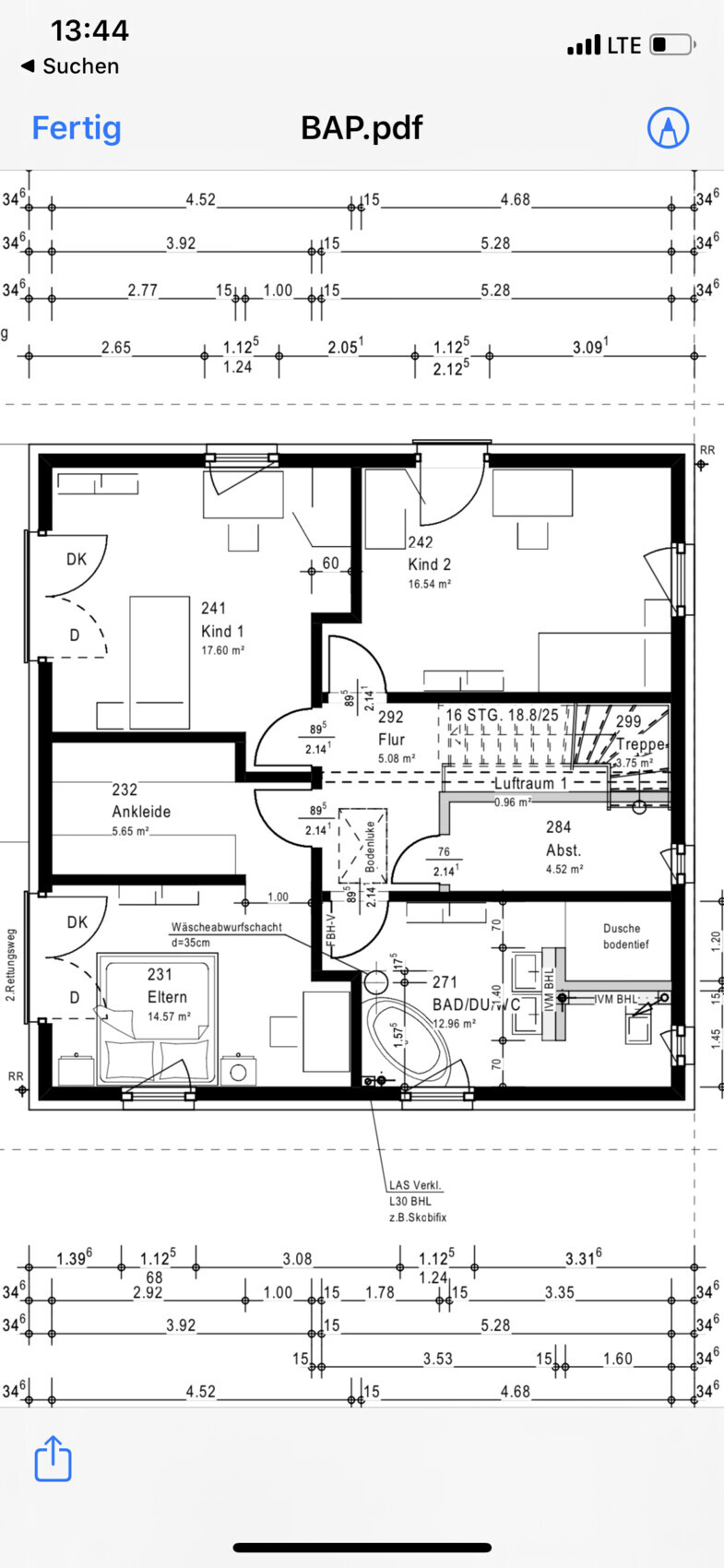
I have built a single-family house with a timber frame construction and plan to fully glue parquet flooring throughout the entire upper floor except the bathroom. The floor will be glued because we have underfloor heating and also want to minimize impact sound.
A fast-setting cement screed has been installed, the heating-up program has already been completed, and the last CM measurement was 1.5%, so the floor should now be ready for covering.
Now to the questions:
1. Does the screed need to be sanded?
2. Should unevenness in the floor be leveled? (According to DIN Schlagmichtot, the specification is up to 3mm (0.12 inches) over 1m (3.3 feet); in a few spots, I have unevenness of about 4mm (0.16 inches))
3. Do the expansion joints incorporated into the screed need to be closed, or can flooring be laid directly over them? Mine are only located at the doorways (one option might be to cut flex grooves every 15cm (6 inches), insert wave connectors, and fill the joints with resin).
I would really appreciate your experiences and advice.
Regards
Svenson
I am currently researching the topic of gluing down parquet flooring and have a few questions I can’t seem to resolve.
The situation is as follows:
I have built a single-family house with a timber frame construction and plan to fully glue parquet flooring throughout the entire upper floor except the bathroom. The floor will be glued because we have underfloor heating and also want to minimize impact sound.
A fast-setting cement screed has been installed, the heating-up program has already been completed, and the last CM measurement was 1.5%, so the floor should now be ready for covering.
Now to the questions:
1. Does the screed need to be sanded?
2. Should unevenness in the floor be leveled? (According to DIN Schlagmichtot, the specification is up to 3mm (0.12 inches) over 1m (3.3 feet); in a few spots, I have unevenness of about 4mm (0.16 inches))
3. Do the expansion joints incorporated into the screed need to be closed, or can flooring be laid directly over them? Mine are only located at the doorways (one option might be to cut flex grooves every 15cm (6 inches), insert wave connectors, and fill the joints with resin).
I would really appreciate your experiences and advice.
Regards
Svenson
P
pagoni202010 Jan 2021 14:35Svenson008 schrieb:
The flooring should be glued because we have underfloor heating and also to minimize impact noise. Are you referring to impact noise transmitted to the floor below or the walking sound?
Gluing has its pros and cons. We currently have 200 m² (2,150 sq ft) of floating flooring installed over underfloor heating without any issues. Certainly, measurements might show that gluing saves a bit of gas, but for us, the floating installation feels more comfortable and less hard underfoot.
I’m definitely not trying to discourage you since gluing is probably the most common installation method. I just wanted to point out that, based on your reasons, it doesn’t necessarily have to be glued.


Hello questioner.
Here are the answers to your questions (unless they have already been answered by other participants):
Now to the questions:
1. Does the screed need to be ground?
Answer: YES. This is a cleaning grind, which the floor or parquet installer must already include in their quote (so not a separate item). No one knows what might have been accidentally spilled on the screed surface beforehand. Therefore, ALWAYS the cleaning grind.
----------------------
2. Do floor unevennesses need to be leveled? (According to DIN Schlagmichtot, the requirement is up to 3mm (0.12 inches) per 1m (3.3 feet); I have unevenness of about 4mm (0.16 inches) in a few spots)
Answer: YES
The filler compound not only compensates for the tolerances exceeded in unevenness but also – which a screed can never do – ensures an evenly absorbent surface to take up moisture from the applied adhesive. Otherwise, there can be irregularities in the curing of the parquet adhesive.
-----------------------
3. Do the expansion joints incorporated in the screed need to be closed, or can the floor covering simply be laid over them? In my case, these are only present at the doorways (cut flexibly every 15cm (6 inches) and insert a wave connector and fill with resin would, I believe, be one possible method)
Answer: NO.
Since this is a heated screed, the joints between rooms must be regarded as MOVEMENT JOINTS and must remain functional.
Therefore, they must not be rigidly closed. For a non-heated screed, this would be viewed differently (but only in residential construction).
-----------------------
Regards and good success: KlaRa
Here are the answers to your questions (unless they have already been answered by other participants):
Now to the questions:
1. Does the screed need to be ground?
Answer: YES. This is a cleaning grind, which the floor or parquet installer must already include in their quote (so not a separate item). No one knows what might have been accidentally spilled on the screed surface beforehand. Therefore, ALWAYS the cleaning grind.
----------------------
2. Do floor unevennesses need to be leveled? (According to DIN Schlagmichtot, the requirement is up to 3mm (0.12 inches) per 1m (3.3 feet); I have unevenness of about 4mm (0.16 inches) in a few spots)
Answer: YES
The filler compound not only compensates for the tolerances exceeded in unevenness but also – which a screed can never do – ensures an evenly absorbent surface to take up moisture from the applied adhesive. Otherwise, there can be irregularities in the curing of the parquet adhesive.
-----------------------
3. Do the expansion joints incorporated in the screed need to be closed, or can the floor covering simply be laid over them? In my case, these are only present at the doorways (cut flexibly every 15cm (6 inches) and insert a wave connector and fill with resin would, I believe, be one possible method)
Answer: NO.
Since this is a heated screed, the joints between rooms must be regarded as MOVEMENT JOINTS and must remain functional.
Therefore, they must not be rigidly closed. For a non-heated screed, this would be viewed differently (but only in residential construction).
-----------------------
Regards and good success: KlaRa
Similar topics