
Hello everyone
This concerns a solid construction house built in 2018/19, where I have PVC windows.
One of them is a two-sided casement window, connected at the bottom to a fixed glazing panel running the entire length.
So, at the bottom there is floor-to-ceiling fixed glazing about 2m (6.5 ft) wide and above that, two casement windows measuring 1 x 1m (3.3 x 3.3 ft) each.
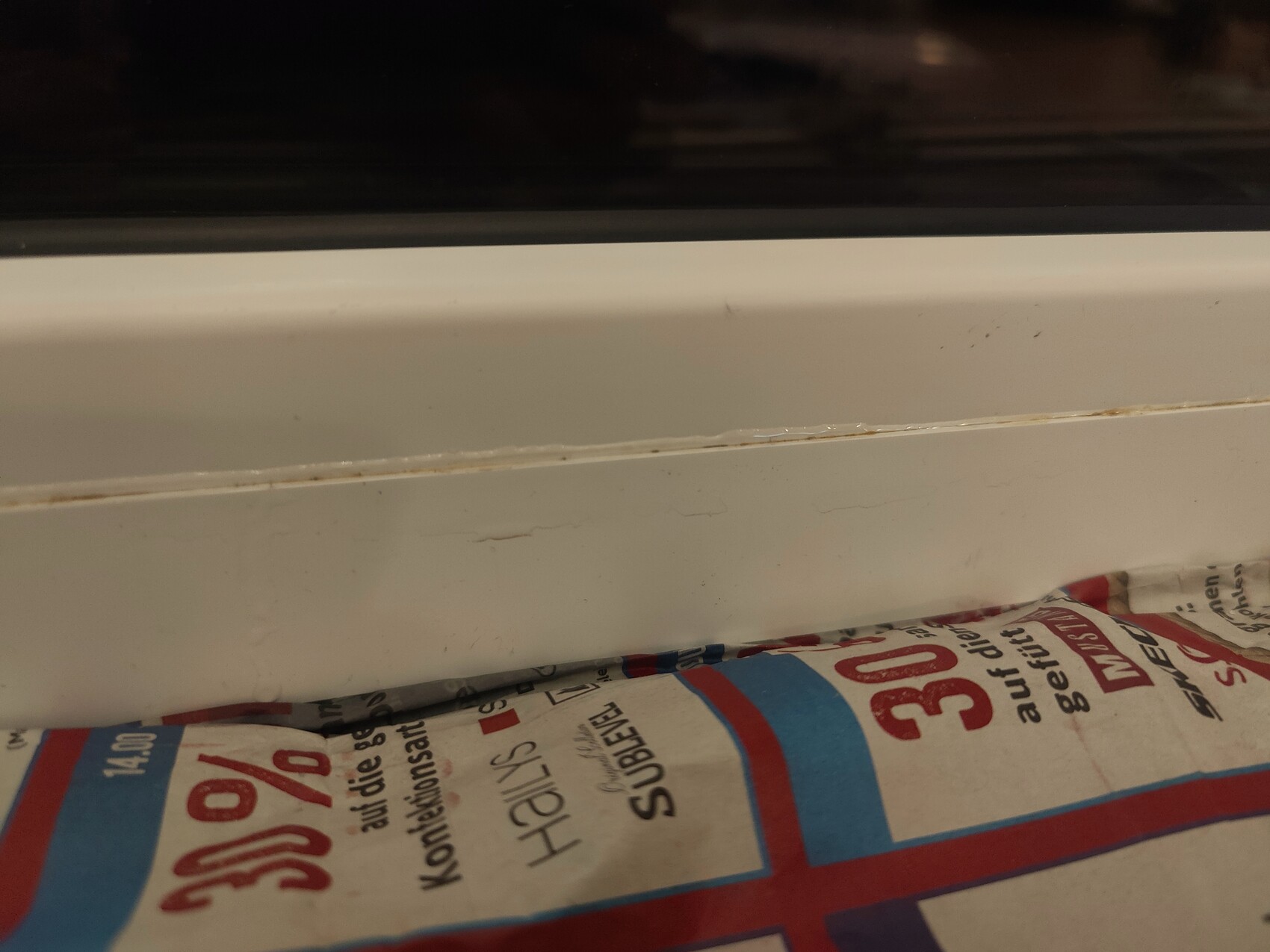
By chance, I just noticed that the fixed glazing seems to be leaking, and as if that weren’t odd enough, it is at a very unusual spot.
The lower frame consists of two parts, so there is a "plastic joint," a seam or connection between these two parts.
And moisture is coming from there, with some brownish discoloration visible as well.
I’ve attached a photo.
Now, the actual question:
How can this happen?
It’s currently dark outside and raining, so I can’t check whether there are drainage caps or similar. But that’s unlikely on fixed glazing, right?
I hope you have a good tip for me.
It seems that hardly anything underneath the laminate flooring has become damp, but of course, I want to fix the cause as quickly as possible...
Best regards
Enrico
This concerns a solid construction house built in 2018/19, where I have PVC windows.
One of them is a two-sided casement window, connected at the bottom to a fixed glazing panel running the entire length.
So, at the bottom there is floor-to-ceiling fixed glazing about 2m (6.5 ft) wide and above that, two casement windows measuring 1 x 1m (3.3 x 3.3 ft) each.
By chance, I just noticed that the fixed glazing seems to be leaking, and as if that weren’t odd enough, it is at a very unusual spot.
The lower frame consists of two parts, so there is a "plastic joint," a seam or connection between these two parts.
And moisture is coming from there, with some brownish discoloration visible as well.
I’ve attached a photo.
Now, the actual question:
How can this happen?
It’s currently dark outside and raining, so I can’t check whether there are drainage caps or similar. But that’s unlikely on fixed glazing, right?
I hope you have a good tip for me.
It seems that hardly anything underneath the laminate flooring has become damp, but of course, I want to fix the cause as quickly as possible...
Best regards
Enrico


parcus schrieb:
But as @11ant says, the picture is basically useless,...... and in my opinion, it leads @Tolentino to a whole bunch of misunderstandings. You actually can’t see ANYTHING, but I would interpret all the points differently nonetheless. This is exactly the problem when questioners simply take photos "as close as possible," DBDDHKP ...https://www.instagram.com/11antgmxde/
https://www.linkedin.com/company/bauen-jetzt/
Sorry, yes, I meant glazing bead.
To me, it’s very clear. What else could the dark part be other than the window glass? Everything else follows from that...
You can even see the reflection in the glass.
But of course, the best would be a better photo. High resolution, showing the entire window.
To me, it’s very clear. What else could the dark part be other than the window glass? Everything else follows from that...
You can even see the reflection in the glass.
But of course, the best would be a better photo. High resolution, showing the entire window.
B
B.Baumeister11 Jan 2023 21:04Ok, here are a few more photos. I think Tolentino’s explanation was quite good.
This morning, I applied black tape to the joint between the frame and the mounting strip, leaving about 1cm (0.4 inches) uncovered.
And at exactly this 1 cm (0.4 inches) you can see a water droplet, while the rest remains dry.
If it were a thermal bridge, wouldn’t there also be condensation on the tape?
By the way, it has been rain-free outside since this morning.


This morning, I applied black tape to the joint between the frame and the mounting strip, leaving about 1cm (0.4 inches) uncovered.
And at exactly this 1 cm (0.4 inches) you can see a water droplet, while the rest remains dry.
If it were a thermal bridge, wouldn’t there also be condensation on the tape?
By the way, it has been rain-free outside since this morning.