
ᐅ Experience with Natural Hydraulic Lime Paint for Interior Walls
Created on: 14 Jun 2015 18:32
W
willWohnenW
willWohnen14 Jun 2015 18:32Hello,
we had the interior of the house plastered with a lime-based plaster.
Only now have we realized that using a dispersion paint will compromise the vapor permeability of this interior plaster.
I have read a lot of positive things about lime paint or hydraulic lime paint. Hydraulic lime can also be purchased fairly cheaply. However, the application process seems to be more challenging, although I haven’t learned all the details yet.
Has anyone here worked with lime paint before?
Is it possible to apply it with a roller, or do you always have to use those large brushes?
Is it necessary to wear a mask?
We were actually planning to have it painted professionally and wanted to hire someone quite affordably. But for lime paint, I suppose it’s better to hire someone experienced, right?
Best regards
we had the interior of the house plastered with a lime-based plaster.
Only now have we realized that using a dispersion paint will compromise the vapor permeability of this interior plaster.
I have read a lot of positive things about lime paint or hydraulic lime paint. Hydraulic lime can also be purchased fairly cheaply. However, the application process seems to be more challenging, although I haven’t learned all the details yet.
Has anyone here worked with lime paint before?
Is it possible to apply it with a roller, or do you always have to use those large brushes?
Is it necessary to wear a mask?
We were actually planning to have it painted professionally and wanted to hire someone quite affordably. But for lime paint, I suppose it’s better to hire someone experienced, right?
Best regards

Hello Willwohnen,
unfortunately, I cannot contribute anything about lime paint. However, I would be interested to know if the lime plaster is really as "rough" as it is often described. We are still considering whether lime plaster or gypsum plaster would be more suitable for us. We want to paint all the walls and not use wallpaper.
unfortunately, I cannot contribute anything about lime paint. However, I would be interested to know if the lime plaster is really as "rough" as it is often described. We are still considering whether lime plaster or gypsum plaster would be more suitable for us. We want to paint all the walls and not use wallpaper.
W
willWohnen15 Jun 2015 17:53@WildThing
Hello, so two people have already commented on our relatively rough plaster. Personally, I don’t think it’s that rough; my parents have true roughcast plaster in their home, and this is a world apart from that. We also noticed that a large part of the "little beads" need to be removed before painting, which can easily be rubbed off with your fingers. So there are still some small rounded bumps left, about 1.5mm (0.06 inches) thick, but overall the wall is still smooth (Q3 finish). You definitely can’t tear your clothes or skin on this plaster. You could have bought a type of finishing coat if you wanted a completely smooth wall, but we didn’t want that. However, our plaster had to be applied twice to reach the current quality. We used Schwenk lime plaster suitable for allergy sufferers. It is gray! There is also Schwenk KIP natural white, but according to a phone call I made, that one is not so white that you wouldn’t still need to paint. (That was also an idea we considered.) I think both the color and texture really depend on the exact product used.
I searched our photos, but I don’t have a close-up showing the beads clearly. Still, I’m attaching a photo where you can see by the cable and the outlet (plastic parts) from which distance the texture is no longer visible.
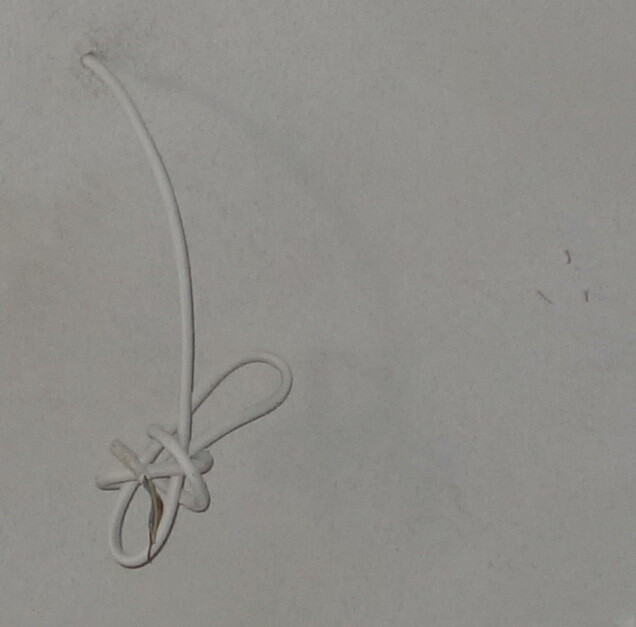
The light also needs to come from the side to even see the texture. Personally, I like it this way quite a bit, but the beads still need to be removed so they don’t stick to the painter’s rollers.
I wouldn’t want it completely smooth. On a perfectly smooth wall, every scratch or similar damage stands out even more.
Hope this helps you a little.
Regards
WillWohnen
Hello, so two people have already commented on our relatively rough plaster. Personally, I don’t think it’s that rough; my parents have true roughcast plaster in their home, and this is a world apart from that. We also noticed that a large part of the "little beads" need to be removed before painting, which can easily be rubbed off with your fingers. So there are still some small rounded bumps left, about 1.5mm (0.06 inches) thick, but overall the wall is still smooth (Q3 finish). You definitely can’t tear your clothes or skin on this plaster. You could have bought a type of finishing coat if you wanted a completely smooth wall, but we didn’t want that. However, our plaster had to be applied twice to reach the current quality. We used Schwenk lime plaster suitable for allergy sufferers. It is gray! There is also Schwenk KIP natural white, but according to a phone call I made, that one is not so white that you wouldn’t still need to paint. (That was also an idea we considered.) I think both the color and texture really depend on the exact product used.
I searched our photos, but I don’t have a close-up showing the beads clearly. Still, I’m attaching a photo where you can see by the cable and the outlet (plastic parts) from which distance the texture is no longer visible.
The light also needs to come from the side to even see the texture. Personally, I like it this way quite a bit, but the beads still need to be removed so they don’t stick to the painter’s rollers.
I wouldn’t want it completely smooth. On a perfectly smooth wall, every scratch or similar damage stands out even more.
Hope this helps you a little.
Regards
WillWohnen
W
willWohnen18 Jun 2015 15:23Hello,
has really no one used hydraulic lime putty yet? That surprises me.
We would actually like to use it, but we just can’t find anyone with experience using it.
There are many unclear statements like it being difficult to repaint or touch up later with hydraulic lime putty—of course with other paints, but we’re not sure if it’s a problem when touching up with white hydraulic lime putty. Apparently, a sintering layer can form that might need to be sanded off..?
But isn’t it the case with any paint that if you repair a spot, you eventually have to repaint the whole wall because otherwise you can always see the patch?
Does a wall paint need to be scrub-resistant—do you actually wipe your walls? I have never wiped an interior wall with a damp cloth...
I will post this message again in this thread, hoping to learn more.
Thanks and regards
willWohnen
has really no one used hydraulic lime putty yet? That surprises me.
We would actually like to use it, but we just can’t find anyone with experience using it.
There are many unclear statements like it being difficult to repaint or touch up later with hydraulic lime putty—of course with other paints, but we’re not sure if it’s a problem when touching up with white hydraulic lime putty. Apparently, a sintering layer can form that might need to be sanded off..?
But isn’t it the case with any paint that if you repair a spot, you eventually have to repaint the whole wall because otherwise you can always see the patch?
Does a wall paint need to be scrub-resistant—do you actually wipe your walls? I have never wiped an interior wall with a damp cloth...
I will post this message again in this thread, hoping to learn more.
Thanks and regards
willWohnen
Hello,
I might be able to contribute something here. For many years, I have been using hydraulic lime paint as an interior wall coating. It significantly improves indoor air quality. In my experience, the application is quite straightforward once you get used to the fact that 2-3 coats are necessary.
If the substrate is mineral-based, meaning the paint is applied directly onto plaster or a previous lime paint layer, then lime painting cannot be replaced by any other paint in terms of both visual appearance and air quality in the room. However, in several apartments I have encountered, the base layer was usually dispersion paint (latex paint). Since I dislike dispersion paint for interior walls, I still applied lime paint over it. Naturally, the effect on the indoor climate is not as strong as on mineral substrates. Nevertheless, the lime paint adhered very well in almost all cases. It is advisable to test it beforehand.
It is sometimes claimed that if dispersion paint is applied over lime paint later on, the lime will peel off. I have tested this and cannot confirm it. Lime paint adheres quite well to dispersion paint, and even after years, nothing peels off. Of course, this does not create a fully vapor-permeable wall, but it does stop sealing the walls increasingly with plastic coatings and avoids any toxic substances in the indoor air.
The hydraulic lime I used had been stored for 2 years. It is best not to use lime that is stored for less. The storage time is crucial. I did not add any additives. Lime behaves very differently during application compared to thick dispersion paint. Rolling with a paint roller does not work. A high-quality brush is required. Everything must be carefully covered. Wearing safety glasses is mandatory. The white color only develops after several hours. But all of this becomes normal with practice.
Another advantage: A 10-liter (2.6 gal) bucket costs around 11 euros here and is then diluted 1 to 3. No other interior paint is this economical. Just give it a try.
I might be able to contribute something here. For many years, I have been using hydraulic lime paint as an interior wall coating. It significantly improves indoor air quality. In my experience, the application is quite straightforward once you get used to the fact that 2-3 coats are necessary.
If the substrate is mineral-based, meaning the paint is applied directly onto plaster or a previous lime paint layer, then lime painting cannot be replaced by any other paint in terms of both visual appearance and air quality in the room. However, in several apartments I have encountered, the base layer was usually dispersion paint (latex paint). Since I dislike dispersion paint for interior walls, I still applied lime paint over it. Naturally, the effect on the indoor climate is not as strong as on mineral substrates. Nevertheless, the lime paint adhered very well in almost all cases. It is advisable to test it beforehand.
It is sometimes claimed that if dispersion paint is applied over lime paint later on, the lime will peel off. I have tested this and cannot confirm it. Lime paint adheres quite well to dispersion paint, and even after years, nothing peels off. Of course, this does not create a fully vapor-permeable wall, but it does stop sealing the walls increasingly with plastic coatings and avoids any toxic substances in the indoor air.
The hydraulic lime I used had been stored for 2 years. It is best not to use lime that is stored for less. The storage time is crucial. I did not add any additives. Lime behaves very differently during application compared to thick dispersion paint. Rolling with a paint roller does not work. A high-quality brush is required. Everything must be carefully covered. Wearing safety glasses is mandatory. The white color only develops after several hours. But all of this becomes normal with practice.
Another advantage: A 10-liter (2.6 gal) bucket costs around 11 euros here and is then diluted 1 to 3. No other interior paint is this economical. Just give it a try.
Similar topics