
We moved into our new build about six months ago. We painted and installed the flooring in December 2023. The house is built to KFW55 standard with a general contractor. Indoor humidity levels are almost always below 60%, rarely higher.
This morning, we noticed efflorescence behind an armchair in the study. We can’t say exactly how long it has been there. Here are two pictures of it. In the first picture, I tapped the plaster 2-3 times with my finger and the paint crumbled right away.

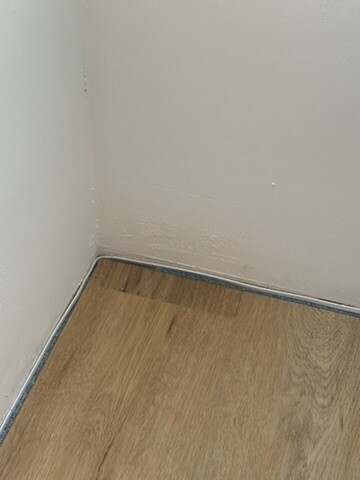
We deliberately did not install baseboards at the time so that we could spot issues like this quickly, as unfortunately, we didn’t have time to conduct a moisture measurement. Before anyone criticizes, we know that was not ideal, but life isn’t always so simple.
Before everyone starts assigning blame, I’d like to get your opinions on:
Our site manager has been informed and they are usually very cooperative and accommodating. I expect he will come to inspect it next week. One of our neighbors (same new development, general contractor built all the houses here) had the same problem and after opening up the walls both inside and outside, they couldn’t find a source. He now has a drying device running there.
I just wanted to get your thoughts so I’m not completely uninformed going into the conversation. It never hurts to be a bit prepared and able to contribute. If the site manager doesn’t initiate follow-up, we will consider hiring an expert ourselves. That’s on our radar.
Thanks for your help!
This morning, we noticed efflorescence behind an armchair in the study. We can’t say exactly how long it has been there. Here are two pictures of it. In the first picture, I tapped the plaster 2-3 times with my finger and the paint crumbled right away.
We deliberately did not install baseboards at the time so that we could spot issues like this quickly, as unfortunately, we didn’t have time to conduct a moisture measurement. Before anyone criticizes, we know that was not ideal, but life isn’t always so simple.
Before everyone starts assigning blame, I’d like to get your opinions on:
- What could be causing this? Could it be from residual moisture inside, or must it be coming from outside?
- How serious is this?
- What would be the best way to proceed?
- If everything outside is sealed, can we simply remove it and repaint?
- If yes, what’s the best method for that?
Our site manager has been informed and they are usually very cooperative and accommodating. I expect he will come to inspect it next week. One of our neighbors (same new development, general contractor built all the houses here) had the same problem and after opening up the walls both inside and outside, they couldn’t find a source. He now has a drying device running there.
I just wanted to get your thoughts so I’m not completely uninformed going into the conversation. It never hurts to be a bit prepared and able to contribute. If the site manager doesn’t initiate follow-up, we will consider hiring an expert ourselves. That’s on our radar.
Thanks for your help!
N
nordanney21 Jun 2024 11:19jrth2151 schrieb:
What could be the cause of this? Could it be due to residual moisture, or does it have to come from outside? If anything, it’s from outside. Not due to residual moisture.
jrth2151 schrieb:
- How serious is this?
- What is the best way to proceed?
- If the exterior is fully sealed, can this simply be removed and repainted?
- If yes, what is the best method?
Report the defect and have it fixed. In the worst case—which can happen quite quickly—the area must be opened from the outside and properly sealed because the contractors were careless.
This morning, things happened very quickly here. The site manager was already here and measured the moisture. In that room, the wall around the perimeter on the exterior wall side is damp. Not 100% saturated, but noticeably higher. For background, it is the northeast corner of the house.
His theory is, as was the case with our neighbor and explained by the drying company there, that water from residual moisture collects between the screed and the base slab, and since this is not perfectly level, it runs to one side, in our case exactly into this corner. Our neighbor went through everything—removing edge strips, multiple rounds of exterior waterproofing, and so on. Since the symptoms are identical for us, the drying company suspects something similar here. It should be mentioned that we had a very wet construction phase during severe storms. At times, our house was partially flooded, and we had to use a submersible pump several times to prevent serious damage. Naturally, all that moisture needs time to dry out.
If there were a structural issue with the waterproofing or similar, it would likely be visible in other areas of the house. We measured the entire ground floor, and it is only this one room. He also reviewed all the plans, and apart from an empty conduit for electrical wiring, nothing is installed on the exterior wall side.
As a first step, we are placing a dehumidifier in the room and will monitor the situation. Once the outside environment is dry again (currently the humidity is about 85% at 23°C (73°F)), the drying company can carry out cavity drying. They have already been contacted and, according to them, it doesn’t make much sense with the current weather conditions, as a negative pressure develops that would pull moist air from outside into the house. Our site manager will come by once a month for measurements, and in September the drying company will measure and assess the situation again. If there is no improvement by then, they will take more advanced measures.
If cavity drying does not solve the problem, the whole process with exterior waterproofing and so forth will start.
So far, this all makes sense to me and seems like a reasonable approach. Or am I completely mistaken?
His theory is, as was the case with our neighbor and explained by the drying company there, that water from residual moisture collects between the screed and the base slab, and since this is not perfectly level, it runs to one side, in our case exactly into this corner. Our neighbor went through everything—removing edge strips, multiple rounds of exterior waterproofing, and so on. Since the symptoms are identical for us, the drying company suspects something similar here. It should be mentioned that we had a very wet construction phase during severe storms. At times, our house was partially flooded, and we had to use a submersible pump several times to prevent serious damage. Naturally, all that moisture needs time to dry out.
If there were a structural issue with the waterproofing or similar, it would likely be visible in other areas of the house. We measured the entire ground floor, and it is only this one room. He also reviewed all the plans, and apart from an empty conduit for electrical wiring, nothing is installed on the exterior wall side.
As a first step, we are placing a dehumidifier in the room and will monitor the situation. Once the outside environment is dry again (currently the humidity is about 85% at 23°C (73°F)), the drying company can carry out cavity drying. They have already been contacted and, according to them, it doesn’t make much sense with the current weather conditions, as a negative pressure develops that would pull moist air from outside into the house. Our site manager will come by once a month for measurements, and in September the drying company will measure and assess the situation again. If there is no improvement by then, they will take more advanced measures.
If cavity drying does not solve the problem, the whole process with exterior waterproofing and so forth will start.
So far, this all makes sense to me and seems like a reasonable approach. Or am I completely mistaken?
N
nordanney21 Jun 2024 12:17jrth2151 schrieb:
So far, this all makes sense to me and seems like a reasonable approach. Or am I completely mistaken?That sounds plausible, and action is being taken. Companies also need to be given a chance to make corrections. If none of that works, then the only option left is to bring in heavy outside pressure.
Similar topics