
ᐅ Extend the hardwood flooring from the hallway into the room.
Created on: 28 Oct 2021 07:06
P
Parvus6Hello,
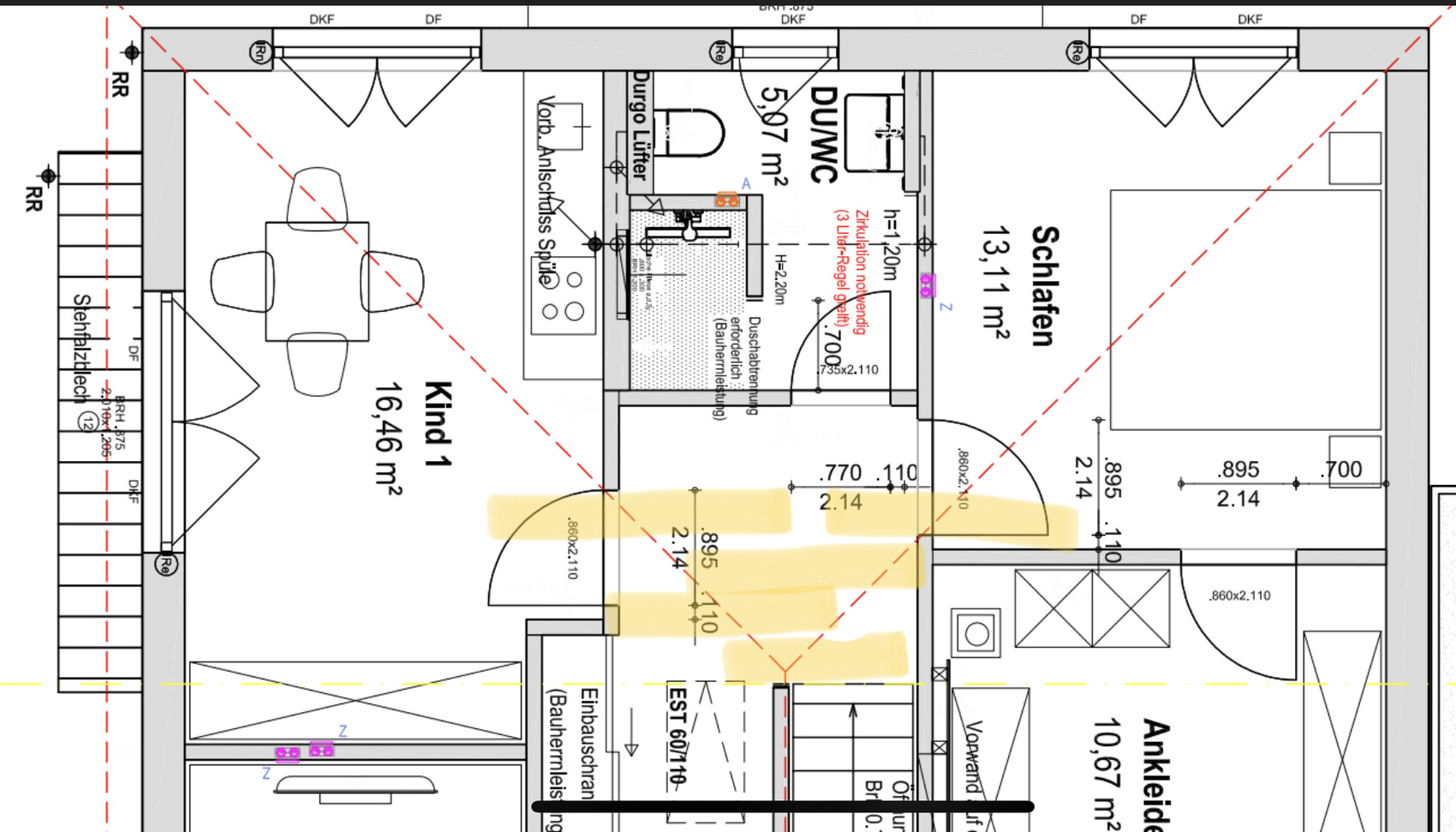
I would like to move my engineered parquet flooring from the hallway into the rooms, or vice versa—from the rooms into the hallway. The floor will be glued down, and I plan to cut the expansion gap afterward.
My main focus is to achieve a seamless look from the hallway into the rooms, and I want to avoid cross grain patterns.
My problem/question is: where is it best to start laying the floor? Should I begin in the hallway or in the rooms? Also, with click engineered parquet, is it possible to click the groove onto the tongue as well as the tongue onto the groove?
I would appreciate any tips or advice.
I would like to move my engineered parquet flooring from the hallway into the rooms, or vice versa—from the rooms into the hallway. The floor will be glued down, and I plan to cut the expansion gap afterward.
My main focus is to achieve a seamless look from the hallway into the rooms, and I want to avoid cross grain patterns.
My problem/question is: where is it best to start laying the floor? Should I begin in the hallway or in the rooms? Also, with click engineered parquet, is it possible to click the groove onto the tongue as well as the tongue onto the groove?
I would appreciate any tips or advice.
B
BBaumeister28 Oct 2021 14:13Honestly, I wouldn’t do it that way. The screed moves, and the individual rooms will be heated differently, plus varying sunlight exposure alone can cause the different screed areas to shift. A cork expansion joint might help here.
Otherwise, I would start in nursery 1 and basically work from the right side of the closet (as we have it) toward the window. The groove must always face down. It’s not possible to connect it the other way around. Once you reach the door edge, it gets tricky. You may need to make quite a few lengthwise cuts, since a wall might not be perfectly plumb or the plaster on a wall might be applied thicker. The longest plank in the door area runs from one side of the house to the opposite side. Especially when gluing, you have a relatively short working time, and it usually doesn’t fit perfectly just when the adhesive starts to form a skin.
Do you already have experience laying and gluing parquet? If not, start in a small room first to gain some experience.
Otherwise, I would start in nursery 1 and basically work from the right side of the closet (as we have it) toward the window. The groove must always face down. It’s not possible to connect it the other way around. Once you reach the door edge, it gets tricky. You may need to make quite a few lengthwise cuts, since a wall might not be perfectly plumb or the plaster on a wall might be applied thicker. The longest plank in the door area runs from one side of the house to the opposite side. Especially when gluing, you have a relatively short working time, and it usually doesn’t fit perfectly just when the adhesive starts to form a skin.
Do you already have experience laying and gluing parquet? If not, start in a small room first to gain some experience.
A
Alessandro29 Oct 2021 09:30I wouldn’t do it that way. If you start on the cabinet side in K1, you might end up having to cut a narrow strip on the window side. I’d rather have that on the cabinet side, where it won’t be visible anyway because of the cabinet.
I would also want a full plank at the stair landing, not in the worst case a 1cm (0.4 inch) strip...
I have full-surface installation throughout the entire upper floor without any expansion joints (the parquet is glued down) and different temperatures in the individual rooms. Nothing happens! So don’t worry about that...
I would also want a full plank at the stair landing, not in the worst case a 1cm (0.4 inch) strip...
I have full-surface installation throughout the entire upper floor without any expansion joints (the parquet is glued down) and different temperatures in the individual rooms. Nothing happens! So don’t worry about that...
Alessandro schrieb:
I have a fully glued installation throughout the entire upper floor without an expansion joint (the parquet is glued down) and different temperatures in the individual rooms. Nothing happens! So don’t worry about it… I wouldn’t state it like that.
You can’t generalize from your ideal case and claim that nothing happens.
The standard specifies that an expansion joint must be included in the floor construction because different types of movement otherwise cause problems.
I would give more weight to the regulation than to a single example.
If you want to avoid the joint, there are special methods. For this, grooves are cut along the edges of the screed joint and special bands are glued in to absorb the movement. I would recommend that approach to you as well.
A joint cut afterwards and sealed will also disrupt the visual appearance, and I doubt you will be able to follow the exact course of the expansion joint in the screed.
So either no joint but with a proper system, or a joint with cork strips as already mentioned by [USER=24620]@BBaumeister.
Best regards, Jann
B
Benutzer20029 Oct 2021 13:05Jann St schrieb:
I wouldn’t just leave it at that.
You can’t generalize from your favorable case and claim that nothing happens.
The standard states that an expansion joint must be included in the floor structure to accommodate different movements; otherwise, problems will occur.
I would give that more weight than to a single incident. Not a single incident. Many parquet installers do this and provide a warranty on the installation. Sometimes poor practices simply don’t comply with the applicable standards.
With a new underfloor heating system where the supply temperatures no longer exceed 30°C (86°F) during the coldest winter, you hardly get any noticeable expansion anymore.
Yes, this method is used and a warranty is provided for it, but then there are adhesives or tapes applied over the joints to accommodate this, and the craftsmen know what they are doing. I have already described a way above to produce it technically correctly. However, it is not simply laid down without these measures.
Similar topics