
Hello everyone,
we bought a house with a heat pump, so we inherited all the settings from the previous owners.
I’m not very familiar with this yet, so please feel free to question anything I say, but I have a feeling that not everything is ideally configured. Several things caught my attention or aren’t clear to me, so let’s see if it all fits into one thread.
We have a Dimplex heat pump installed, model LA17TU. In the basement, there is a Hydrotower HWK 332 Econ with a heat pump manager. It would be great if someone is familiar with this system.
First question: In the advanced settings, there is an option to set a limit value for the second heat source (i.e., the electric heating element).
The manual explains: “Depending on the dimensioning of the heat pump, the second heat source is only required below a certain limit temperature. The second heat source will only activate at temperatures below the set limit temperature.”
The limit temperature is set to -5°C (23°F). That would mean the heating element runs whenever the temperature is below -5°C (23°F), right? Isn’t that set too high? At -5°C (23°F), the heat pump should still be able to perform sufficiently without needing the high-consumption heating element. On the other hand, the manual specifies a setting range from -20°C (-4°F) to +20°C (68°F), with -5°C (23°F) in bold, which makes it look like a default value.
Second question concerns the heating curve.
The manual contains a section on optimizing the heating curve. According to this, the heat pump is controlled based on the return temperature. In the settings menu, under the heating circuit options, you can select the temperature sensor as either “supply” or “return.” Currently, “supply” is selected. Doesn’t this contradict the statement that the control is based on the return temperature? Or could it mean something else?
Also, the endpoint of the heating curve puzzles me. According to online information, our local reference outdoor temperature is -14°C (7°F). Is the heating curve endpoint really only dependent on the reference outdoor temperature and not on the building’s construction?
When I look at the tables and curves in the manual, a reference outdoor temperature of -14°C (7°F) corresponds to a required return temperature of 28°C (82°F), which results in a heating curve endpoint of 29°C (84°F) to be set on the device. The actual indoor temperature level is then adjusted by shifting the curve in parallel. However, the currently set heating curve endpoint is 45°C (113°F). I’m hesitant to make such a big change without knowing exactly what it will affect. Are building-specific conditions possibly important here?
Regards,
TObi
we bought a house with a heat pump, so we inherited all the settings from the previous owners.
I’m not very familiar with this yet, so please feel free to question anything I say, but I have a feeling that not everything is ideally configured. Several things caught my attention or aren’t clear to me, so let’s see if it all fits into one thread.
We have a Dimplex heat pump installed, model LA17TU. In the basement, there is a Hydrotower HWK 332 Econ with a heat pump manager. It would be great if someone is familiar with this system.
First question: In the advanced settings, there is an option to set a limit value for the second heat source (i.e., the electric heating element).
The manual explains: “Depending on the dimensioning of the heat pump, the second heat source is only required below a certain limit temperature. The second heat source will only activate at temperatures below the set limit temperature.”
The limit temperature is set to -5°C (23°F). That would mean the heating element runs whenever the temperature is below -5°C (23°F), right? Isn’t that set too high? At -5°C (23°F), the heat pump should still be able to perform sufficiently without needing the high-consumption heating element. On the other hand, the manual specifies a setting range from -20°C (-4°F) to +20°C (68°F), with -5°C (23°F) in bold, which makes it look like a default value.
Second question concerns the heating curve.
The manual contains a section on optimizing the heating curve. According to this, the heat pump is controlled based on the return temperature. In the settings menu, under the heating circuit options, you can select the temperature sensor as either “supply” or “return.” Currently, “supply” is selected. Doesn’t this contradict the statement that the control is based on the return temperature? Or could it mean something else?
Also, the endpoint of the heating curve puzzles me. According to online information, our local reference outdoor temperature is -14°C (7°F). Is the heating curve endpoint really only dependent on the reference outdoor temperature and not on the building’s construction?
When I look at the tables and curves in the manual, a reference outdoor temperature of -14°C (7°F) corresponds to a required return temperature of 28°C (82°F), which results in a heating curve endpoint of 29°C (84°F) to be set on the device. The actual indoor temperature level is then adjusted by shifting the curve in parallel. However, the currently set heating curve endpoint is 45°C (113°F). I’m hesitant to make such a big change without knowing exactly what it will affect. Are building-specific conditions possibly important here?
Regards,
TObi
Tobibi schrieb:
I have to say, we have a large house with 200 sqm (2,150 sq ft) of living space from the 1980s, which is insulated as poorly as was common at that time. In recent years, 12,000 kWh of heating electricity has been consumed. So now you show up with that. 🙄
For radiators, 45°C (113°F) supply temperature is definitely required if you don’t want to be cold.
Did you replace the oil boiler directly with a heat pump without any other (insulation) measures? Or was underfloor heating only installed then?
Okay, if you skim through the posts, you can find some information (which could have been shared here as well).
The heat pump was installed in 2011. As suspected, the oil heater was removed, and the heat pump was installed. Underfloor heating was already in place before that. Radiators are located in the basement and the room above the garage. (In one of the posts, you mentioned the heat pump is 6 years old?!)
The heat pump has already had a malfunction. What was the cause?
Is the heat pump running optimally? Were the mentioned balancing adjustments (hydraulic/thermal) carried out? Were the thermostatic radiator valves (TRVs) replaced during the heat pump installation? Presumably not. This means you cannot monitor the flow rates at all because they are not visible. No sight glasses!? Show us the TRVs.
Can you see the (brown) water from the underfloor heating anywhere? Was the system flushed at the time (in 2011)?
Regarding your specific questions about your heat pump, I can’t say much. Just this: the minimum flow rate of the heat pump (according to the datasheet) should be ensured at all times.
A house from the 1980s (basically in its original condition) requires the underfloor heating to be running very hot for the house to get warm. You probably noticed this yourself last winter.
Insulation measures have also been discussed (windows/facade/ceiling insulation...). Together, this represents a major project and needs to be planned (energy consultant).
The heat pump was installed in 2011. As suspected, the oil heater was removed, and the heat pump was installed. Underfloor heating was already in place before that. Radiators are located in the basement and the room above the garage. (In one of the posts, you mentioned the heat pump is 6 years old?!)
The heat pump has already had a malfunction. What was the cause?
Is the heat pump running optimally? Were the mentioned balancing adjustments (hydraulic/thermal) carried out? Were the thermostatic radiator valves (TRVs) replaced during the heat pump installation? Presumably not. This means you cannot monitor the flow rates at all because they are not visible. No sight glasses!? Show us the TRVs.
Can you see the (brown) water from the underfloor heating anywhere? Was the system flushed at the time (in 2011)?
Regarding your specific questions about your heat pump, I can’t say much. Just this: the minimum flow rate of the heat pump (according to the datasheet) should be ensured at all times.
A house from the 1980s (basically in its original condition) requires the underfloor heating to be running very hot for the house to get warm. You probably noticed this yourself last winter.
Insulation measures have also been discussed (windows/facade/ceiling insulation...). Together, this represents a major project and needs to be planned (energy consultant).
So, I’m only getting around to responding now. Yes, the underfloor heating has always been there; only the basement has a few radiators, which are usually turned off. There are also radiators in a finished room above the garage. This room doesn’t need to be cozy warm but should maintain roughly normal room temperature. The underfloor heating and radiators operate on separate circuits with independently controlled supply temperatures.
The heat pump once had a soft starter that broke and was replaced.
I don’t know if the pipes were flushed when switching to the heat pump. According to the previous owner, a hydraulic balancing was done about 4 or 5 years ago, but I don’t have any documentation for it.
This is what the heating circuit distributor on the ground floor looks like:
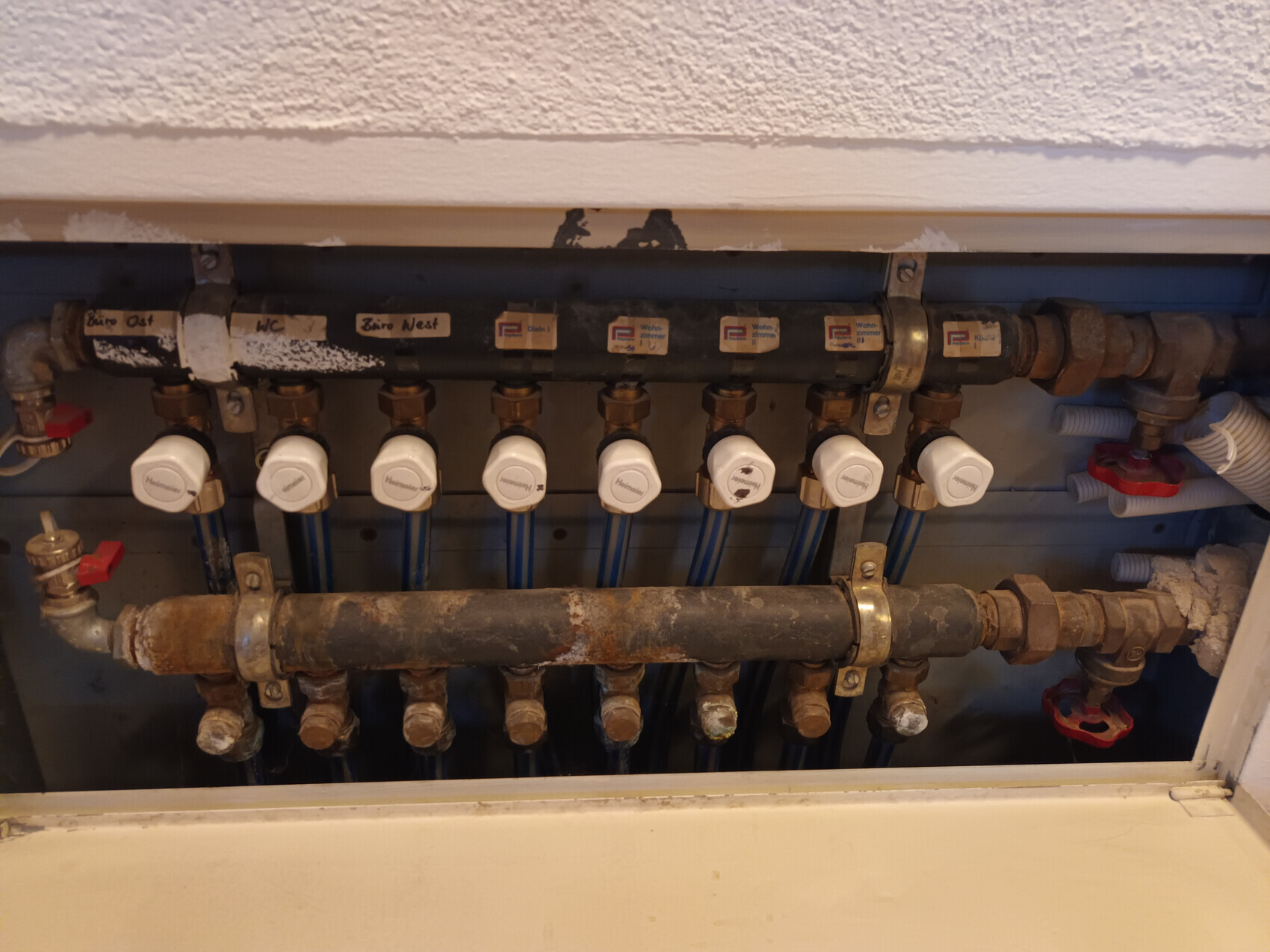
The first floor is more or less identical, except that in some rooms there are electric controllers with a dial. I can’t directly adjust or read the flow rate, only turn the valves. I basically have everything fully open. I also don’t see the water directly anywhere (should I?).
Whether the heat pump is running optimally is basically what this thread is supposed to be about.
The heat pump once had a soft starter that broke and was replaced.
I don’t know if the pipes were flushed when switching to the heat pump. According to the previous owner, a hydraulic balancing was done about 4 or 5 years ago, but I don’t have any documentation for it.
This is what the heating circuit distributor on the ground floor looks like:
The first floor is more or less identical, except that in some rooms there are electric controllers with a dial. I can’t directly adjust or read the flow rate, only turn the valves. I basically have everything fully open. I also don’t see the water directly anywhere (should I?).
Whether the heat pump is running optimally is basically what this thread is supposed to be about.
Similar topics