
ᐅ Burglar Protection: Motion Sensors or Continuous Lighting?
Created on: 22 Oct 2019 19:15
L
Lückenfüller
Hello everyone,
Today, the foundation pit is being excavated at our site (finally, the city has given the go-ahead!). After my appointment with the electrician today, I have a question for you regarding burglary protection and lighting. Here are the key facts:
- To the right is a neighboring house, but they cannot see this area. To the left and above, there are only fields and bushes—perfect for sneaking up. Above us on the first floor, friends are building/living; the garden is currently officially a shared area. (Image attached)
- The windows will be RC2n rated, triple-glazed.
- So far, we had planned three motion detectors with our general contractor for the garden side. In addition, there will be three outdoor floodlights (switchable).
How would you arrange the motion detectors/lights for burglary protection? Connect pet-immune motion sensors with powerful halogen floodlights? Could constant lighting quickly reduce the effect? What do you suggest?
If you need more information, just ask!
Best regards,
Lückenfüller
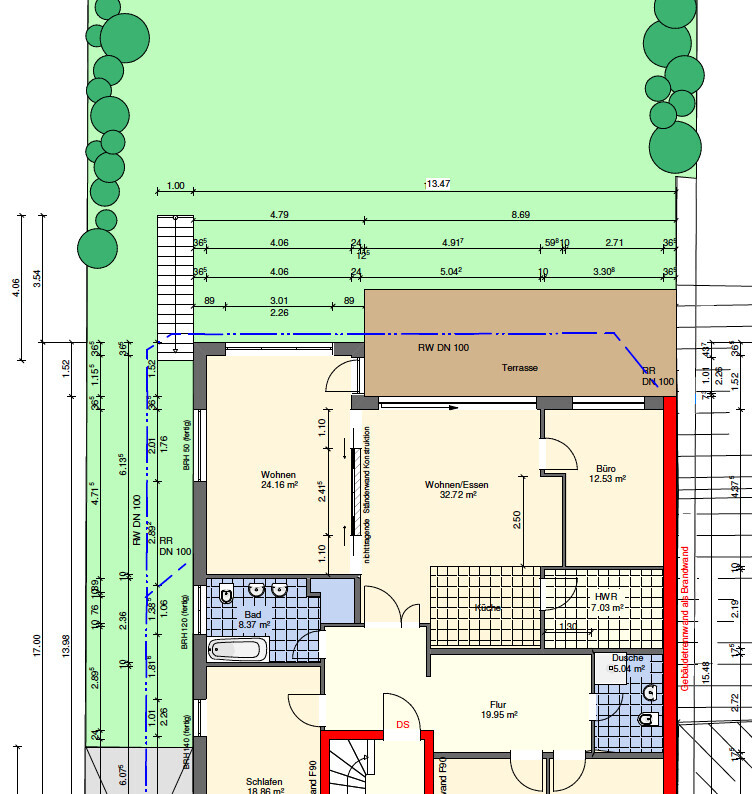
Today, the foundation pit is being excavated at our site (finally, the city has given the go-ahead!). After my appointment with the electrician today, I have a question for you regarding burglary protection and lighting. Here are the key facts:
- To the right is a neighboring house, but they cannot see this area. To the left and above, there are only fields and bushes—perfect for sneaking up. Above us on the first floor, friends are building/living; the garden is currently officially a shared area. (Image attached)
- The windows will be RC2n rated, triple-glazed.
- So far, we had planned three motion detectors with our general contractor for the garden side. In addition, there will be three outdoor floodlights (switchable).
How would you arrange the motion detectors/lights for burglary protection? Connect pet-immune motion sensors with powerful halogen floodlights? Could constant lighting quickly reduce the effect? What do you suggest?
If you need more information, just ask!
Best regards,
Lückenfüller
D
Deliverer23 Oct 2019 16:10Why should motion detectors prevent burglars from breaking in? Even if they came at night, which they usually do not, it would at least save the much more noticeable flashlight...
The only thing that might help would be an exterior motion detector that then switches on one or two lights inside the house.
The only thing that might help would be an exterior motion detector that then switches on one or two lights inside the house.
Since this is a condominium association: you need to talk to the other owners, as the exterior walls are likely common property, so the other owners must give their consent. Since the garden is also intended to become common property, you should expect the motion sensors there to be triggered frequently.
Deliverer schrieb:
Why should motion sensors deter burglars? Even if they came at night, which they usually don’t, it would be easier to just use a much more conspicuous flashlight...
The only thing that might help would be an outdoor motion sensor that then turns on one or two lights inside the house.Contrary to your opinion, it actually increases the risk of being detected.
D
Deliverer25 Oct 2019 12:20As already mentioned: Only about 15% of burglaries occur at night. And even in those cases, lighting does not help because those who could see the burglar are asleep.
I have nothing against motion detectors – I like to have some light when I park my bike. But they simply do not provide burglary protection.
I have nothing against motion detectors – I like to have some light when I park my bike. But they simply do not provide burglary protection.
So maybe we have the same source. T-Online with the report from 2015. It mentions night and morning hours.
However, half of the break-ins occur between October and January. During this period, it’s already dark from 6 p.m. to 12 a.m. (18-24 hours).
More than 26% of the cases happen between 6 p.m. and midnight (18-24 hours), which is already about a quarter.
At that time, neighbors are usually still awake. This is easy to explain. The perpetrators do not want to be noticed. Therefore, they choose times when no one is home, such as during working hours and early morning.
What further increases the risk of being discovered? Good lighting and a long time to get into the property. This is where burglary prevention comes in.
However, half of the break-ins occur between October and January. During this period, it’s already dark from 6 p.m. to 12 a.m. (18-24 hours).
More than 26% of the cases happen between 6 p.m. and midnight (18-24 hours), which is already about a quarter.
At that time, neighbors are usually still awake. This is easy to explain. The perpetrators do not want to be noticed. Therefore, they choose times when no one is home, such as during working hours and early morning.
What further increases the risk of being discovered? Good lighting and a long time to get into the property. This is where burglary prevention comes in.
L
Lückenfüller27 Oct 2019 12:43Thanks in advance for your feedback!
We are still considering whether the other builders upstairs also have the option to deactivate the motion detectors in case they have a garden party or similar event in the evening. At the same time, they might forget to reactivate the motion detectors afterwards.
User0815 schrieb:
Since this is a condominium association: you need to talk to the other owners. The exterior walls are likely common property, so the other owners must agree. Also, because the garden is intended to become common property, you should expect the motion detectors there to trigger frequently.
We are still considering whether the other builders upstairs also have the option to deactivate the motion detectors in case they have a garden party or similar event in the evening. At the same time, they might forget to reactivate the motion detectors afterwards.
Similar topics