
B
Babenhausen28 Feb 2020 08:08Hello,
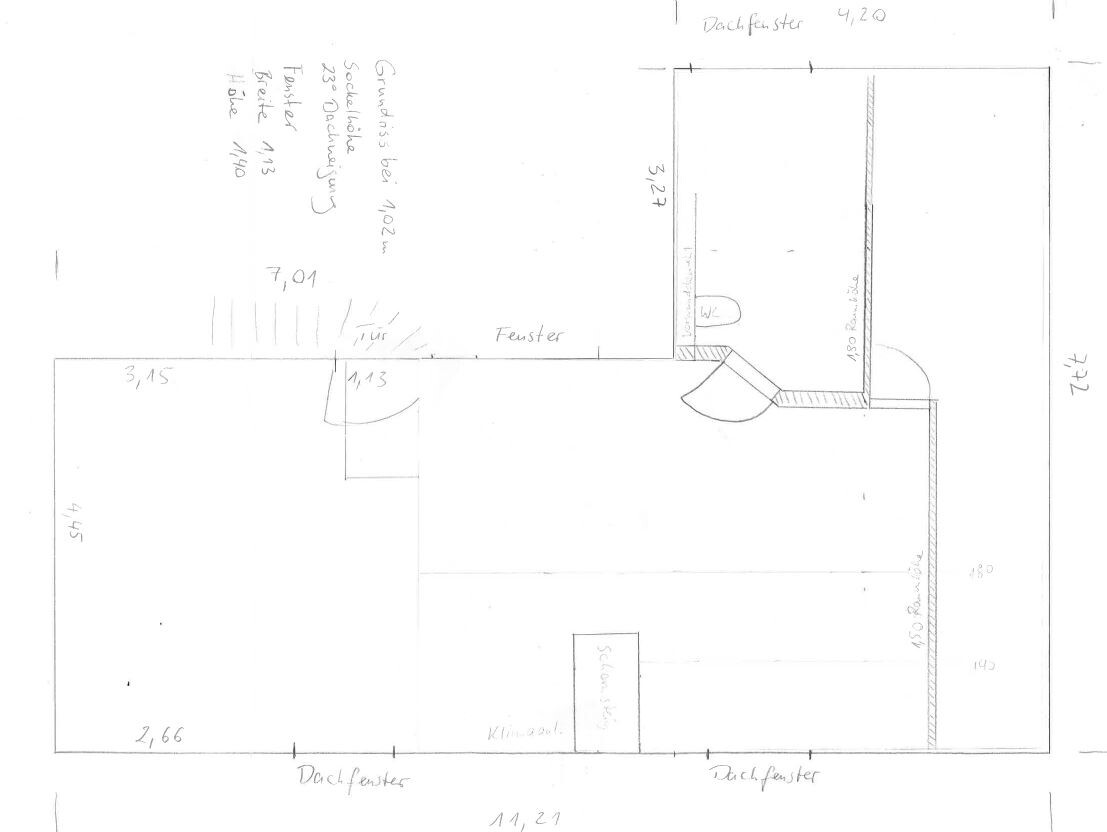
my parents-in-law, my wife, and I are undertaking a major project to divide a terraced house into two units: one for the seniors in the basement and one for the younger generation, expecting a child, on the raised ground floor and attic. The conservatory, guest toilet, laundry room, workshop, heating system (located in the basement, top right), and sauna will be shared areas.
The attic has a floor area of 74 sqm (795 sq ft) with a base height of 1.02 m (3 ft 4 in) and a roof pitch of 23°, so there is not much space with a height over 1.8 m (6 ft). Access is from the conservatory via an open staircase.
So far, only the supply and waste pipes as well as the heating pipes run through the area where I have marked the toilet. Except for the chimney, the room is completely open.
We plan to install our bathroom where the pipes come up from the basement (our bed will be placed in the bottom right corner, and a workspace will be created on the left). Below the roof window, there will be a bathtub (my wife takes a bath every other day), and a double sink will be installed on the right side on the recessed wall.
Now, the focus is on the hot water supply.
The simplest solution would be to connect the bathtub and sink to the hot water from the basement. However, since there is no circulation pipe installed, it would probably take a very long time to get hot water at the sink, as the pipe would be about 20 m (66 ft) long.
Therefore, we are considering installing an electric point-of-use water heater directly behind the sink (theoretically, a small instant water heater would be sufficient) but still using the hot water from the basement for the bathtub.
What do you think? Which type of hot water supply would be the most practical for our needs?
Best regards from
Babenhausen
my parents-in-law, my wife, and I are undertaking a major project to divide a terraced house into two units: one for the seniors in the basement and one for the younger generation, expecting a child, on the raised ground floor and attic. The conservatory, guest toilet, laundry room, workshop, heating system (located in the basement, top right), and sauna will be shared areas.
The attic has a floor area of 74 sqm (795 sq ft) with a base height of 1.02 m (3 ft 4 in) and a roof pitch of 23°, so there is not much space with a height over 1.8 m (6 ft). Access is from the conservatory via an open staircase.
So far, only the supply and waste pipes as well as the heating pipes run through the area where I have marked the toilet. Except for the chimney, the room is completely open.
We plan to install our bathroom where the pipes come up from the basement (our bed will be placed in the bottom right corner, and a workspace will be created on the left). Below the roof window, there will be a bathtub (my wife takes a bath every other day), and a double sink will be installed on the right side on the recessed wall.
Now, the focus is on the hot water supply.
The simplest solution would be to connect the bathtub and sink to the hot water from the basement. However, since there is no circulation pipe installed, it would probably take a very long time to get hot water at the sink, as the pipe would be about 20 m (66 ft) long.
Therefore, we are considering installing an electric point-of-use water heater directly behind the sink (theoretically, a small instant water heater would be sufficient) but still using the hot water from the basement for the bathtub.
What do you think? Which type of hot water supply would be the most practical for our needs?
Best regards from
Babenhausen
 Vicky Pedia28 Feb 2020 18:23
Is a circulation line from the basement really that complicated? I would prefer that. For a tankless water heater, you need a separate supply line. That doesn’t make it any easier. Alternatively, only a boiler (hot water storage tank).
B
Babenhausen29 Feb 2020 08:16Hello,
thank you for your reply.
The question is what makes more sense.
I asked a plumber for a quote. The circulation line with pump would cost about €600 (approximately $650).
However, we probably only use the bathroom in the morning to freshen up and in the evening to get ready for bed, so the pump would run all day, or the water temperature would be maintained continuously (hot water tank).
What do you mean by a separate supply line to the tankless water heater?
thank you for your reply.
The question is what makes more sense.
I asked a plumber for a quote. The circulation line with pump would cost about €600 (approximately $650).
However, we probably only use the bathroom in the morning to freshen up and in the evening to get ready for bed, so the pump would run all day, or the water temperature would be maintained continuously (hot water tank).
What do you mean by a separate supply line to the tankless water heater?

An electric instantaneous water heater also requires a dedicated power supply and must be registered with the utility provider, depending on its capacity. You can also handle the entire water supply upstairs with this device. A circulation pump can be controlled by a timer as well. I would not install both—either one or the other.
Vicky Pedia29 Feb 2020 16:58The tankless water heater is not getting any cheaper either. So, the circulation option isn’t such a bad choice after all.
Similar topics