
Since we are currently planning the plumbing, I brought up the topic of backflow preventers. We have three points in the basement where wastewater is discharged outside. For some reason, they didn’t channel everything to one location...
The plumber says that backflow preventers are not planned for our system. Apparently, they are only required if rainwater is also discharged into the sewer system. In our case, this is not allowed, meaning only wastewater goes into the sewer.
Since we are building in a flood-prone area, I believe it is still possible that water could back up through the sewer system.
What do you think? Wouldn’t I need backflow preventers after all?
The plumber says that backflow preventers are not planned for our system. Apparently, they are only required if rainwater is also discharged into the sewer system. In our case, this is not allowed, meaning only wastewater goes into the sewer.
Since we are building in a flood-prone area, I believe it is still possible that water could back up through the sewer system.
What do you think? Wouldn’t I need backflow preventers after all?

wrobel schrieb:
If drains are located below the backflow level, a lifting system is mandatory. As far as I have been told, this is not necessary. If the backwater valve is closed, no wastewater should be discharged below that level. As long as there is still a toilet above the backflow level, a lifting system is not required; an electric backwater valve is sufficient.
toxicmolotow schrieb:
And as shown in the last diagram, this is not allowed. In my opinion (as a layperson), the barrier must be between the drain in the basement (KG) and the incoming pipes from above. //EDIT: There is actually no backwater valve installed in that setup, so it functions as shown. However, pipes are needed that first go upwards and then downwards.
Alternatively, with a backwater valve: Separate wastewater pipes must lead to the sewer—one for below the backflow level and one for above it. This ensures continuous drainage above the backflow level and inflow below.
T
toxicmolotof24 Jan 2018 19:49Exactly what Uwe is saying is what I mean.
The company Kessel has created a clear diagram for this.
I see exactly that problem in the diagram, because the pipe continues upward right at the washing machine connection.
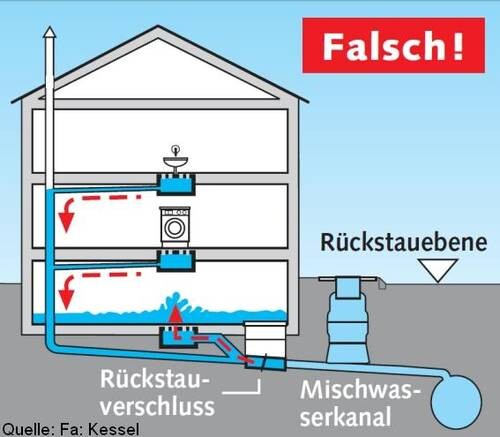
The company Kessel has created a clear diagram for this.
I see exactly that problem in the diagram, because the pipe continues upward right at the washing machine connection.

wrobel schrieb:
If drains are located below the backwater level, a sewage lifting station is mandatory.
OlliHello,
I’m quoting myself again. This is what really matters.
In this regard, Toxi is not entirely wrong; it would definitely be better to connect the drain lines from the ground floor and upper floor separately and independently of the basement to the inspection chamber. In case of a blockage or backflow between the house and the chamber, both lines can then operate independently.
If you take another close look at the first sketch, you can see that the water from the basement is pumped above the backwater level (the pipe bend visible on the ground floor). If you imagine filling the chamber with water, you’ll notice that water first flows out of the top of the chamber before it can run back into the basement through the bend.
Only this way—and no other—is the installation professionally correct.
Olli
T
toxicmolotof25 Jan 2018 20:32That's right, the picture at the top shows a small sewage lifting unit installed. In this case, it would also be acceptable without a backwater valve.
wrobel schrieb:
I’m quoting myself again.
That’s what really counts. Then, in this housing development, almost every building would be non-compliant. Because every basement has an electric backwater valve, but none has a lift station.
What just occurred to me that we also need to consider: Wrobel is, of course, correct in this case—if the sewer invert level is above the drains, so the wastewater can’t flow by gravity, then a lift station is necessary. But as long as gravity drainage is ensured and the other conditions (toilets, etc.) are met, a backwater valve is sufficient.

Similar topics