
Hello everyone,
We renovated an older building to a KfW-55 standard house (on paper). In reality, it almost meets KfW-40.
Today, the tenant in the attic informed us that the room temperature is about 31°C (88°F). During the renovation, we already made provisions (empty conduits, connections...) for an air conditioning system.
How large would you size an air conditioner? Attached is a floor plan of the attic. Living room = 26m² (280 sq ft) with a volume of 70m³ (2,470 cu ft), where the partial wall in the hallway does not reach the ceiling due to the sloped roof. This allows air circulation to the hallway and kitchen.
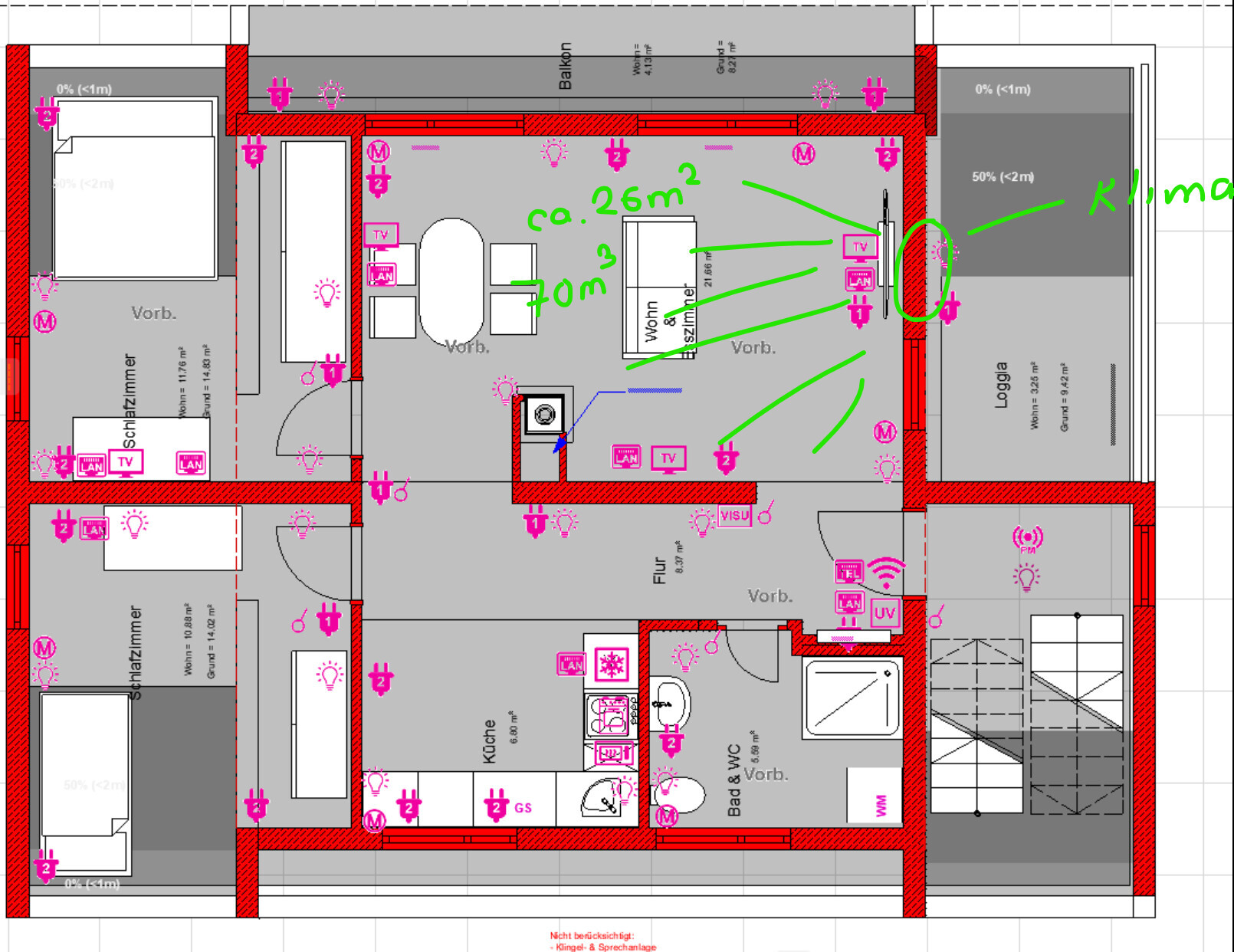
I have noted the following performance differences in Bosch air conditioning units:
Climate 3000 26WE
Design cooling capacity 2.8 kW
SCOP (Seasonal Coefficient of Performance) moderate climate 4.1
Nominal airflow (indoor) 520 Nm³/h
Climate 3000 35WE
Design cooling capacity 3.6 kW
SCOP moderate climate 4.2
Nominal airflow (indoor) 530 Nm³/h
Climate 3000 53WE
Design cooling capacity 5.3 kW
SCOP moderate climate 4.0
Nominal airflow (indoor) 800 Nm³/h
Climate 8000 35WE
Design cooling capacity 3.5 kW
SCOP moderate climate 5.1
Nominal airflow (indoor) 851 Nm³/h
We renovated an older building to a KfW-55 standard house (on paper). In reality, it almost meets KfW-40.
Today, the tenant in the attic informed us that the room temperature is about 31°C (88°F). During the renovation, we already made provisions (empty conduits, connections...) for an air conditioning system.
How large would you size an air conditioner? Attached is a floor plan of the attic. Living room = 26m² (280 sq ft) with a volume of 70m³ (2,470 cu ft), where the partial wall in the hallway does not reach the ceiling due to the sloped roof. This allows air circulation to the hallway and kitchen.
I have noted the following performance differences in Bosch air conditioning units:
Climate 3000 26WE
Design cooling capacity 2.8 kW
SCOP (Seasonal Coefficient of Performance) moderate climate 4.1
Nominal airflow (indoor) 520 Nm³/h
Climate 3000 35WE
Design cooling capacity 3.6 kW
SCOP moderate climate 4.2
Nominal airflow (indoor) 530 Nm³/h
Climate 3000 53WE
Design cooling capacity 5.3 kW
SCOP moderate climate 4.0
Nominal airflow (indoor) 800 Nm³/h
Climate 8000 35WE
Design cooling capacity 3.5 kW
SCOP moderate climate 5.1
Nominal airflow (indoor) 851 Nm³/h
Addition: I found the following in the technical appendix (TAB) of our distribution system operator:
We already have a heat pump (7 kW) for the entire building (3-family house) prepared for controllable consumption. This means any additional air conditioning system would need to be registered and set up or prepared to be switchable. (Whether this is easy to implement, I would need to discuss with my electrician. Most likely, a cable for switching on and off would have to be laid from the apartment’s sub-distribution panel to the basement (technical room/main distribution panel).)
The following are considered controllable consumption units (SteuVE):
with a connection capacity of more than 4.2 kW.
- Private charging points for electric vehicles (EVs) without publicly accessible charging points according to § 2 No. 5 of the Charging Station Ordinance (LSV)
- Heat pump heating systems, including supplementary or emergency heating devices (e.g., heating rods)
- Room cooling systems (ARK / air conditioning units) classified by type of system as defined by BNetzA BK6-22-300
- Electrical energy storage systems (battery storage)
Heat pump heaters and air conditioning units connected to the same grid connection that exceed a total of 4.2 kW for several devices of the same type are treated as one controllable consumption unit.
Example: In a multi-family house with three owners, each owns a 2.5 kW air conditioner; the total is 7.5 kW and is considered one SteuVE under §14a.
Consumption units with 4.2 kW or less must still be reported in the grid’s ODR and are not allowed to participate in the regulation according to §14a EnWG.
We already have a heat pump (7 kW) for the entire building (3-family house) prepared for controllable consumption. This means any additional air conditioning system would need to be registered and set up or prepared to be switchable. (Whether this is easy to implement, I would need to discuss with my electrician. Most likely, a cable for switching on and off would have to be laid from the apartment’s sub-distribution panel to the basement (technical room/main distribution panel).)
I have two air conditioning units in the house (150m² (1,615 sq ft)). One is in the open-plan living and dining area on the ground floor (2.5kW cooling capacity), and the other is in the hallway on the upper floor (3.5kW cooling capacity). I turn them on fairly early and let them run at the lowest setting throughout the day. At night, I switch them off. It feels like the smallest unit should be sufficient. The challenge is more likely to be air distribution, which will probably require additional fans. Upstairs, I always have a fan running that pushes the cold air from the hallway into the rooms.
Keep in mind that the power ratings refer to cooling capacity. The electrical power consumption, which your energy provider is interested in, is significantly lower.
Keep in mind that the power ratings refer to cooling capacity. The electrical power consumption, which your energy provider is interested in, is significantly lower.
Michilo schrieb:
The air distribution is more likely to cause problems How should this nominal airflow be interpreted?
Michilo schrieb:
Keep in mind that the specification refers to the cooling capacity. The electrical power consumption, which your utility provider is concerned with, is considerably lower. The datasheet states:
Specified cooling capacity at indoor air temperature 27(19) °C (80.6(66.2) °F) and outdoor air temperature 35 °C (95 °F) = 3.5 kWnetzplan schrieb:
How should this nominal air flow be interpreted?I'm not exactly sure. My guess is that it refers to the airflow passing through the indoor unit per hour. What I meant is the air distribution within the building/apartment. For the lower bedroom, there will probably need to be a fan in the door to achieve the same temperature as in the living area. It will be cooler even without that, just not as cold as directly by the air conditioner.
netzplan schrieb:
The datasheet says:You shouldn’t use the brochure, but rather the installation manual, which distinguishes between nominal cooling capacity, nominal heating capacity, and maximum power consumption. The maximum power consumption is what your energy supplier is interested in.Together with the heat pump, you will exceed 4.2 kW. The heat pump will have an electric heating element and will exceed the limit on paper by itself.
Michilo schrieb:
Don’t use the brochure, but the installation manual, which differentiates between nominal cooling capacity, nominal heating capacity, and maximum power consumption. The maximum power consumption is what your utility provider is interested in. How should the power consumption of the 8000 series (3.5 kW (3.5 kW)) be understood?
Power consumption at nominal capacity (3.5 kW (3.5 kW)) = 780 W
Power output (min–max) 0.9–4.2 kW (even more than 3.5 kW)
Maximum power consumption = 2000 W (i.e., when it likely operates above nominal capacity)
This would mean that such an air conditioning unit could even be protected with a 3-phase 1.5 mm² (AWG 16) cable and a 10 A fuse.
Similar topics