
 askforafriend18 Feb 2022 14:57
Hi everyone,
I’m starting a general discussion thread about Habeck’s photovoltaic Easter package. We are currently in the new construction phase and are considering waiting until all the details are clear. If it becomes interesting, do you have any information—or would you start right away? Without higher self-consumption, the topic of photovoltaics is becoming less and less attractive. I’ll quote an article on the subject:
“For private new builds, the coalition government aims to make the installation of photovoltaic systems standard. To this end, Habeck promised better funding rates and simplified use of photovoltaics.”
At first, I thought the Easter package mainly referred to commercial systems, but apparently, there is also support available for private homeowners.
I’m starting a general discussion thread about Habeck’s photovoltaic Easter package. We are currently in the new construction phase and are considering waiting until all the details are clear. If it becomes interesting, do you have any information—or would you start right away? Without higher self-consumption, the topic of photovoltaics is becoming less and less attractive. I’ll quote an article on the subject:
“For private new builds, the coalition government aims to make the installation of photovoltaic systems standard. To this end, Habeck promised better funding rates and simplified use of photovoltaics.”
At first, I thought the Easter package mainly referred to commercial systems, but apparently, there is also support available for private homeowners.
W
WilderSueden18 Feb 2022 15:22As long as nothing official has been announced, planning will be difficult.
It is basically decided that photovoltaic systems will be mandatory when building new or replacing a roof. I would expect a regulation similar to the one in Baden-Württemberg. So, anyone finishing in about two years should definitely plan for photovoltaic installation.
Otherwise, I’m hoping the feed-in tariff will increase somewhat. It is currently moving toward unprofitability, and even additional self-consumption with larger systems won’t change that much. We are building a system with over 40 panels plus a 6 kWh battery, and I expect the battery will rarely be empty during the summer months. Therefore, extra capacity probably won’t increase self-consumption significantly. Winter will probably be different, but I’m a bit skeptical there as well. On sunny days, we should have more than enough solar gains, so not much will go to the heat pump. Whether I choose 6 or 10 kWp will likely not make much difference for self-consumption.
In any case, I plan to investigate the cost of expanding the system and then decide. The economics of self-consumption are quite different now with electricity prices around 50 cents per kWh compared to the 30 cents I originally calculated...
Alternatively, I’m also considering fully equipping the carport with photovoltaic panels. This would give me two new orientations and make a later retrofit less complicated since no full scaffolding would be needed.
It is basically decided that photovoltaic systems will be mandatory when building new or replacing a roof. I would expect a regulation similar to the one in Baden-Württemberg. So, anyone finishing in about two years should definitely plan for photovoltaic installation.
Otherwise, I’m hoping the feed-in tariff will increase somewhat. It is currently moving toward unprofitability, and even additional self-consumption with larger systems won’t change that much. We are building a system with over 40 panels plus a 6 kWh battery, and I expect the battery will rarely be empty during the summer months. Therefore, extra capacity probably won’t increase self-consumption significantly. Winter will probably be different, but I’m a bit skeptical there as well. On sunny days, we should have more than enough solar gains, so not much will go to the heat pump. Whether I choose 6 or 10 kWp will likely not make much difference for self-consumption.
In any case, I plan to investigate the cost of expanding the system and then decide. The economics of self-consumption are quite different now with electricity prices around 50 cents per kWh compared to the 30 cents I originally calculated...
Alternatively, I’m also considering fully equipping the carport with photovoltaic panels. This would give me two new orientations and make a later retrofit less complicated since no full scaffolding would be needed.

If you are building with a heat pump, whether an air-source heat pump or a ground-source heat pump, I would always recommend installing a photovoltaic system. I have never regretted getting one. Even recently, it provided power for my house for almost 24 hours straight on three separate days. 😎
askforafriend18 Feb 2022 16:03Well, I definitely want one for the reason "I want to have one because it’s kind of cool and, above all, sustainable." It’s just that right now, I don’t have any obligation (KFW55 standard), and we also use district heating (no heat pump). The only leverage would be a future electric vehicle. So, I will wait and see what happens. Do you really think the feed-in tariff will be adjusted?
B
Benutzer20018 Feb 2022 16:13Due to the continuous expansion of photovoltaic systems (with the initial country-specific obligations), I do not expect feed-in tariffs to increase. Why would they? Otherwise, it would again be an unnecessary subsidy.
Considering the current price structure (electricity prices, photovoltaic system costs), a photovoltaic system is always profitable nowadays and especially with a view to the future (self-consumption, e-mobility). There is also a good photovoltaic thread on this topic in the Enpal forum.
https://www.hausbau-forum.de/threads/wer-hat-erfahrung-mit-der-anschaffung-einer-enpal-pv-anlage.42163/#post-556862
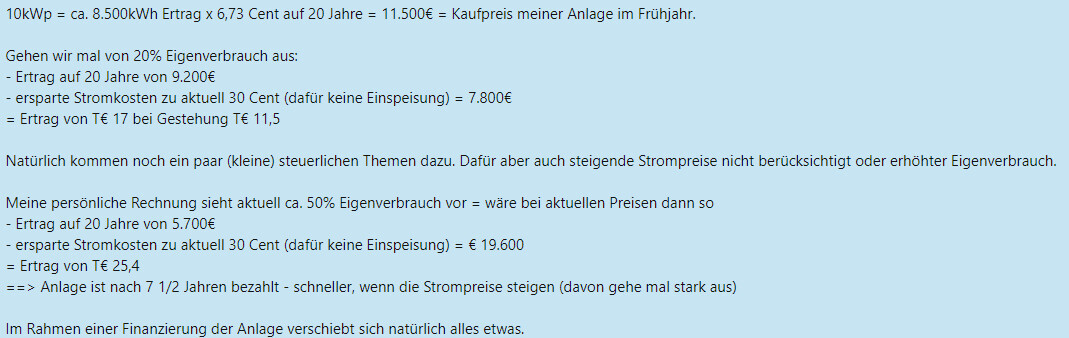
Try calculating the first option with electricity costs at 50 cents per kWh...
Then you don’t need any subsidies anymore.
Considering the current price structure (electricity prices, photovoltaic system costs), a photovoltaic system is always profitable nowadays and especially with a view to the future (self-consumption, e-mobility). There is also a good photovoltaic thread on this topic in the Enpal forum.
https://www.hausbau-forum.de/threads/wer-hat-erfahrung-mit-der-anschaffung-einer-enpal-pv-anlage.42163/#post-556862
Try calculating the first option with electricity costs at 50 cents per kWh...
Then you don’t need any subsidies anymore.

Interesting thread in the Enpal forum!
I think it would make sense (and is long overdue) to significantly reduce all the bureaucracy. Private rooftop photovoltaic systems up to 30kWp VAT exempt (or at a reduced rate), no VAT accounting, no income surplus calculation (EÜR), a straightforward feed-in tariff, and simple options for tenant electricity would be almost everything needed.
However, given the increasing complexity that has now become almost a natural law in Germany, I am only cautiously optimistic.
I think it would make sense (and is long overdue) to significantly reduce all the bureaucracy. Private rooftop photovoltaic systems up to 30kWp VAT exempt (or at a reduced rate), no VAT accounting, no income surplus calculation (EÜR), a straightforward feed-in tariff, and simple options for tenant electricity would be almost everything needed.
However, given the increasing complexity that has now become almost a natural law in Germany, I am only cautiously optimistic.
Similar topics