
Hello everyone,
I need your help. We have the problem that we can’t get our bathroom properly warm. Due to the small underfloor heating area in the bathroom, three additional wall heaters were installed. Still, we can’t get the temperature above about 21 degrees Celsius (70°F). The calculation was based on 24 degrees Celsius (75°F). I have already switched off the EER and set the flow rate to the maximum (3 liters per minute). All other rooms easily reach their target temperature and are sometimes already at the minimum flow rate.
Do you have any other ideas on what could be done?
Thank you very much and best regards
I need your help. We have the problem that we can’t get our bathroom properly warm. Due to the small underfloor heating area in the bathroom, three additional wall heaters were installed. Still, we can’t get the temperature above about 21 degrees Celsius (70°F). The calculation was based on 24 degrees Celsius (75°F). I have already switched off the EER and set the flow rate to the maximum (3 liters per minute). All other rooms easily reach their target temperature and are sometimes already at the minimum flow rate.
Do you have any other ideas on what could be done?
Thank you very much and best regards
EdelStoff schrieb:
This is roughly what it looks like, only the pipes for the wall heating are thinner and have a separate circuit:
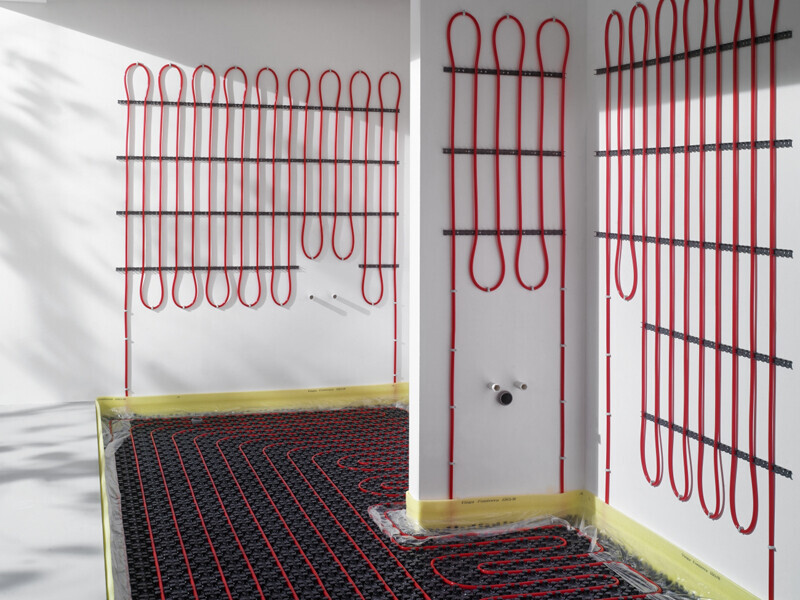
Why only roughly? Is this your bathroom or not?
It seems very "neat" to me.
So: flow rates and dimensions?
Flow rates and temperatures (supply/return) at the manifold of all bathroom heating circuits. (Ideally for the entire house. Heating curve, settings, etc.)
E
EdelStoff9 Dec 2021 09:53Mycraft schrieb:
Perform a hydraulic balancing and don’t just adjust the heating circuits randomly. Doing otherwise can mess up the entire hydraulics and nothing will get warm.
The heating circuit pump might also not be delivering the required flow rates.
Do you have individual room controllers? If so, disconnect them or open all of them, then perform the hydraulic balancing. The individual room controllers are all disconnected. Could you explain how to perform hydraulic balancing?
face26 schrieb:
Have you double-checked with a different thermometer?
Is the thermostat mounted on an exterior or interior wall?
At what height?
Have you measured at another location?
Your question is quite valid. The thermometer is placed on the T-wall (interior wall) at about 1.50m (5 feet). I also measured with other thermometers, and the result is always the same.
driver55 schrieb:
He already did that with the wall heating…
What are the dimensions of the heating loops? Diameter and wall thickness? (Like drinking straws?) Yes, the wall heating uses thinner pipes (like drinking straws) than those for the underfloor heating. The underfloor heating pipes are 17x2mm (17x0.08 inches).
driver55 schrieb:
Why only approximate? Is this your bathroom or not?
It seems very limited to me.
So: design flow rates and dimensions?
Flow rates and temperatures (supply/return) at the manifold of all bathroom heating circuits. (Preferably for all in the house. Heating curve, settings, etc.) No, this is not my bathroom. Unfortunately, I couldn’t find a picture of our bathroom quickly. The design flow rate is 10cm (4 inches).
Heating curve is 0.35
Room setpoint 22°C (72°F)
Parallel shift 0
When you say supply/return temperature, do you mean measured with an infrared thermometer at the manifold?

EdelStoff schrieb:
All the EERs are disconnected. Can you also explain how to perform a hydraulic balancing?Forget the idea that the heat pump heats individual rooms separately.Imagine your entire house with its rooms as one large water circuit.
Each room has an adjustable inlet that controls how much water flows through it in a certain time.
The whole circuit is heated to a certain temperature.
To bring a room to the desired temperature, you need to let in a specific amount of water depending on the room size.
If all rooms were the same size, this would be simple—you’d just let the same amount of water in everywhere.
But since rooms are always different sizes, you have to adjust the amount of water accordingly for each room.
You control this via the inlet (manifold for the underfloor heating, where you can set the flow rate).
Unfortunately, some rooms can’t receive enough water to reach the desired temperature (usually bathrooms, because they are small and require higher temperatures).
You can either create space for more water (by reducing pipe spacing or using wall heating) or increase the water temperature.
Increasing the temperature (this is the well-known flow temperature) delivers the needed heat to the bathroom but also raises the temperature in the other rooms.
So, you have to reduce the water volume there until you reach your desired temperature.
This process is called hydraulic balancing.
Now, there is the issue that at low outside temperatures, the heat output may no longer be sufficient.
You might be tempted to increase the water volume in every room, but then you have to adjust everything precisely again, plus you’re limited by smaller rooms that can’t handle more water.
However, our heating system knows from the outdoor sensor when the temperature drops outside.
So, it raises the flow temperature to compensate.
Since all rooms were previously adjusted to their proper temperature during hydraulic balancing, this works effectively.
This is the heating curve of the system, which specifies how much the flow temperature must change when the outside temperature changes.
This is a simplified explanation but represents the basic principle.
EdelStoff schrieb:
VLA is 10cm (4 inches).
Heating curve is 0.35
Room target temperature 22°C (72°F)
Parallel shift 0
By temperature VR/return flow do you mean measured with an IR thermometer at the heating circuit valve? Sorry, those details can’t be correct! You’d have more of a sauna than a “cold” bathroom!
(If the corresponding flow rates are present)
At 0°C (32°F) outdoor temperature, with 0.35/22 settings you’re already running at 35°C (95°F)!
Regarding the question: Yes.
E
EdelStoff9 Dec 2021 10:25Thank you for the detailed response.
I have roughly tried the same approach. For example, the living room is already set to 1.25 l/min (0.25 l/min x 5 heating circuits); it’s hardly possible to reduce it further. I have also throttled the rooms that tend to be too warm. Should I lower the heating curve instead and then perform the thermal balancing again?
What exactly is hydraulic balancing? Where can I check it?
I have roughly tried the same approach. For example, the living room is already set to 1.25 l/min (0.25 l/min x 5 heating circuits); it’s hardly possible to reduce it further. I have also throttled the rooms that tend to be too warm. Should I lower the heating curve instead and then perform the thermal balancing again?
What exactly is hydraulic balancing? Where can I check it?
E
EdelStoff9 Dec 2021 10:36driver55 schrieb:
Sorry, the data can’t be correct! You would have a sauna, not a “cold” bathroom!
(If the corresponding flow rates are present)
Regarding the question: Yes. HKV:
Bathroom supply 26°C (79°F) return 23.4°C (74°F)
Wall supply 25.4°C (78°F) return 22.8°C (73°F)
I find it strange that there were quite significant fluctuations recently. I also recorded a measurement with bathroom supply at 27°C (81°F). Of course, it could also be due to the infrared thermometer. According to the heating system, the supply should be 29.1°C (84°F).
Similar topics