
Hello everyone,
I need your help. We have the problem that we can’t get our bathroom properly warm. Due to the small underfloor heating area in the bathroom, three additional wall heaters were installed. Still, we can’t get the temperature above about 21 degrees Celsius (70°F). The calculation was based on 24 degrees Celsius (75°F). I have already switched off the EER and set the flow rate to the maximum (3 liters per minute). All other rooms easily reach their target temperature and are sometimes already at the minimum flow rate.
Do you have any other ideas on what could be done?
Thank you very much and best regards
I need your help. We have the problem that we can’t get our bathroom properly warm. Due to the small underfloor heating area in the bathroom, three additional wall heaters were installed. Still, we can’t get the temperature above about 21 degrees Celsius (70°F). The calculation was based on 24 degrees Celsius (75°F). I have already switched off the EER and set the flow rate to the maximum (3 liters per minute). All other rooms easily reach their target temperature and are sometimes already at the minimum flow rate.
Do you have any other ideas on what could be done?
Thank you very much and best regards

EdelStoff schrieb:
What exactly is hydraulic balancing? Where can I check it?Hydraulic balancing is the rough adjustment.Thermal balancing is then the fine-tuning of the system, specifically tailored to you as the occupant. The heating technician simply cannot know all your preferences in advance, so they can’t set everything 100% perfectly. They do about 90%, and you have to handle the remaining 10% (or hire someone to do it).
With hydraulic balancing, you compensate for different pipe lengths in the heating circuits, which cause varying resistances and uneven supply. Shorter circuits tend to flow more due to lower resistance; the heating water releases less heat over the short distance and returns at a temperature only slightly lower than the supply temperature. This reduces the overall temperature difference (delta T). This issue is especially problematic for non-modulating heat pumps and return-water controlled heat pumps—commonly referred to as “short cycling.” With perfect hydraulic balancing, the longest circuits are fully open, and the shorter ones are throttled so that all circuits have very similar return temperatures.
The calculation of hydraulic balancing also includes thermal balancing, since target room temperatures are factored into the calculation. However, many errors inevitably creep into the calculation.
Hydraulic balancing merely ensures that each circuit receives the proper flow (since multiple circuits may be in one room, with some being under- and others over-supplied). The calculation results provide the basic settings for each circuit—so it’s obvious that some inaccuracies occur and some fine adjustments will be necessary here and there.
The whole process is quite time-consuming anyway. If you significantly change the flow rates, you need to wait and measure for 2 to 3 days before the effects are fully visible. During this time, solar gains (including from other rooms) should not distort the results; otherwise, it takes even longer. If you can shorten this process substantially through some preliminary calculations (hydraulic balancing), it is very helpful.
H
hampshire9 Dec 2021 10:47Mycraft schrieb:
This is a simplified representation that illustrates the basic function. This is currently the best and most easily understandable explanation available online. Thank you (even though this knowledge does not have a practical application in my house).
@EdelStoff
I understand it this way: Unfortunately, your heating system is either poorly implemented or there is a fault. If your house is already quite warm but the bathroom remains too cold despite the flow being set to maximum, the only way to warm up the bathroom is by increasing the supply temperature and reducing the flow to all other rooms. This is an awkward and inefficient solution.
Here is what I would do:
- Report the system as "faulty" to the heating technician because the bathroom is not getting warm enough. Avoid showing any background knowledge or speculating. The message should be: The bathroom is too cold. Please ensure it gets warm.
- Prepare for the possibility that there is no actual fault and no good solution exists (without accepting this to the technician too quickly—let them come up with ideas).
- Set a priority: whether I want to run the entire heating system less efficiently or install an additional heat source in the bathroom after careful consideration, or cope with the lower temperatures.
- I would be reluctant to pay in full for a poorly designed heating system. This would require further discussion—and possibly have the heating technician cover the cost of an additional heater with an attractive design. (We have an Eve from Tubes that we can control by time to locally produce a few extra degrees. It provides nice lighting and looks good but is not very quiet. It is rarely used, sometimes in the bathroom.)

Well, the idea with the straws doesn’t sound very effective at first. The heat output isn’t optimal.
Do you have any data on the wall elements? Length, diameter, or even a room-by-room heating load calculation showing how much output they are supposed to provide?
The concern would be that the tubes don’t deliver enough heat output. But if the bathroom was specified to be heated to 24°C (75°F), then it would be a design or planning mistake.
So I agree with [USER=46205]@hampshire that if nothing obviously wrong is going on, the heating engineer should be the point of contact.
Do you have any data on the wall elements? Length, diameter, or even a room-by-room heating load calculation showing how much output they are supposed to provide?
The concern would be that the tubes don’t deliver enough heat output. But if the bathroom was specified to be heated to 24°C (75°F), then it would be a design or planning mistake.
So I agree with [USER=46205]@hampshire that if nothing obviously wrong is going on, the heating engineer should be the point of contact.
E
EdelStoff9 Dec 2021 11:01@Mycraft Thanks a lot, I understand that.
@face26
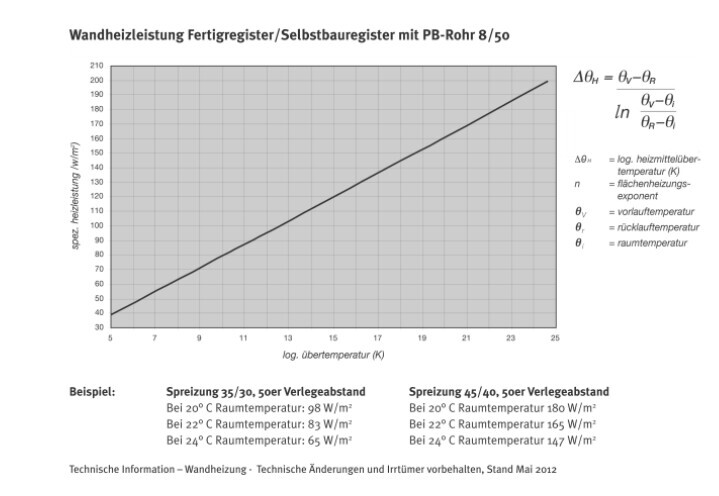
Unfortunately, this is the only information I could find about the wall heating elements.
@hampshire
Yes, the supply temperature could be an option, but I’m reluctant to increase it. It feels like it might be better to lower the supply temperature and increase the flow rate instead. The other rooms are all fine.
Okay, so you also think something is off and that I should contact the heating installer. Should I reset everything first and then write to the heating installer?
@face26
Unfortunately, this is the only information I could find about the wall heating elements.
@hampshire
Yes, the supply temperature could be an option, but I’m reluctant to increase it. It feels like it might be better to lower the supply temperature and increase the flow rate instead. The other rooms are all fine.
Okay, so you also think something is off and that I should contact the heating installer. Should I reset everything first and then write to the heating installer?
E
EdelStoff9 Dec 2021 12:43ypg schrieb:
Maybe the flow-through cylinder is swapped?Interesting idea. I will turn off the bathroom circuit and see what happens.Similar topics