
ᐅ House with 180 m² => RecoVair VAR 260/4 or better 360/4?
Created on: 7 Jul 2018 12:01
C
Christian NW
Hello everyone.
Our new build will have exactly 181 m² (1,950 sq ft) of living space.
According to the specifications, the Vaillant recoVair VAR 260/4 (up to 190 m² / 2,045 sq ft) should be sufficient. However, we are wondering if it might still make sense to choose the larger model (RecoVair VAR 360/4, up to 290 m² / 3,120 sq ft)?
1. Would the larger unit possibly operate more quietly because it would run under less load?
2. What about the electricity consumption?
... What do you think?
Our new build will have exactly 181 m² (1,950 sq ft) of living space.
According to the specifications, the Vaillant recoVair VAR 260/4 (up to 190 m² / 2,045 sq ft) should be sufficient. However, we are wondering if it might still make sense to choose the larger model (RecoVair VAR 360/4, up to 290 m² / 3,120 sq ft)?
1. Would the larger unit possibly operate more quietly because it would run under less load?
2. What about the electricity consumption?
... What do you think?


OWLer schrieb:
What is your room volume and what air exchange rate are you aiming for? The datasheet states a maximum airflow of 260 m³ (9,180 ft³). I would need to ask specifically 🙂 I will provide that later.
I keep coming back to the same question 😉
We have 579m³ (20,440 cubic feet) of air volume to be ventilated before factoring in furniture and other objects displacing air, targeting a household of 4 people.
For the heating load calculation, an air exchange rate of 0.3 was assumed. That would mean 173m³/h (102 cubic feet per minute). This is within the normal range of the 260 model, which can be set to a nominal airflow between 115-200m³/h (68-118 cubic feet per minute). If I calculate 30m³ (18 cubic feet) per person, the recoVAIR 260/4 should cover this easily.
A party mode on turbo with 260m³/h (153 cubic feet per minute) would result in a maximum air exchange rate of less than 0.5.
The 360/4 E can be set in the menu between 175-280m³/h (103-165 cubic feet per minute). This would mean a minimum air exchange rate of 0.3 with hardly any upper limit.
However, the noise levels are quite similar. Assuming the larger system runs at level 1 while the smaller one would need to run at level 2, both devices would be equally loud. The smaller unit has a maximum of 59dB, whereas the larger one can reach up to 66dB.
@Yaso2.0 How did it turn out for you?
We have 579m³ (20,440 cubic feet) of air volume to be ventilated before factoring in furniture and other objects displacing air, targeting a household of 4 people.
For the heating load calculation, an air exchange rate of 0.3 was assumed. That would mean 173m³/h (102 cubic feet per minute). This is within the normal range of the 260 model, which can be set to a nominal airflow between 115-200m³/h (68-118 cubic feet per minute). If I calculate 30m³ (18 cubic feet) per person, the recoVAIR 260/4 should cover this easily.
A party mode on turbo with 260m³/h (153 cubic feet per minute) would result in a maximum air exchange rate of less than 0.5.
The 360/4 E can be set in the menu between 175-280m³/h (103-165 cubic feet per minute). This would mean a minimum air exchange rate of 0.3 with hardly any upper limit.
However, the noise levels are quite similar. Assuming the larger system runs at level 1 while the smaller one would need to run at level 2, both devices would be equally loud. The smaller unit has a maximum of 59dB, whereas the larger one can reach up to 66dB.
@Yaso2.0 How did it turn out for you?
Am I missing something... I had it calculated after all.
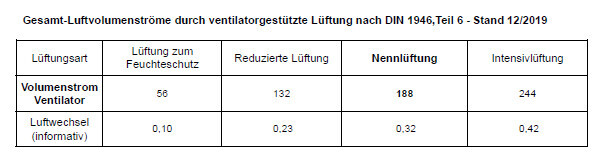
I think the small system will probably be sufficient for me. However, I will tell the heating engineer that I don’t need the enthalpy heat exchanger. At first, I will likely get moisture out of the building, and then I can buy an enthalpy exchanger in advance and install it if it gets too dry in winter.
I think the small system will probably be sufficient for me. However, I will tell the heating engineer that I don’t need the enthalpy heat exchanger. At first, I will likely get moisture out of the building, and then I can buy an enthalpy exchanger in advance and install it if it gets too dry in winter.

OWLer schrieb:
and then I buy an enthalpy exchanger as a spare and install it when it gets too dry in winter. Why bother? Just install it properly right away. Why pay twice? It can only recover a certain amount of moisture anyway. Any excess will be ventilated out, so you might as well install it from the start.
OWLer schrieb:
@Yaso2.0 How did it turn out for you?What exactly do you mean 😀
Similar topics