
K
Kimbasson17 Oct 2021 15:08Hello everyone,
this is our first post; until now, we have only been active readers.
We are planning a complete renovation of an old timber-framed house and want to start working outside first since we can only begin inside the house around December. Over the past two weekends, we have already removed a lot of overgrowth, such as small hazel trees and especially a huge tangle of blackberry thorns to even make the house accessible.
The current status is that the house is now accessible, but almost everywhere in front of the house, stumps and roots are still sticking out of the ground.
We are now considering the best approach. Our plan:
A) Remove and dig out all thorn roots, etc., before they grow back in the spring. How do you think we should proceed with this?
Our idea is to use an excavator (a friend can help us) to remove the top layer of soil (about 40cm (16 inches)?) along with as many roots and stumps as possible and transport it away. We are already wondering where the best and most cost-effective place to dispose of this would be.
Then we would dig out another 30cm (12 inches) and temporarily store the soil, which we hope is "good" and root-free, on our property because we will probably need it later for uneven areas and holes in a meadow that is also part of the property. Does this make sense, or will the soil up to one meter (3 feet) deep be full of blackberry roots that eventually grow back?
B) Create a construction site driveway or "parking area."
The street does not offer space to park in front of the house, so we urgently need a parking and storage area in front of the house. Here, we want to fill the excavated area with gravel. Later, most of this area will become a paved courtyard, so we can reuse a large portion of the gravel for that.
Does this seem reasonable to you, or do you have any tips and/or alternative solutions?
We look forward to all suggestions and advice!
Best regards, Kimbasson
this is our first post; until now, we have only been active readers.
We are planning a complete renovation of an old timber-framed house and want to start working outside first since we can only begin inside the house around December. Over the past two weekends, we have already removed a lot of overgrowth, such as small hazel trees and especially a huge tangle of blackberry thorns to even make the house accessible.
The current status is that the house is now accessible, but almost everywhere in front of the house, stumps and roots are still sticking out of the ground.
We are now considering the best approach. Our plan:
A) Remove and dig out all thorn roots, etc., before they grow back in the spring. How do you think we should proceed with this?
Our idea is to use an excavator (a friend can help us) to remove the top layer of soil (about 40cm (16 inches)?) along with as many roots and stumps as possible and transport it away. We are already wondering where the best and most cost-effective place to dispose of this would be.
Then we would dig out another 30cm (12 inches) and temporarily store the soil, which we hope is "good" and root-free, on our property because we will probably need it later for uneven areas and holes in a meadow that is also part of the property. Does this make sense, or will the soil up to one meter (3 feet) deep be full of blackberry roots that eventually grow back?
B) Create a construction site driveway or "parking area."
The street does not offer space to park in front of the house, so we urgently need a parking and storage area in front of the house. Here, we want to fill the excavated area with gravel. Later, most of this area will become a paved courtyard, so we can reuse a large portion of the gravel for that.
Does this seem reasonable to you, or do you have any tips and/or alternative solutions?
We look forward to all suggestions and advice!
Best regards, Kimbasson
The area should later become a courtyard, so your planning sounds good.
Regarding excavation, I wouldn’t do it that way. You are removing too much topsoil. What will be put back later?
I would remove the roots with an excavator and dispose of them. Green waste disposal is free, at least where I am.
Sift the soil and cover it until it is reused. Without light, most plant residues will die. However, so will the microorganisms and other soil life like earthworms.
If you want to add soil, only apply the first layer, otherwise, you will lose the soil. New soil is expensive and not free from weeds.
Regarding excavation, I wouldn’t do it that way. You are removing too much topsoil. What will be put back later?
I would remove the roots with an excavator and dispose of them. Green waste disposal is free, at least where I am.
Sift the soil and cover it until it is reused. Without light, most plant residues will die. However, so will the microorganisms and other soil life like earthworms.
If you want to add soil, only apply the first layer, otherwise, you will lose the soil. New soil is expensive and not free from weeds.
K
Kimbasson17 Oct 2021 15:42Hello haydee and thank you for your reply.
The area we are talking about will mostly become a paved courtyard and driveway later on – we expect the house to be finished in at least 1.5 years.
Hmm, if we don’t excavate much or at all, we save a lot of work and costs. I’m just concerned that many small roots might remain in the soil and eventually grow back through the surface, meaning we would have to redo it all again. Do you not see any risk if we pull out the larger roots and stumps and then just cover everything with a thick layer of gravel?
Below is a photo of the area in question. 🙂
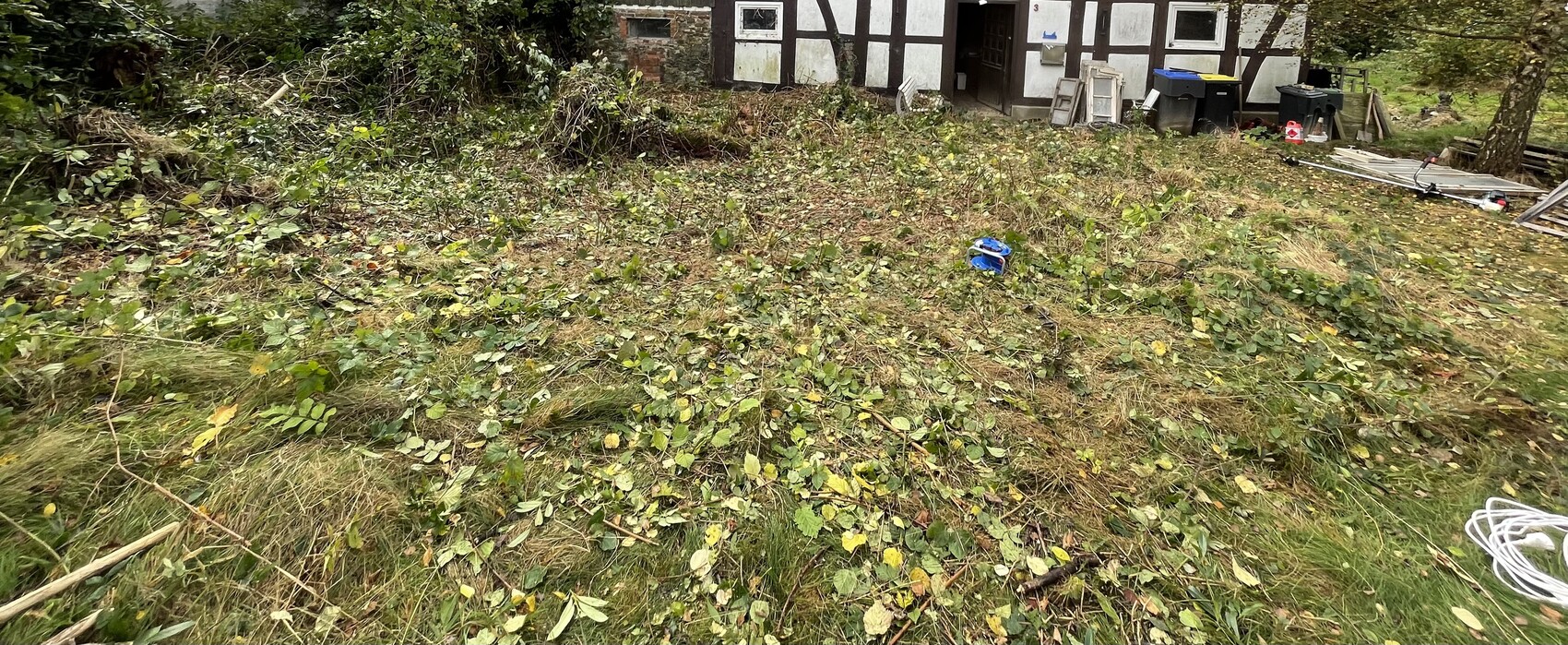
The area we are talking about will mostly become a paved courtyard and driveway later on – we expect the house to be finished in at least 1.5 years.
Hmm, if we don’t excavate much or at all, we save a lot of work and costs. I’m just concerned that many small roots might remain in the soil and eventually grow back through the surface, meaning we would have to redo it all again. Do you not see any risk if we pull out the larger roots and stumps and then just cover everything with a thick layer of gravel?
Below is a photo of the area in question. 🙂
Since you are not in a rush with the lawn and similar areas, I would only remove the stumps and all large debris.
In the area where you plan to plant later, I would lightly loosen the soil on the surface and sow a cover crop.
This germinates quickly, helps keep weeds under control, and improves the soil, or after freezing, supports humus formation.
As the final step, as usual, cultivate the topsoil and sow or plant.
In the paved area: This will need to be excavated anyway. Here, I would also roughly sieve the soil and temporarily store the topsoil, and if necessary, move it to your lawn at the end.
If there are indeed strong root weeds that can penetrate even compacted frost protection layers, there is certainly the option to install a geotextile fabric.
In the area where you plan to plant later, I would lightly loosen the soil on the surface and sow a cover crop.
This germinates quickly, helps keep weeds under control, and improves the soil, or after freezing, supports humus formation.
As the final step, as usual, cultivate the topsoil and sow or plant.
In the paved area: This will need to be excavated anyway. Here, I would also roughly sieve the soil and temporarily store the topsoil, and if necessary, move it to your lawn at the end.
If there are indeed strong root weeds that can penetrate even compacted frost protection layers, there is certainly the option to install a geotextile fabric.
The base area will be excavated anyway and compacted tightly and quite densely. Usually, new material is added on top. It’s generally not a problem underneath. If you want to be on the safe side, buy a thick geotextile fabric—not the thin stuff from the hardware store—and place it underneath.
A
allstar8317 Oct 2021 17:20If you start digging with an excavator now, you'll always have mud in front of the house.
Similar topics