
ᐅ KfW55 standard with air-to-water heat pump or ground-source heat pump and surface collector
Created on: 10 Aug 2017 17:07
J
JohnnySmithJ
JohnnySmith10 Aug 2017 17:07Hello,
Last year, we purchased a semi-detached house and are now in the final stages before starting the renovation and extension to achieve KFW55 energy efficiency standard.
We have a gas connection, but it will probably be difficult to meet KFW55 with it.
The KFW energy efficiency expert conducted a preliminary assessment using an air-to-water heat pump, and that works. However, I find a ground source heat pump more appealing.
The Geological Office Hamburg states the following:
"Based on nearby boreholes, the generalized soil layers are as follows: sand up to 1 meter (3 feet) depth, glacial till loam up to 3 meters (10 feet), sand up to 23 meters (75 feet), glacial marl (Drenthe main moraine) up to 30 meters (98 feet), and sand down to 60 meters (197 feet). It should be noted that about 300 meters (984 feet) away there is a shallow emergency drinking water well, filtered in the groundwater aquifer beneath the Drenthe main moraine. Due to the short distance, geothermal probe boreholes must not be drilled into this production horizon. The groundwater level is at approximately 7 meters (23 feet) depth; stagnant water is present from about 0.5 meters (1.5 feet) depth."
"The heat extraction performance of a horizontal collector is likely to be low because the stagnant water body occasionally dries out."
So only horizontal collectors are an option, though I am unsure because of the drying stagnant water body mentioned. The installation would probably need to be in the glacial till loam layer up to 3 meters (10 feet) deep.
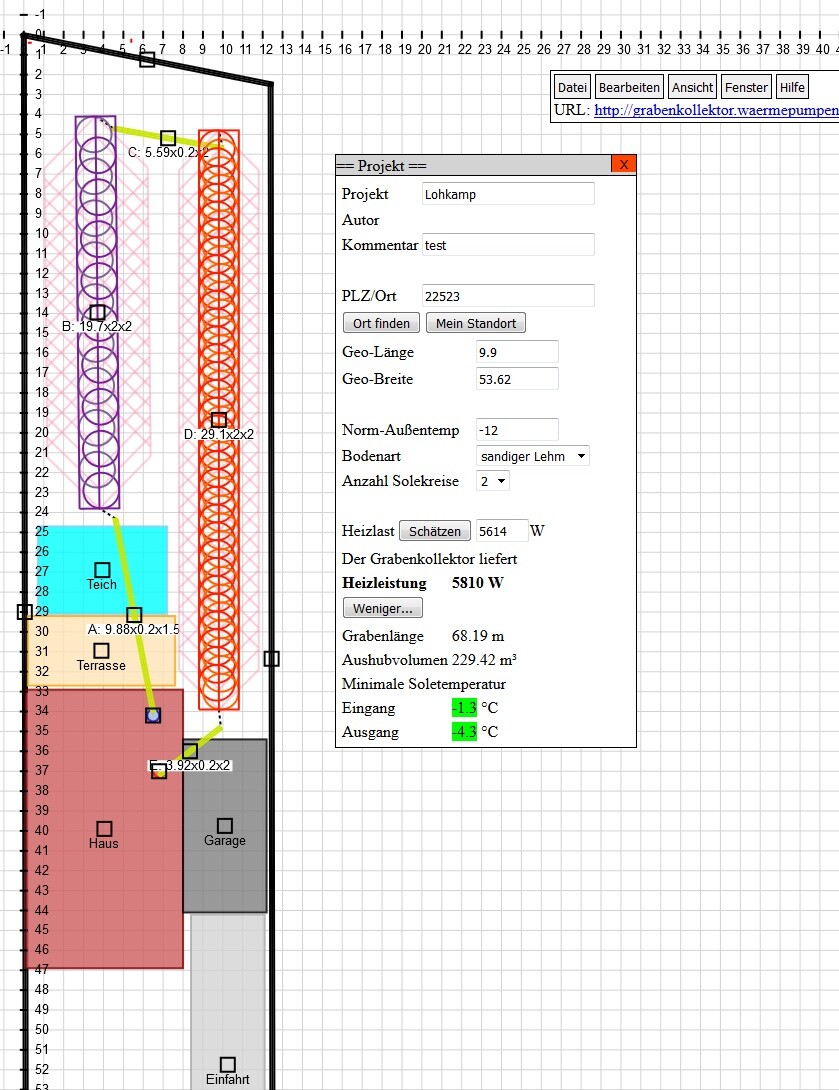
I have attached a rough sketch of how this could be implemented using a trench collector. Would this work as planned?
Best regards,
JohnnySmith
Last year, we purchased a semi-detached house and are now in the final stages before starting the renovation and extension to achieve KFW55 energy efficiency standard.
We have a gas connection, but it will probably be difficult to meet KFW55 with it.
The KFW energy efficiency expert conducted a preliminary assessment using an air-to-water heat pump, and that works. However, I find a ground source heat pump more appealing.
The Geological Office Hamburg states the following:
"Based on nearby boreholes, the generalized soil layers are as follows: sand up to 1 meter (3 feet) depth, glacial till loam up to 3 meters (10 feet), sand up to 23 meters (75 feet), glacial marl (Drenthe main moraine) up to 30 meters (98 feet), and sand down to 60 meters (197 feet). It should be noted that about 300 meters (984 feet) away there is a shallow emergency drinking water well, filtered in the groundwater aquifer beneath the Drenthe main moraine. Due to the short distance, geothermal probe boreholes must not be drilled into this production horizon. The groundwater level is at approximately 7 meters (23 feet) depth; stagnant water is present from about 0.5 meters (1.5 feet) depth."
"The heat extraction performance of a horizontal collector is likely to be low because the stagnant water body occasionally dries out."
So only horizontal collectors are an option, though I am unsure because of the drying stagnant water body mentioned. The installation would probably need to be in the glacial till loam layer up to 3 meters (10 feet) deep.
I have attached a rough sketch of how this could be implemented using a trench collector. Would this work as planned?
Best regards,
JohnnySmith
Similar topics