
ᐅ Is it possible to install ceiling heating within an acoustic ceiling?
Created on: 4 Feb 2024 18:21
L
LostWolf
In my living room (an extension with many exterior walls), an acoustic ceiling is planned to minimize echo.
For this purpose, I was considering wood and felt panels that have been available for a few years, or even the more visually appealing wood panels by Lignotrend.
Unfortunately, the floor area is not sufficient to heat the room (a higher heating load of about 55 W/m² (5.1 W/ft²) compared to the rest of the house, which averages around 30 W/m² (2.8 W/ft²)).
Since the only large wall will be an exposed concrete wall, wall heating is not possible there—at most, it could be installed in the rear part of the room.
Are there any ceiling heating systems that also provide acoustic benefits and are visually attractive (wood, for example)?
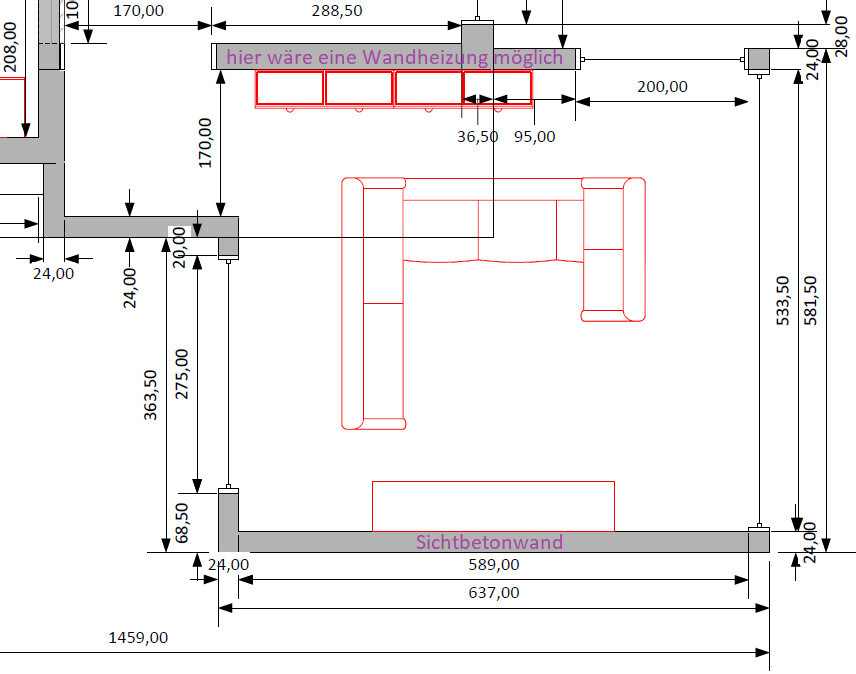
For this purpose, I was considering wood and felt panels that have been available for a few years, or even the more visually appealing wood panels by Lignotrend.
Unfortunately, the floor area is not sufficient to heat the room (a higher heating load of about 55 W/m² (5.1 W/ft²) compared to the rest of the house, which averages around 30 W/m² (2.8 W/ft²)).
Since the only large wall will be an exposed concrete wall, wall heating is not possible there—at most, it could be installed in the rear part of the room.
Are there any ceiling heating systems that also provide acoustic benefits and are visually attractive (wood, for example)?
jens.knoedel schrieb:
P.S. You mentioned in another thread that the extension is currently being built. That only reinforces my statement of "poor planning" if you can now only install a thin-layer system and therefore have issues with the heating. Why would anyone plan such a new build without proper heating design?Not poorly planned, simply unavoidable. Why? -> is completely irrelevant to the issue here
So, can we please stay on topic?

LostWolf schrieb:
I can't work with 50mm (2 inches) because my screed system only allows 75 or 150mm (3 or 6 inches).Where is the problem? - The greatest common divisor of 50 and 75 is 25. There should be a way to adjust something. Before adding an extra component, it's better to try to figure out a solution.https://www.instagram.com/11antgmxde/
https://www.linkedin.com/company/bauen-jetzt/