
ᐅ Installation of an Air-to-Water Heat Pump – Is This Setup Correct?
Created on: 6 Jun 2020 13:58
M
Mertha257
Hello dear forum members,
We have been considering the installation location for our planned air-to-water heat pump for several days now. It is intended to be placed on the east side of the house, specifically in the gap between the bay window wall and the back wall of the garage (see image).
The discharge direction would be toward the east, away from the house, but after about 3 meters (10 feet) there is the neighbor’s garage/garden shed.
After researching various manufacturers, the heat pump fits in this space, as the minimum clearances from walls at the back and sides range between 15–40 cm (6–16 inches), which we can achieve.
However, I have two concerns:
1.) Possible thermal short-circuit: Given the enclosure by the bay window, our own garage rear wall, and the neighboring building, will the air-to-water heat pump be able to discharge the used, cooler air effectively enough and far enough so that sufficient fresh, warm air can flow to the intake? I do not want to compromise the efficiency of the heat pump due to the installation location. Unfortunately, there is no other feasible place to install it...
2.) Noise impact: It is often advised that air-to-water heat pumps should not be placed in wall niches or corners to avoid sound amplification/reflection. Although I plan to decouple the heat pump as much as possible and build a proper foundation, our bedroom is located on the first floor directly above this spot.
What are your thoughts on these two points? Do you have any experience regarding this? Point #1 is especially important to me, as I have found some good approaches to avoid or reduce noise.
Thank you very much for your advice!
Have a great weekend everyone!
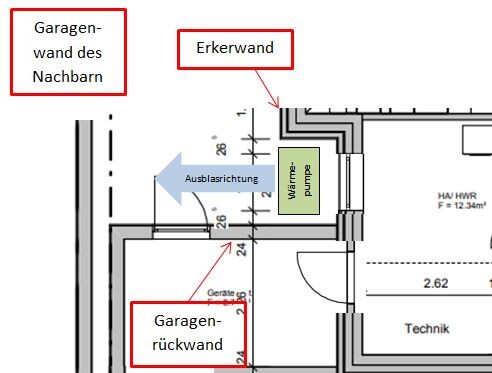
We have been considering the installation location for our planned air-to-water heat pump for several days now. It is intended to be placed on the east side of the house, specifically in the gap between the bay window wall and the back wall of the garage (see image).
The discharge direction would be toward the east, away from the house, but after about 3 meters (10 feet) there is the neighbor’s garage/garden shed.
After researching various manufacturers, the heat pump fits in this space, as the minimum clearances from walls at the back and sides range between 15–40 cm (6–16 inches), which we can achieve.
However, I have two concerns:
1.) Possible thermal short-circuit: Given the enclosure by the bay window, our own garage rear wall, and the neighboring building, will the air-to-water heat pump be able to discharge the used, cooler air effectively enough and far enough so that sufficient fresh, warm air can flow to the intake? I do not want to compromise the efficiency of the heat pump due to the installation location. Unfortunately, there is no other feasible place to install it...
2.) Noise impact: It is often advised that air-to-water heat pumps should not be placed in wall niches or corners to avoid sound amplification/reflection. Although I plan to decouple the heat pump as much as possible and build a proper foundation, our bedroom is located on the first floor directly above this spot.
What are your thoughts on these two points? Do you have any experience regarding this? Point #1 is especially important to me, as I have found some good approaches to avoid or reduce noise.
Thank you very much for your advice!
Have a great weekend everyone!
M
Mertha2577 Jun 2020 09:40Karl H. schrieb:
I wouldn’t bring the noise source into the house. That won’t improve anything.
What heating capacity is the heat pump supposed to have (heating load calculation)? Are there budget restrictions (the most expensive ones are usually quieter)? Depending on that, I might be able to give some recommendations.
Regards, Karl Hello Karl,
There isn’t a heating load calculation yet. We are in the final planning stages. The single-family home will be 180sqm (1938 sq ft).
Of course, there are budget restrictions, but we would be willing to invest more in an air-to-water heat pump if that would address the issues with efficiency and noise level.
What would be your recommendations?
Thanks and best regards
S
Strahleman7 Jun 2020 09:59Mertha257 schrieb:
Do you have this device in operation? No, but it was included in our standard package since our heating technician had very good experiences with it. However, we are now building with a brine-to-water heat pump.
Of course, the noise source is brought indoors. But when I look at our neighbors’ outdoor units, they are not really loud even in winter. Any washing machine is much louder. Are you building with a basement? Then you would have even more distance to the unit compared to if it is located in the ground-floor utility room.
Alternatively, there are also outdoor units installed facing upwards. This should be better in terms of noise. Some friends did it that way. Their neighbor’s garage wall was about 4-5 meters (13-16 feet) away. Supposedly, it is not a problem, but I still wouldn’t necessarily want to do it.
Mertha257 schrieb:
Hello Karl,
There is no heat load calculation yet. We are in the final planning stage. The single-family house will have 180sqm (1937 sq ft).
Of course, there are budget restrictions, but we would be willing to invest more in an air-to-water heat pump if we could address the issues with efficiency and noise level.
What would be your recommendations?
Thanks and regards For a house of that size, 8-10kW will definitely be sufficient. In the premium segment, you will find the extremely quiet but bulky Kermi Xchange Dynamik and the very quiet Wolf CHA Monoblock. Also quiet in the mid-range is the Daikin Altherma 3 (I have this Daikin myself).
For a quiet outdoor unit, a large volume (like the Kermi) offers key design advantages: a very large and thus slowly rotating fan, a large evaporator surface for slower airflow, space for good sound insulation of the compressor, and a stable (low vibration) housing. A neighbor has the Kermi, and you can barely hear it.
Regards
Karl
8 to 10 kW for 180m2 (1,937 sq ft)... You’re living in the past... Depending on the house standard, between 4 and 6 kW is usually sufficient... And for a heat pump, oversizing is generally very problematic.
No one doubts that quiet heat pumps exist—they definitely do. Even the more affordable Mitsubishi units are no problem when freestanding or mounted on a wall, so you don’t need a “so-called premium class.” However, the installation location can significantly impact noise levels, and even a quiet heat pump can become extremely annoying if a low-frequency resonance develops. A freestanding air-to-water heat pump is usually completely unproblematic nowadays, but such a nonsensical location (sorry @TE, but being surrounded by walls is really tough ) is rarely chosen.
No one doubts that quiet heat pumps exist—they definitely do. Even the more affordable Mitsubishi units are no problem when freestanding or mounted on a wall, so you don’t need a “so-called premium class.” However, the installation location can significantly impact noise levels, and even a quiet heat pump can become extremely annoying if a low-frequency resonance develops. A freestanding air-to-water heat pump is usually completely unproblematic nowadays, but such a nonsensical location (sorry @TE, but being surrounded by walls is really tough ) is rarely chosen.
Tego12 schrieb:
8 to 10 kW for 180m2 (1937 sq ft)... But you are living in the past... Depending on the house standard, between 4 and 6 kW is usually sufficient... And with a heat pump, oversizing is generally a really bad idea. I live in the reality of the valid Energy Saving Ordinance 2016! Better insulation standards are always possible, of course, but not a given. We will see. Regarding oversizing: My house requires 5.8 kW but has a fully modulating heat pump rated at 8 kW. Advantage: operation in maximum whisper mode without loss of comfort, resulting in less stress on components (longer service life). Thanks to modulation, I do not have short cycling and achieve an excellent seasonal performance factor of 4.4.
Regards
Karl
Of course, you picked out the unimportant aspect and ignored the original poster’s issue regarding noise disturbance at a specific installation location, but be that as it may.
Even with full modulation, the rule is: if possible, choose the smallest possible model, because these can usually modulate to lower levels. What matters is not the maximum output but the lowest possible modulation level, as this ensures high efficiency and minimal cycling, especially during transitional periods (when large-scale cycling usually occurs). But yes, I agree with you—modulating air-to-water heat pumps are at least better than on/off units when oversized.
Even with full modulation, the rule is: if possible, choose the smallest possible model, because these can usually modulate to lower levels. What matters is not the maximum output but the lowest possible modulation level, as this ensures high efficiency and minimal cycling, especially during transitional periods (when large-scale cycling usually occurs). But yes, I agree with you—modulating air-to-water heat pumps are at least better than on/off units when oversized.
Similar topics