
ᐅ How long can rainwater be stored in a rainwater harvesting tank?
Created on: 28 Jun 2018 21:19
S
stefansteiner
We have a plot of land in Vienna measuring 450m2 (4844 sq ft) and a roof area of about 100m2 (1076 sq ft) – our house construction will start this September.
Although everyone advises against buying a rainwater cistern (they say it’s never cost-effective), I simply want to make use of the water resource (for now only for the garden – not for the house), but maybe that will change later.
So – I have the option to buy an 8000L (2100 gallons) cistern for the same price as a 4000L (1050 gallons) one.
My idea is that with an 8000L system I could build up a water surplus over the winter and start spring with a full tank, then gradually use the buffer until summer.
In your opinion, does this make sense or is it better to just buy the 4000L?
Thank you in advance for your feedback and best regards from Vienna,
stefansteiner
Although everyone advises against buying a rainwater cistern (they say it’s never cost-effective), I simply want to make use of the water resource (for now only for the garden – not for the house), but maybe that will change later.
So – I have the option to buy an 8000L (2100 gallons) cistern for the same price as a 4000L (1050 gallons) one.
My idea is that with an 8000L system I could build up a water surplus over the winter and start spring with a full tank, then gradually use the buffer until summer.
In your opinion, does this make sense or is it better to just buy the 4000L?
Thank you in advance for your feedback and best regards from Vienna,
stefansteiner
 markus270329 Jun 2018 09:45
andimann schrieb:
our irrigation system pumps about 1200 liters (320 gallons) of water into the garden almost daily.Really? That adds up to around 216 cubic meters (7,630 cubic feet) of water just during the summer months, and that without a cistern? Either your water rates are different, or you have a deep pocket.
andimann schrieb:
Hello,
Advice 1: Forget about the whole rainwater cistern idea; it doesn’t really benefit the environment or your wallet.
Advice 2: If you absolutely want to go for it, choose the large 8000 L (2100 gallons) cistern.
Best regards,
AndreasI find that argument quite misleading. Of course, it makes a big difference whether you use rainwater from a cistern or tap water. On average, you use about 15–20 L/m² (0.4–0.5 gallons/sq ft) per week during the summer months. For a 300 m² (3200 sq ft) garden, that amounts to 6000 L (1600 gallons) of water per week. Filters are included from the start and don’t cost a fortune. Also, consider the sewage and drinking water fees for that volume of water over the years.
Regarding the environment: Tap water requires energy-intensive treatment, which is not really environmentally friendly. So why not take advantage of the option and simply use rainwater? Just think long term!
markus270329 Jun 2018 09:52niri09 schrieb:
On average, people use 15-20 L/m² per week (summer months), so for a 300 m² (3,230 ft²) garden that amounts to 6,000 L (1,585 gallons) of water per week.With all due respect, these values cannot be applied universally. We have just under 600 m² (6,458 ft²) of garden planted with grass, trees, and hedges. Everything is only two years old, and except for newly planted areas or really long dry spells, almost nothing is watered.
According to your general calculation, I could otherwise buy the waterworks myself.
andimann schrieb:
It will probably be 620 liters per square meter per year, which equals 62,000 liters on the roof per year.You are of course right, stupid comma!

Hello,
It’s not quite that much. I started the irrigation at the end of April or beginning of May and have used around 55-60 m3 (1,940-2,120 ft3) of water in the garden since then. Over the summer, it will probably total between 120-150 m3 (4,240-5,300 ft3). Water costs here €1.80 per m3 (about $1.80 per 35 ft3), and of course, we have a garden water meter, so there are no wastewater charges for that. So it’s a maximum of €250-300 (about $250-300) per year.
And how much does a rainwater tank with pump and everything else fully installed cost? Have you done the math?
The problem with a rainwater tank is simply that, with standard sizes, it doesn’t store enough water to bridge longer dry spells. This is exactly the issue our neighbors with tanks have. In spring, the tank fills up, but from early summer it’s usually empty, and then tap water is used for watering.
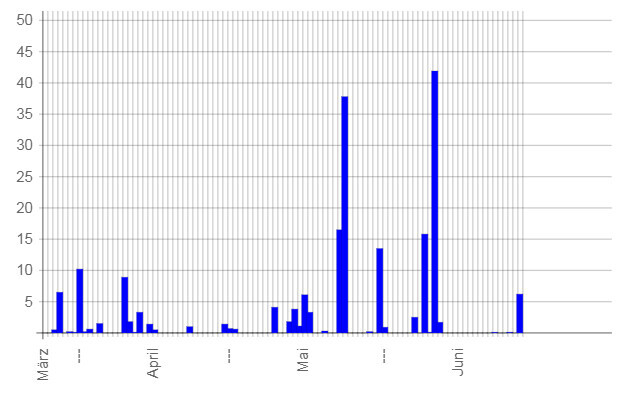
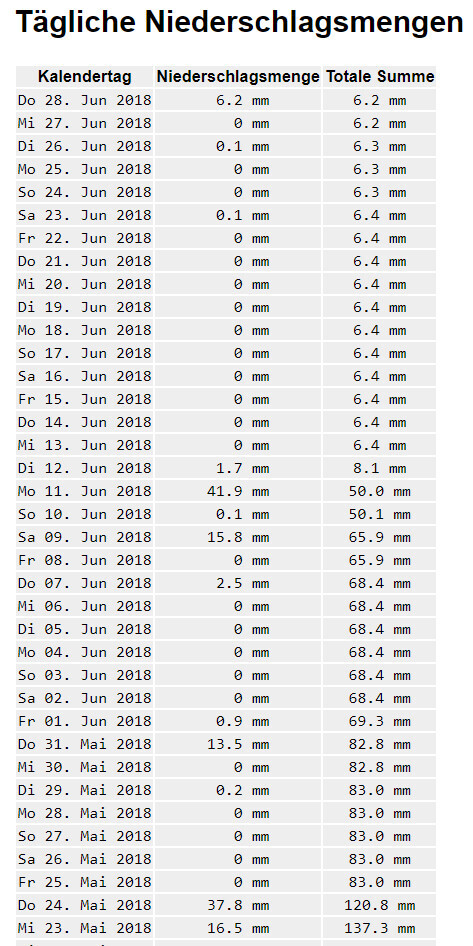
I have attached the rainfall data for our location.
Maybe that makes the problem clearer. Here, there might be 40 mm (about 1.6 inches) of rain at once (which equals around 4,000 liters (about 1,050 gallons) from our roof area, enough for 3-4 days of watering), but then there is often a 2-week drought. This means 4 days the tank supplies water and then 10 days tap water is needed.
In other words, even a rainwater tank would at best reduce our garden water consumption by about 40%.
So that’s a saving of at most €100 (about $100) per year. And for that, install a rainwater tank costing €2,000-5,000 (about $2,000-5,000) in the garden?
Anyone can do it, but I wouldn’t.
Best regards,
Andreas
markus2703 schrieb:
Really? That’s about 216 m3 (7,621 ft3) of water just for the summer half of the year, and without a rainwater tank? Either you pay different water rates or you have a deep pocket.
It’s not quite that much. I started the irrigation at the end of April or beginning of May and have used around 55-60 m3 (1,940-2,120 ft3) of water in the garden since then. Over the summer, it will probably total between 120-150 m3 (4,240-5,300 ft3). Water costs here €1.80 per m3 (about $1.80 per 35 ft3), and of course, we have a garden water meter, so there are no wastewater charges for that. So it’s a maximum of €250-300 (about $250-300) per year.
And how much does a rainwater tank with pump and everything else fully installed cost? Have you done the math?
The problem with a rainwater tank is simply that, with standard sizes, it doesn’t store enough water to bridge longer dry spells. This is exactly the issue our neighbors with tanks have. In spring, the tank fills up, but from early summer it’s usually empty, and then tap water is used for watering.
I have attached the rainfall data for our location.
Maybe that makes the problem clearer. Here, there might be 40 mm (about 1.6 inches) of rain at once (which equals around 4,000 liters (about 1,050 gallons) from our roof area, enough for 3-4 days of watering), but then there is often a 2-week drought. This means 4 days the tank supplies water and then 10 days tap water is needed.
In other words, even a rainwater tank would at best reduce our garden water consumption by about 40%.
So that’s a saving of at most €100 (about $100) per year. And for that, install a rainwater tank costing €2,000-5,000 (about $2,000-5,000) in the garden?
Anyone can do it, but I wouldn’t.
Best regards,
Andreas
Similar topics