
ᐅ Facade insulation or roof insulation, home insulation, building consultant?
Created on: 27 Nov 2015 10:11
R
ReLaXHello everyone,
we are a happy couple currently looking for a suitable house. We have just started, and there are many questions on our minds.
One house is under closer consideration and, according to online information, has a final energy demand of 156 kWh/(m²·a). It is an end-terrace house with 118m² (1270 sq ft) of living space, with a gas central heating system from 1973, located in the beautiful NRW region.
We received the property brochure, and it shows two different values. One is the final energy demand of the building, listed online as 156 kWh/(m²·a). The other is the primary energy demand, which is 180 kWh/(m²·a). What exactly is the difference between these two figures?
According to the realtor, the annual gas costs amount to 1200€. Is that realistic given the above values?
If one considers improving insulation, what kind of savings can be expected? I have read that there are three options for external wall insulation, plus the possibility of roof insulation. From what I understand, extensive external wall insulation can save up to 30%. In comparison, roof insulation is said to save around 20%. Of course, the gas heating system could also be replaced, but we’ll leave that calculation aside for now.
Our question is: is it worthwhile to invest in new insulation? Contractors will likely recommend insulation, but that’s not an objective opinion since they are not neutral! A house is lived in until you can no longer climb the stairs, up to retirement age. That means with 30 years old, there are still about 35 years of living time left. Of course, insulation also increases the property value, which can partly be recovered upon resale.
-------------------
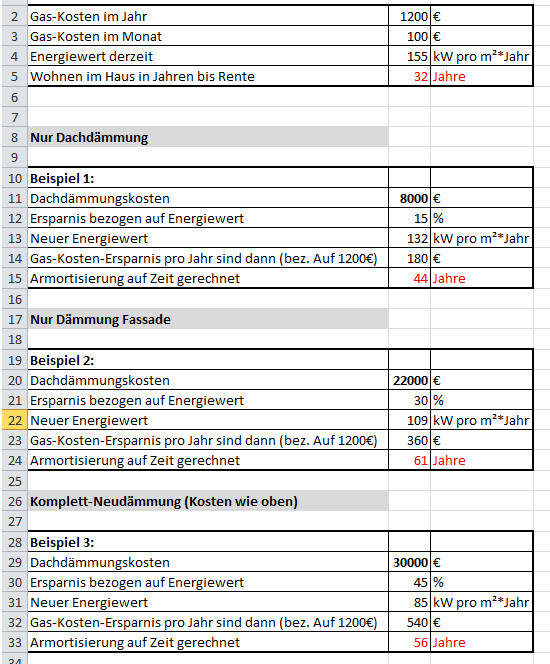
Now to the three example calculations I made:
-------------------
Another question is how insulation can be done later on (after purchasing and living in the house for 5 or 10 years). Is it possible without major disruption, while already living there? Or should insulation work always be done before moving in?
Thank you in advance for all information and contributions!
ReLaX ;-)
we are a happy couple currently looking for a suitable house. We have just started, and there are many questions on our minds.
One house is under closer consideration and, according to online information, has a final energy demand of 156 kWh/(m²·a). It is an end-terrace house with 118m² (1270 sq ft) of living space, with a gas central heating system from 1973, located in the beautiful NRW region.
We received the property brochure, and it shows two different values. One is the final energy demand of the building, listed online as 156 kWh/(m²·a). The other is the primary energy demand, which is 180 kWh/(m²·a). What exactly is the difference between these two figures?
According to the realtor, the annual gas costs amount to 1200€. Is that realistic given the above values?
If one considers improving insulation, what kind of savings can be expected? I have read that there are three options for external wall insulation, plus the possibility of roof insulation. From what I understand, extensive external wall insulation can save up to 30%. In comparison, roof insulation is said to save around 20%. Of course, the gas heating system could also be replaced, but we’ll leave that calculation aside for now.
Our question is: is it worthwhile to invest in new insulation? Contractors will likely recommend insulation, but that’s not an objective opinion since they are not neutral! A house is lived in until you can no longer climb the stairs, up to retirement age. That means with 30 years old, there are still about 35 years of living time left. Of course, insulation also increases the property value, which can partly be recovered upon resale.
-------------------
Now to the three example calculations I made:
-------------------
Another question is how insulation can be done later on (after purchasing and living in the house for 5 or 10 years). Is it possible without major disruption, while already living there? Or should insulation work always be done before moving in?
Thank you in advance for all information and contributions!
ReLaX ;-)
N
nordanney27 Nov 2015 10:32Insulation is also somewhat a matter of "green conscience," not necessarily just about saving a lot of money.
For a 40-year-old house, you should consider the entire building when planning energy-efficient renovations:
- Exterior wall insulation
- Roof insulation
- Ceiling insulation (below the roof)
- Basement ceiling insulation
- New windows
- New heating system
- Is hot water included in the gas consumption? (If yes, the savings you calculate will be significantly lower, since only part of the gas consumption can be reduced by heating improvements. There are no savings for the portion used for hot water.)
If the house still has very old windows, I would (personally) focus more on the windows.
Exterior wall insulation can be done at any time, and even if you want to move the windows outward, it doesn’t create a big mess for you.
For a 40-year-old house, you should consider the entire building when planning energy-efficient renovations:
- Exterior wall insulation
- Roof insulation
- Ceiling insulation (below the roof)
- Basement ceiling insulation
- New windows
- New heating system
- Is hot water included in the gas consumption? (If yes, the savings you calculate will be significantly lower, since only part of the gas consumption can be reduced by heating improvements. There are no savings for the portion used for hot water.)
If the house still has very old windows, I would (personally) focus more on the windows.
Exterior wall insulation can be done at any time, and even if you want to move the windows outward, it doesn’t create a big mess for you.
From a purely economic perspective, insulating an existing building is often not worthwhile if you assume that energy costs will not increase.
Whether it is comfortable to live in a drafty and possibly damp apartment from the 1970s is another matter. Likewise, whether this will lead to higher follow-up costs later on for repairs due to moisture or mold damage.
Is buying a new TV worth it if the old tube model still works without a remote control?
Whether it is comfortable to live in a drafty and possibly damp apartment from the 1970s is another matter. Likewise, whether this will lead to higher follow-up costs later on for repairs due to moisture or mold damage.
Is buying a new TV worth it if the old tube model still works without a remote control?
156 vs 180 may be a theoretical versus actual calculation? In new construction, the energy suppliers also play a role in calculating primary energy (electricity has a higher primary energy factor than, for example, gas… this does not change the fact that the heat demand is the same) – the idea is that some energy sources produce fewer emissions than others. However, this should not be relevant here.
€1200 per year (p.a.) could be accurate. My parents have a mid-terrace house and pay just under €800 p.a.
€1200 / €0.7 * 10 / 180 = 95 m² (1024 sq ft)... or 108 m² (1163 sq ft). How many square meters does the property have?
Is the heating system from 1973?! If so, you should replace it.
Regarding renovation: I would not do it. 160 kWh/m² per year (160 kWh/m² p.a.) is not new construction, but also not a suburban house. If the roof needs to be replaced anyway at some point, you can do it at the same time. The house works as it is (which should not be underestimated). If in year 3 you notice it is always cold near the windows and you feel uncomfortable, you can still replace it then – but to improve living comfort, not because someone made it look good on paper.
€1200 per year (p.a.) could be accurate. My parents have a mid-terrace house and pay just under €800 p.a.
€1200 / €0.7 * 10 / 180 = 95 m² (1024 sq ft)... or 108 m² (1163 sq ft). How many square meters does the property have?
Is the heating system from 1973?! If so, you should replace it.
Regarding renovation: I would not do it. 160 kWh/m² per year (160 kWh/m² p.a.) is not new construction, but also not a suburban house. If the roof needs to be replaced anyway at some point, you can do it at the same time. The house works as it is (which should not be underestimated). If in year 3 you notice it is always cold near the windows and you feel uncomfortable, you can still replace it then – but to improve living comfort, not because someone made it look good on paper.


Wiki: "The primary energy demand (according to the Energy Saving Ordinance, abbreviated as QP) of a system includes, in addition to the actual energy demand for an energy carrier, the amount of energy required by upstream processes outside the system boundary for the extraction, conversion, and distribution of the energy carrier (primary energy)."
Wiki: "Final energy is the portion of primary energy remaining after energy conversion and transmission losses, which has passed through the consumer’s building connection."
Calculation: €1,200 gross = €1,008 net / 5.28 cents per kWh (gas price for the Euskirchen area) = 19,098 kWh / 118 m² (1,270 sq ft) = 161 kWh/m² (15 kBTU/sq ft). The value stated on the certificate is therefore accurate, which cannot be said for all certificates.
The energy refurbishment of a house should not only be considered in terms of saving as much final energy as possible, but also in terms of living in a home that provides so-called "comfort." The rooms should be designed and insulated in such a way that they invite comfortable living. This comfort, which should not be confused with the well-known German term "Gemütlichkeit," has a physiological and psychological component that should not be underestimated. A key parameter is, for example, a maximum difference between room air temperature and the surface temperature of the interior face of exterior walls of 2-3 °C (4-5 °F), with a minimum surface temperature of around 18°C (64°F). This value is often significantly undercut in poorly insulated older buildings: occupants tend to move away from cold walls and feel uncomfortable. At particularly cold spots (thermal bridges), condensation from warm, humid air can occur, leading to mold growth.
An energy retrofit must be planned and considered within the overall context of the building. This includes insulation of building components from the basement ceiling/foundation slab up to the ceiling above the upper floor/roof, as well as windows and building services (heating, ventilation). Insulating only some components will cause the uninsulated parts to become condensation points. New windows installed in an uninsulated facade have the same effect.
In your case, it is worthwhile to carry out a so-called building energy consultation according to BAFA standards, which is also subsidized. A qualified consultant, preferably an architect or civil engineer with in-depth knowledge of refurbishing older buildings, will calculate the current energy status of the building using approved software based on a building survey and develop insulation and heating options, each with calculated final energy demand and payback period.
Generally, insulating the top floor ceiling (= retrofit requirement according to the Energy Saving Ordinance up to 2 years after purchase) is worthwhile and the most cost-effective measure. All other measures must be checked within a concept that integrates renovation wishes, possible structural or moisture damage, and constructional particularities (building waterproofing).
Before purchasing, you should have the house checked by an expert/architect/civil engineer as part of a property evaluation under these aspects to realistically estimate the refurbishment and modernization costs for your financing planning.
Wiki: "Final energy is the portion of primary energy remaining after energy conversion and transmission losses, which has passed through the consumer’s building connection."
Calculation: €1,200 gross = €1,008 net / 5.28 cents per kWh (gas price for the Euskirchen area) = 19,098 kWh / 118 m² (1,270 sq ft) = 161 kWh/m² (15 kBTU/sq ft). The value stated on the certificate is therefore accurate, which cannot be said for all certificates.
The energy refurbishment of a house should not only be considered in terms of saving as much final energy as possible, but also in terms of living in a home that provides so-called "comfort." The rooms should be designed and insulated in such a way that they invite comfortable living. This comfort, which should not be confused with the well-known German term "Gemütlichkeit," has a physiological and psychological component that should not be underestimated. A key parameter is, for example, a maximum difference between room air temperature and the surface temperature of the interior face of exterior walls of 2-3 °C (4-5 °F), with a minimum surface temperature of around 18°C (64°F). This value is often significantly undercut in poorly insulated older buildings: occupants tend to move away from cold walls and feel uncomfortable. At particularly cold spots (thermal bridges), condensation from warm, humid air can occur, leading to mold growth.
An energy retrofit must be planned and considered within the overall context of the building. This includes insulation of building components from the basement ceiling/foundation slab up to the ceiling above the upper floor/roof, as well as windows and building services (heating, ventilation). Insulating only some components will cause the uninsulated parts to become condensation points. New windows installed in an uninsulated facade have the same effect.
In your case, it is worthwhile to carry out a so-called building energy consultation according to BAFA standards, which is also subsidized. A qualified consultant, preferably an architect or civil engineer with in-depth knowledge of refurbishing older buildings, will calculate the current energy status of the building using approved software based on a building survey and develop insulation and heating options, each with calculated final energy demand and payback period.
Generally, insulating the top floor ceiling (= retrofit requirement according to the Energy Saving Ordinance up to 2 years after purchase) is worthwhile and the most cost-effective measure. All other measures must be checked within a concept that integrates renovation wishes, possible structural or moisture damage, and constructional particularities (building waterproofing).
Before purchasing, you should have the house checked by an expert/architect/civil engineer as part of a property evaluation under these aspects to realistically estimate the refurbishment and modernization costs for your financing planning.
Similar topics