
ᐅ Facade insulation or roof insulation, home insulation, building consultant?
Created on: 27 Nov 2015 10:11
R
ReLaX
Hello everyone,
we are a happy couple currently looking for a suitable house. We have just started, and there are many questions on our minds.
One house is under closer consideration and, according to online information, has a final energy demand of 156 kWh/(m²·a). It is an end-terrace house with 118m² (1270 sq ft) of living space, with a gas central heating system from 1973, located in the beautiful NRW region.
We received the property brochure, and it shows two different values. One is the final energy demand of the building, listed online as 156 kWh/(m²·a). The other is the primary energy demand, which is 180 kWh/(m²·a). What exactly is the difference between these two figures?
According to the realtor, the annual gas costs amount to 1200€. Is that realistic given the above values?
If one considers improving insulation, what kind of savings can be expected? I have read that there are three options for external wall insulation, plus the possibility of roof insulation. From what I understand, extensive external wall insulation can save up to 30%. In comparison, roof insulation is said to save around 20%. Of course, the gas heating system could also be replaced, but we’ll leave that calculation aside for now.
Our question is: is it worthwhile to invest in new insulation? Contractors will likely recommend insulation, but that’s not an objective opinion since they are not neutral! A house is lived in until you can no longer climb the stairs, up to retirement age. That means with 30 years old, there are still about 35 years of living time left. Of course, insulation also increases the property value, which can partly be recovered upon resale.
-------------------
Now to the three example calculations I made:
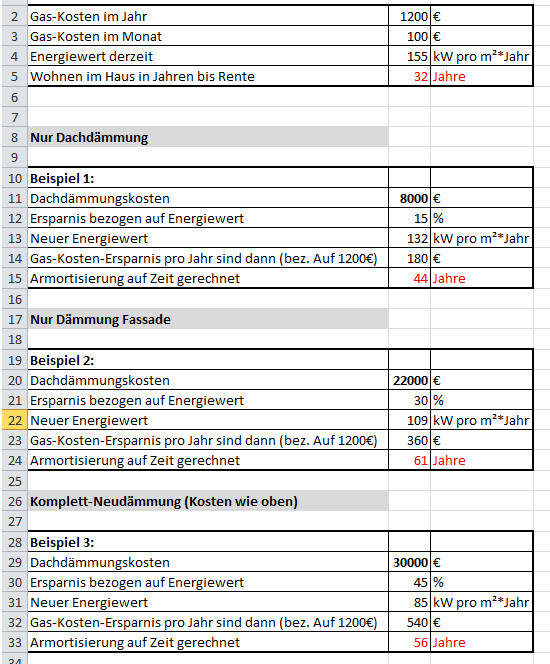
-------------------
Another question is how insulation can be done later on (after purchasing and living in the house for 5 or 10 years). Is it possible without major disruption, while already living there? Or should insulation work always be done before moving in?
Thank you in advance for all information and contributions!
ReLaX ;-)
we are a happy couple currently looking for a suitable house. We have just started, and there are many questions on our minds.
One house is under closer consideration and, according to online information, has a final energy demand of 156 kWh/(m²·a). It is an end-terrace house with 118m² (1270 sq ft) of living space, with a gas central heating system from 1973, located in the beautiful NRW region.
We received the property brochure, and it shows two different values. One is the final energy demand of the building, listed online as 156 kWh/(m²·a). The other is the primary energy demand, which is 180 kWh/(m²·a). What exactly is the difference between these two figures?
According to the realtor, the annual gas costs amount to 1200€. Is that realistic given the above values?
If one considers improving insulation, what kind of savings can be expected? I have read that there are three options for external wall insulation, plus the possibility of roof insulation. From what I understand, extensive external wall insulation can save up to 30%. In comparison, roof insulation is said to save around 20%. Of course, the gas heating system could also be replaced, but we’ll leave that calculation aside for now.
Our question is: is it worthwhile to invest in new insulation? Contractors will likely recommend insulation, but that’s not an objective opinion since they are not neutral! A house is lived in until you can no longer climb the stairs, up to retirement age. That means with 30 years old, there are still about 35 years of living time left. Of course, insulation also increases the property value, which can partly be recovered upon resale.
-------------------
Now to the three example calculations I made:
-------------------
Another question is how insulation can be done later on (after purchasing and living in the house for 5 or 10 years). Is it possible without major disruption, while already living there? Or should insulation work always be done before moving in?
Thank you in advance for all information and contributions!
ReLaX ;-)
 EveundGerd27 Nov 2015 20:49
I have the following questions:
What type of stone is the masonry made of? How thick is the masonry?
Are there recesses for radiators under the windows or not?
How old are the windows? And what material are they made of?
How is the house heated? How is hot water produced?
Is the top floor ceiling made of concrete or wooden construction?
As a former owner of a house from 1964, I know all about renovations and the like. 😉
What type of stone is the masonry made of? How thick is the masonry?
Are there recesses for radiators under the windows or not?
How old are the windows? And what material are they made of?
How is the house heated? How is hot water produced?
Is the top floor ceiling made of concrete or wooden construction?
As a former owner of a house from 1964, I know all about renovations and the like. 😉
First of all, thank you very much for the many and sometimes very detailed answers.
I never expected such an extensive response.
I will need to read through everything carefully again.
Now to some statements:
Is it possible to say what a professional of this caliber charges and where I can find someone? Could the consumer advice center possibly help here?
Same question as above:
Is it possible to say what a professional of this caliber charges and where I can find someone? Could the consumer advice center possibly help here?
Best regards, ReLaX
I never expected such an extensive response.
I will need to read through everything carefully again.
Now to some statements:
W. Pickartz schrieb:
In your case, a so-called building energy consultation according to BAFA standards, which is also subsidized, would be worthwhile. A qualified consultant, preferably an architect or structural engineer with in-depth knowledge of renovating older buildings, uses approved software based on a building survey to calculate the current energy state of the building and creates different insulation and heating options, each with the calculated final energy demand and the payback period.
Is it possible to say what a professional of this caliber charges and where I can find someone? Could the consumer advice center possibly help here?
W. Pickartz schrieb:
Before purchasing, you should have the house inspected by an expert (appraiser/architect/structural engineer) as part of a property purchase consultation under these aspects, to realistically estimate the renovation and modernization effort for your financing planning.
Same question as above:
Is it possible to say what a professional of this caliber charges and where I can find someone? Could the consumer advice center possibly help here?
Best regards, ReLaX

The approved and eligible BAFA building energy consultants are listed in the dena register as energy efficiency experts (... nicer name ...). You should definitely consult only an architect or structural engineer who can advise you comprehensively on the overall context of a planned renovation and energy retrofit. Unfortunately, the training standards are not yet standardized; many “consultants” listed in the dena register are craftsmen with advanced training certified by the Chamber of Industry and Commerce (IHK) who offer BAFA consultations after a short additional course. However, they lack the qualification to provide comprehensive advice on all aspects of energy renovation. This also includes the building survey, identifying building damage such as moisture damage, since only dry components can be insulated. Therefore, energy retrofitting may also include a renovation plan for the repair and sustainable elimination of building defects. In my opinion, consumer advice centers mostly refer to advanced craftsmen.
The GEB: A BAFA-funded GEB (building energy consultation) is a comprehensive building analysis that describes the current energy condition. Using BAFA-authorized software, the current energy consumption in the unrenovated state is calculated. In comparison, the subsequent simulation describes and calculates the energy savings of various insulation options, considering a new heating system, renewable energy sources, or the installation of new windows.
For the report (about 90 pages), including the collection and input of building data, cost-effectiveness calculations, and building physics calculations of renovation options (building insulation/heating system), I charge a fee. We can discuss this as well as the BAFA subsidy in a private message; I am also happy to talk by phone.
Purchase Consultation: I conduct property purchase consultations in NRW/RLP. My terms are available on my website. I am also happy to send you detailed information about my property purchase consultation by email if you provide your email address. We can also arrange a phone call for this.
Most purchase consultants are craftsmen or real estate agents, occasionally structural engineers. The same recommendations and limitations as for the GEB apply here.
-----------------------
Good evening Will,
I have deleted your fee schedule. Please discuss this with users via private message.
Thank you and best regards, Building Expert
Building Expert
The GEB: A BAFA-funded GEB (building energy consultation) is a comprehensive building analysis that describes the current energy condition. Using BAFA-authorized software, the current energy consumption in the unrenovated state is calculated. In comparison, the subsequent simulation describes and calculates the energy savings of various insulation options, considering a new heating system, renewable energy sources, or the installation of new windows.
For the report (about 90 pages), including the collection and input of building data, cost-effectiveness calculations, and building physics calculations of renovation options (building insulation/heating system), I charge a fee. We can discuss this as well as the BAFA subsidy in a private message; I am also happy to talk by phone.
Purchase Consultation: I conduct property purchase consultations in NRW/RLP. My terms are available on my website. I am also happy to send you detailed information about my property purchase consultation by email if you provide your email address. We can also arrange a phone call for this.
Most purchase consultants are craftsmen or real estate agents, occasionally structural engineers. The same recommendations and limitations as for the GEB apply here.
-----------------------
Good evening Will,
I have deleted your fee schedule. Please discuss this with users via private message.
Thank you and best regards, Building Expert
Building Expert
In your payback calculation, you have neglected both the interest on the construction costs and the price development of heating expenses. Unfortunately, I cannot tell you what assumptions should be made there, especially regarding the latter. Presumably, natural gas will cost somewhat more than 5.28 cents per kilowatt-hour in 2050, or you might be using a different energy source than gas by then. However, it is unlikely to be a low-temperature heat pump designed for underfloor heating, unless the house has been extensively renovated by that time.