
ᐅ Balanced Mechanical Ventilation Vallox ValloPlus 350MV – Experiences, User Guide?
Created on: 8 Oct 2023 08:12
K
kati1337
Good morning forum community,
Since our plumber stood us up again last Friday regarding the introduction to the equipment, I’m reaching out to you all.
Does anyone have the ventilation unit mentioned above and could help us with some settings?
We have a relatively high electricity consumption at night and have partly traced it back to the ventilation system. We are now trying to optimize it but have not yet received proper instruction on the device.
First, I searched online for a manual and found one, but the information there is very basic. It basically only explains how to use arrow keys within menus, but not what the settings mean. Especially the “special settings” menu is hardly explained at all.
Does anyone know if there is a better or professional manual for this device and, if so, where I can find it?
Furthermore, I am unsure which settings we should apply. The house is still new, and we currently have very high humidity. I want to reduce it. In our old house, I used to run a dehumidifier in the living areas for some time. This time, I wanted to try if it would work with just the ventilation system. However, within the first month, I barely managed to reduce the humidity. Maybe I have the wrong settings.
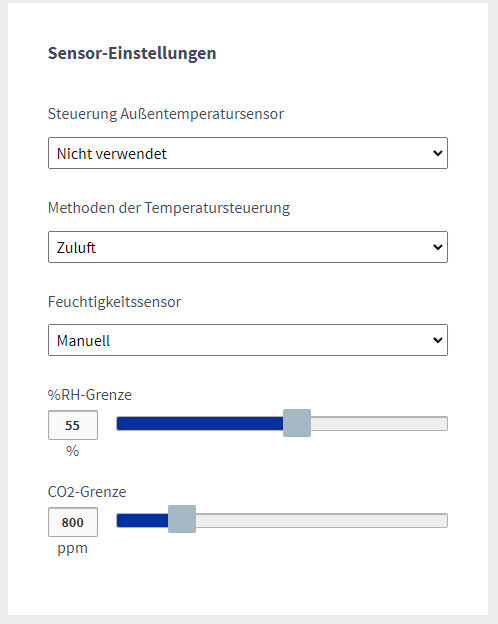
For the sensor settings, I lowered the relative humidity (%RH) limit to 55% and set the sensor to “manual.” Only when set to “manual” can I adjust the threshold. If I set it to 55% and then switch it back to “automatic” above, the RH limit resets to a much higher value.
So I assume manual is correct? But I would still like the ventilation to automatically reduce humidity during operation if the measured value exceeds the threshold.
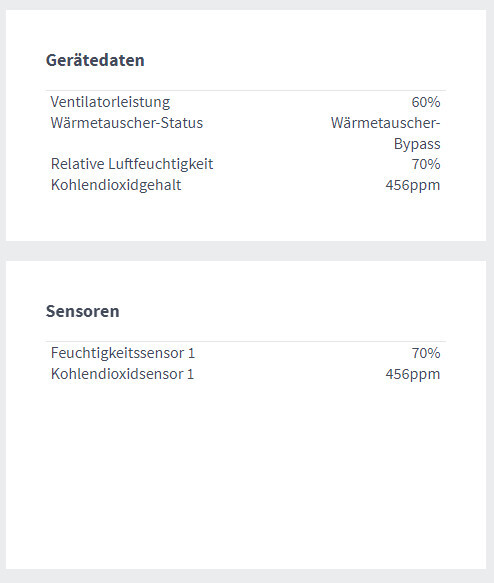
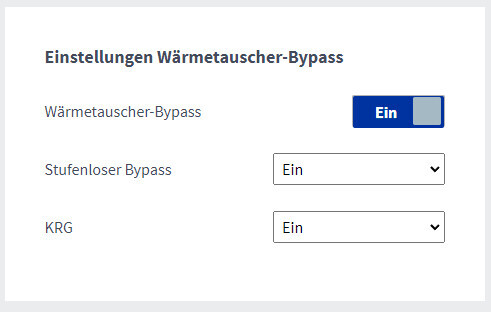
Currently, the humidity is at 70%, which is much too high for me. Also, in the device data, you can see the heat exchanger is set to the heat exchanger bypass. I assume that’s not useful since we are heating now. Should I therefore switch the bypass slider to “off” in the “special settings” menu until next summer?
There are also these “heating settings”:
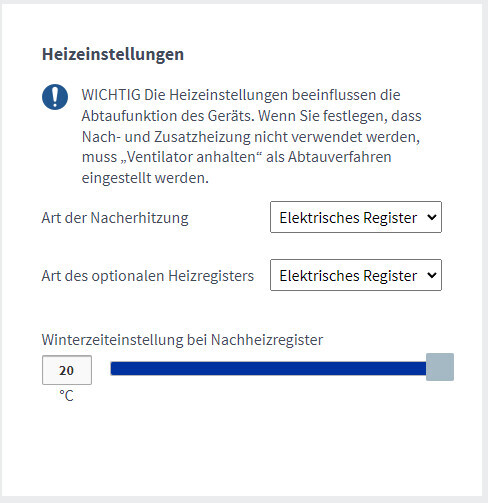
They are set to the values configured after commissioning. Is this reasonable? I have no idea what these are for. Our previous ventilation system was part of a combined unit with an air-to-water heat pump, so I don’t think it had anything like this.
And lastly, these profiles you can switch between:
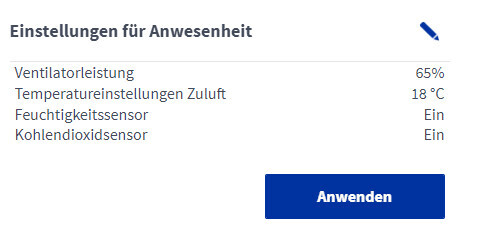
All profiles have the supply air temperature set to 18°C (64°F). I read somewhere that it might make energetic sense to heat the rest via underfloor heating. However, I don’t want to lower it any further because I don’t want to risk a draft overnight if cold air blows into the room over the bed.
The basic fan settings are currently 50% for both exhaust and supply air – I neither know if that makes sense nor if these settings are applied anywhere. Because in the “present” profile, it is set to 65%. Which value is active then, or when is the basic setting ever used?
I would be very grateful for your advice on optimizing this.
Since our plumber stood us up again last Friday regarding the introduction to the equipment, I’m reaching out to you all.
Does anyone have the ventilation unit mentioned above and could help us with some settings?
We have a relatively high electricity consumption at night and have partly traced it back to the ventilation system. We are now trying to optimize it but have not yet received proper instruction on the device.
First, I searched online for a manual and found one, but the information there is very basic. It basically only explains how to use arrow keys within menus, but not what the settings mean. Especially the “special settings” menu is hardly explained at all.
Does anyone know if there is a better or professional manual for this device and, if so, where I can find it?
Furthermore, I am unsure which settings we should apply. The house is still new, and we currently have very high humidity. I want to reduce it. In our old house, I used to run a dehumidifier in the living areas for some time. This time, I wanted to try if it would work with just the ventilation system. However, within the first month, I barely managed to reduce the humidity. Maybe I have the wrong settings.
For the sensor settings, I lowered the relative humidity (%RH) limit to 55% and set the sensor to “manual.” Only when set to “manual” can I adjust the threshold. If I set it to 55% and then switch it back to “automatic” above, the RH limit resets to a much higher value.
So I assume manual is correct? But I would still like the ventilation to automatically reduce humidity during operation if the measured value exceeds the threshold.
Currently, the humidity is at 70%, which is much too high for me. Also, in the device data, you can see the heat exchanger is set to the heat exchanger bypass. I assume that’s not useful since we are heating now. Should I therefore switch the bypass slider to “off” in the “special settings” menu until next summer?
There are also these “heating settings”:
They are set to the values configured after commissioning. Is this reasonable? I have no idea what these are for. Our previous ventilation system was part of a combined unit with an air-to-water heat pump, so I don’t think it had anything like this.
And lastly, these profiles you can switch between:
All profiles have the supply air temperature set to 18°C (64°F). I read somewhere that it might make energetic sense to heat the rest via underfloor heating. However, I don’t want to lower it any further because I don’t want to risk a draft overnight if cold air blows into the room over the bed.
The basic fan settings are currently 50% for both exhaust and supply air – I neither know if that makes sense nor if these settings are applied anywhere. Because in the “present” profile, it is set to 65%. Which value is active then, or when is the basic setting ever used?
I would be very grateful for your advice on optimizing this.
R
RotorMotor8 Oct 2023 10:35What is the power consumption of the ventilation system?
I assume the bypass is automatically controlled based on the desired temperature. I think 18 degrees Celsius (64°F) triggers it to open.
However, I consider 20 degrees Celsius (68°F) for the heating coil to be too high. 14 degrees Celsius (57°F) should be sufficient here as well.
Outside, it is very humid where we are. I had to program a custom solution that only tries to ventilate moisture out when it is actually drier outside. Most ventilation systems measure humidity only indoors and keep increasing the fan speed, which means they draw in more moisture from outside even when it is raining, and then increase speed even further. I’m not sure what simple measures can be taken at home to address this.
I assume the bypass is automatically controlled based on the desired temperature. I think 18 degrees Celsius (64°F) triggers it to open.
However, I consider 20 degrees Celsius (68°F) for the heating coil to be too high. 14 degrees Celsius (57°F) should be sufficient here as well.
Outside, it is very humid where we are. I had to program a custom solution that only tries to ventilate moisture out when it is actually drier outside. Most ventilation systems measure humidity only indoors and keep increasing the fan speed, which means they draw in more moisture from outside even when it is raining, and then increase speed even further. I’m not sure what simple measures can be taken at home to address this.
RotorMotor schrieb:
What is the power consumption of the ventilation system?I’m not exactly sure. But I created a schedule, and now we run the system in “Away” mode at night (meaning reduced fan power), which has led to a significant energy saving overnight. I would say this change reduced consumption by about 100W during the night.RotorMotor schrieb:
I assume the bypass is automatically controlled based on the desired temperature. I think 18 degrees is what triggers it to open.So you mean that 18°C (64°F) causes the air to bypass the heat exchanger? Isn’t that part supposed to be for heat recovery? Outside it’s currently warmer again, but this morning the outdoor air was 12°C (54°F) and the supply air was 18°C (64°F). Either it was heated by the post-heating element (an electric heater instead of heat recovery?), since that value was still set to 20°C (68°F) — or it works automatically as you say. This morning the status also showed "heat exchanger bypass".RotorMotor schrieb:
I think the supply air heating coil set to 20°C (68°F) is way too high. 14°C (57°F) should be enough.We were planning to turn it off completely or set it to something low, like 5°C (41°F). Is it important to have it on? What is it used for?RotorMotor schrieb:
It’s very humid outside here. I had to program something myself that only tries to ventilate moisture out when it’s actually drier outside. Most ventilation systems only measure indoor humidity and just keep increasing the fan speed, so they end up bringing in more moisture even when it’s raining, and then ramp up even more. I’m not sure what can be done about that with basic setups.It’s the same here right now. I’m just surprised because we didn’t have such problems in our old house. Back then, it always removed moisture effectively — for example, laundry dried pretty quickly indoors. We had an air-to-water heat pump and ventilation combined in one unit, but otherwise a similar setup.R
RotorMotor8 Oct 2023 13:52kati1337 schrieb:
Unfortunately, I don’t know exactly. But I created a schedule and now run the system at "Away" mode during the night (meaning reduced fan power), which has resulted in significant energy savings overnight. I would say this change saved about 100W overnight. Wow, doesn’t that make it very loud?
But from the chart you could already see 77%, which is really impressive for a 350 unit. ;-)
It could also be caused if the dampers are heavily throttled.
kati1337 schrieb:
So you mean the 18 degrees cause the air not to pass through the heat exchanger? Yes, I suppose so. It’s continuously adjustable, so maybe some air still goes through proportionally, but it’s mixed down with cooler outside air, I think.
kati1337 schrieb:
We would have now either completely switched it off or set it to something low like 5°C (41°F) or so?
Is it important to keep it on? What is its purpose? If it gets too cold, the heat exchanger can freeze up or even be damaged by freezing.
I use the heating coil only to prevent that.
kati1337 schrieb:
Same here currently. I’m just wondering, because we didn’t really have such problems in the old house. The humidity was always properly removed. For example, laundry dried very quickly indoors. Back then we had an air-to-water heat pump and ventilation combined in one unit, but otherwise a similar setup. Did the old system maybe not have an enthalpy exchanger while the new one does?
Such a exchanger recovers moisture.
RotorMotor schrieb:
Wow, wouldn’t that be really loud as well?
But in the graph you can already see 77%, which is quite significant for a 350mm (14 inch) unit. ;-)
It could also be caused if the valves are heavily throttled.
Yes, I suspect so. Since it’s continuously variable, some air might already be passing through proportionally, but I think it’s being mixed down with somewhat cooler outside air.
If it gets too cold, the heat exchanger can freeze up or even get damaged.
I only use the reheating coil to prevent that.
Did the old system perhaps not have an enthalpy exchanger while the new one does?
Such a exchanger recovers moisture. Is there anywhere I can check if it has an enthalpy exchanger? But I don’t think it does. At least, I hope not. I actually want the moisture out most of the time.
I’ll have to ask the plumber whether the valves are throttled; I hope not. I don’t have the feeling that the ventilation system has been specially “tuned” in any way. In the old house, it was adjusted – they had these measuring devices that looked like small megaphones and did measurements in every room.
And yes, that was insanely loud. 😀 When we hadn’t throttled it down at night yet, it was clearly audible in my bedroom, and I’m usually not sensitive to white noise.
The 77% feels quite high to me too. We have a large house, but still... at the moment it’s always running at a high level because I set the moisture limit quite low (>60% is mold risk, right?), and for about a month now, it feels like the moisture levels haven’t changed at all.
Hi everyone,
I’m quickly updating this in case anyone else is looking for answers about the system. Our plumber came by yesterday and explained the house technology to us.
We don’t need to disable the bypass in the advanced settings; the system adjusts automatically. The "bypass" display relates to the fact that the supply air is still sufficiently warmed through the heat exchanger, so heat recovery is not yet needed.
The plumber suggested setting the supply air temperature to the actual temperature we want in the room. We had lowered it a bit, thinking it would save electricity. This way, the controls of the mechanical ventilation with heat recovery work better.
The system itself cannot dehumidify. He said that during winter, when it gets colder outside, the outdoor humidity drops, and then indoor dehumidification will happen naturally. Right now, not much is happening because it’s still quite humid outside. The moisture is generally still present because the house is new; he said it should improve after the first winter.
We have now raised the humidity threshold slightly. The current actual value today is 66%, and the target is 62%. This means the system is running with a much lower load now. When it gets colder outside, I will gradually lower the humidity threshold to the level I prefer. At the moment, a too-low value only causes the ventilation to use more power without effectively removing moisture.
The reheating coil settings are irrelevant since we don’t have one. We also don’t have an enthalpy exchanger.
He said that ideally, if it doesn’t bother you, the system should run continuously. We find it a bit loud at night, so we set it to “away” mode during the night (which reduces ventilation), but in the morning we do 30 minutes of intensive ventilation mode.
This approach is working well for us now.
We will continue to monitor the situation and may reduce the system’s performance somewhat if it doesn’t negatively affect the values or indoor climate.
I’m quickly updating this in case anyone else is looking for answers about the system. Our plumber came by yesterday and explained the house technology to us.
We don’t need to disable the bypass in the advanced settings; the system adjusts automatically. The "bypass" display relates to the fact that the supply air is still sufficiently warmed through the heat exchanger, so heat recovery is not yet needed.
The plumber suggested setting the supply air temperature to the actual temperature we want in the room. We had lowered it a bit, thinking it would save electricity. This way, the controls of the mechanical ventilation with heat recovery work better.
The system itself cannot dehumidify. He said that during winter, when it gets colder outside, the outdoor humidity drops, and then indoor dehumidification will happen naturally. Right now, not much is happening because it’s still quite humid outside. The moisture is generally still present because the house is new; he said it should improve after the first winter.
We have now raised the humidity threshold slightly. The current actual value today is 66%, and the target is 62%. This means the system is running with a much lower load now. When it gets colder outside, I will gradually lower the humidity threshold to the level I prefer. At the moment, a too-low value only causes the ventilation to use more power without effectively removing moisture.
The reheating coil settings are irrelevant since we don’t have one. We also don’t have an enthalpy exchanger.
He said that ideally, if it doesn’t bother you, the system should run continuously. We find it a bit loud at night, so we set it to “away” mode during the night (which reduces ventilation), but in the morning we do 30 minutes of intensive ventilation mode.
This approach is working well for us now.
We will continue to monitor the situation and may reduce the system’s performance somewhat if it doesn’t negatively affect the values or indoor climate.
Similar topics