
Hello,
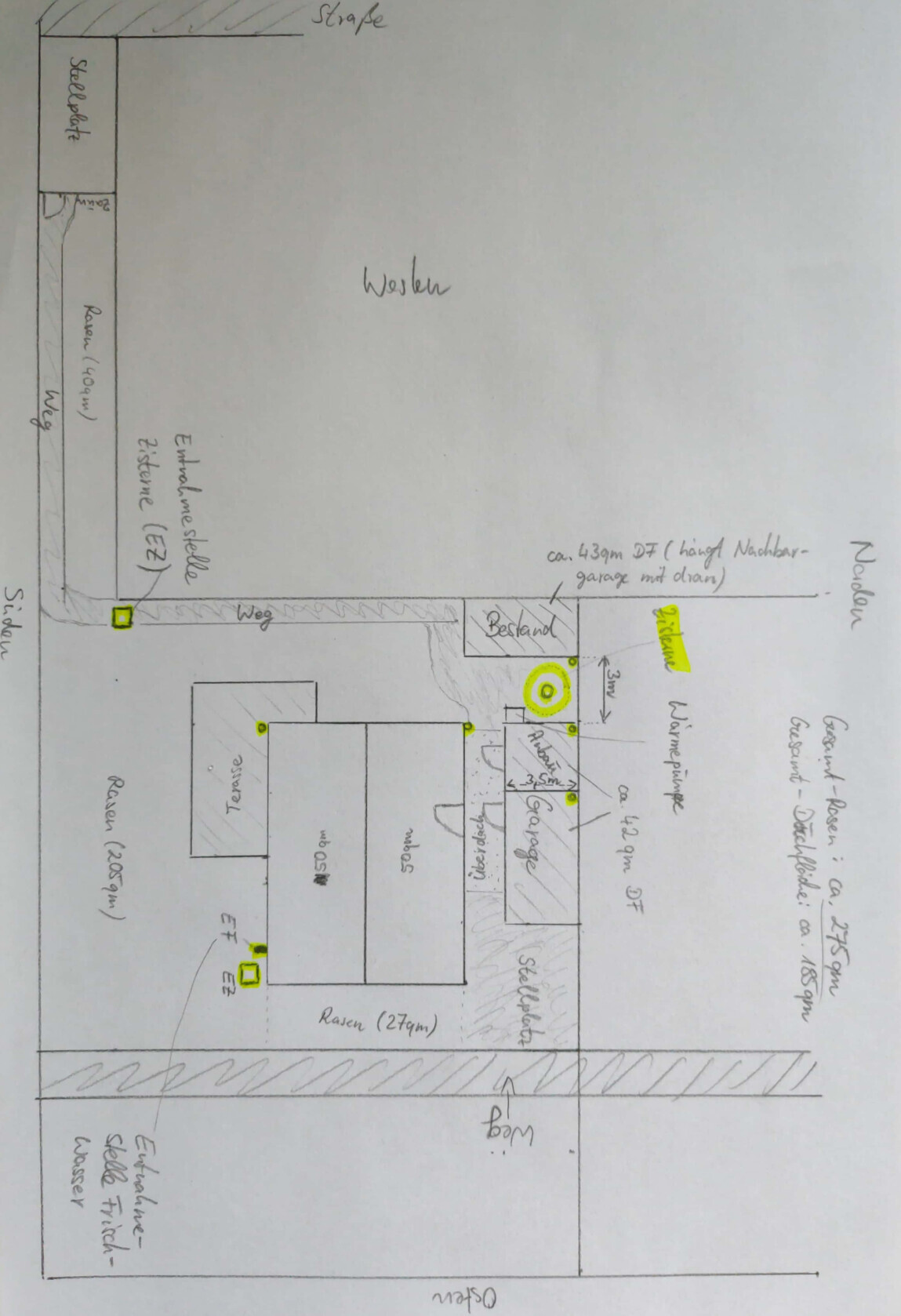
I have been thinking about rainwater harvesting. I have approximately 185 sqm (2,000 sq ft) of roof area and about 275 sqm (3,000 sq ft) of green space. We would like to use the rainwater for garden irrigation and cleaning. I have attached a PNG of the property’s outdoor area. Here are a few questions:
- The garage and the garage extension have internal downspouts for drainage. If I lay underground pipes in advance, how can these be connected when relocating the garage? Or is it better to combine the downspouts inside the garage and then lead them outside during the construction of the garage?
- The existing building has its own downspout, as does each roof surface of the house. I plan to connect the two roof downspouts with a T-fitting. Is it usual to also combine the garage drainage with that of the existing building before the water goes into the cistern?
- I am also unsure about the size of the cistern. When I enter the data into online calculators, it always suggests about 2,500 liters (660 gallons). My excavation contractor recommended 5,000 liters (1,320 gallons). Ideally, the cistern should fit into the corner between the garage and the existing building. This suggests a somewhat smaller cistern, as the corner area back there is only 3.5 x 3 m (11.5 x 10 ft). Additionally, the heat pump foundation still needs to go back there. It could get tight. What do you think?
- Withdrawal: My excavation contractor suggested routing a suction hose into the house to place the pump there. I was actually thinking more of a submersible pump, without bringing anything inside the house, just running a supply line from the cistern directly to the withdrawal points. In your opinion, which option would be better? I don’t have enough pros and cons to make a decision. How is the submersible pump supplied with power?
- I would like the withdrawal points of the cistern to be placed southwest along the long path (this is my private path - we built in a second row) and another point to the east of the house. What is the best way to route the pipes from the cistern to these points? Or is the distance too far for a pump?
- I would also like the pump to switch on only when water is drawn. Is a submersible pump capable of this?
Thanks in advance for your help.
I have been thinking about rainwater harvesting. I have approximately 185 sqm (2,000 sq ft) of roof area and about 275 sqm (3,000 sq ft) of green space. We would like to use the rainwater for garden irrigation and cleaning. I have attached a PNG of the property’s outdoor area. Here are a few questions:
- The garage and the garage extension have internal downspouts for drainage. If I lay underground pipes in advance, how can these be connected when relocating the garage? Or is it better to combine the downspouts inside the garage and then lead them outside during the construction of the garage?
- The existing building has its own downspout, as does each roof surface of the house. I plan to connect the two roof downspouts with a T-fitting. Is it usual to also combine the garage drainage with that of the existing building before the water goes into the cistern?
- I am also unsure about the size of the cistern. When I enter the data into online calculators, it always suggests about 2,500 liters (660 gallons). My excavation contractor recommended 5,000 liters (1,320 gallons). Ideally, the cistern should fit into the corner between the garage and the existing building. This suggests a somewhat smaller cistern, as the corner area back there is only 3.5 x 3 m (11.5 x 10 ft). Additionally, the heat pump foundation still needs to go back there. It could get tight. What do you think?
- Withdrawal: My excavation contractor suggested routing a suction hose into the house to place the pump there. I was actually thinking more of a submersible pump, without bringing anything inside the house, just running a supply line from the cistern directly to the withdrawal points. In your opinion, which option would be better? I don’t have enough pros and cons to make a decision. How is the submersible pump supplied with power?
- I would like the withdrawal points of the cistern to be placed southwest along the long path (this is my private path - we built in a second row) and another point to the east of the house. What is the best way to route the pipes from the cistern to these points? Or is the distance too far for a pump?
- I would also like the pump to switch on only when water is drawn. Is a submersible pump capable of this?
Thanks in advance for your help.

There are already many discussions on this topic.
- Direct all possible water into the rainwater tank, including from the terrace, etc. (this also saves fees for sealed surfaces).
- Size the rainwater tank larger (heavy rainfall can be utilized and buffered). I would suggest 10,000 liters (2,640 gallons).
- Install a well pump (e.g., Tipp AJ 4 Plus 100/57 AUT), with control and pressure switch already integrated; it only requires electricity.
- Then run a PE-HD pipe (DN 32) from the pump. It doesn’t matter whether to a water tap, floor socket, or directly to valves for automatic irrigation.
Check out the Graf Carat XL. The 10,000-liter tank fits perfectly. Please avoid buying the sets. The pump I suggest is better suited for irrigation (pressure and flow rate).
Lawns require about 15 liters per square meter per week (0.5 gallons per square foot per week). That means for your area, 4,125 liters (1,090 gallons) per week. So with 10,000 liters (2,640 gallons), you can bridge a little over two weeks of drought. You’ll also need to water the other parts of your garden.
2,500 or 5,000 liters (660 or 1,320 gallons) won’t be very useful.
We have 1,000 square meters (10,764 square feet) of lawn and a 76,000-liter (20,070 gallons) rainwater tank. That is enough for our demanding lawn (20 liters per square meter per week / 0.65 gallons per square foot per week) and the rest of the garden, only supplemented by refilling from the well.
- Direct all possible water into the rainwater tank, including from the terrace, etc. (this also saves fees for sealed surfaces).
- Size the rainwater tank larger (heavy rainfall can be utilized and buffered). I would suggest 10,000 liters (2,640 gallons).
- Install a well pump (e.g., Tipp AJ 4 Plus 100/57 AUT), with control and pressure switch already integrated; it only requires electricity.
- Then run a PE-HD pipe (DN 32) from the pump. It doesn’t matter whether to a water tap, floor socket, or directly to valves for automatic irrigation.
Check out the Graf Carat XL. The 10,000-liter tank fits perfectly. Please avoid buying the sets. The pump I suggest is better suited for irrigation (pressure and flow rate).
Lawns require about 15 liters per square meter per week (0.5 gallons per square foot per week). That means for your area, 4,125 liters (1,090 gallons) per week. So with 10,000 liters (2,640 gallons), you can bridge a little over two weeks of drought. You’ll also need to water the other parts of your garden.
2,500 or 5,000 liters (660 or 1,320 gallons) won’t be very useful.
We have 1,000 square meters (10,764 square feet) of lawn and a 76,000-liter (20,070 gallons) rainwater tank. That is enough for our demanding lawn (20 liters per square meter per week / 0.65 gallons per square foot per week) and the rest of the garden, only supplemented by refilling from the well.
Similar topics