
ᐅ Insulation between rafters, remove old felt paper beneath the roof tile
Created on: 21 Jan 2024 15:52
M
Mice_83Hello everyone,
I have purchased a terraced house from 1991 with an uninsulated roof structure. When the roof tiles were originally installed, a kind of felt membrane was placed under and between the tiles. After more than 30 years, this felt has become cracked and is already peeling off in some areas. I have attached photos for reference.
Can anyone tell me what type of roof construction and felt membrane this might be?
Additionally, I would like to install insulation between the rafters. Is it possible to simply remove or cut out the felt beforehand to ensure that the ventilation layer beneath the roof tiles is not blocked?

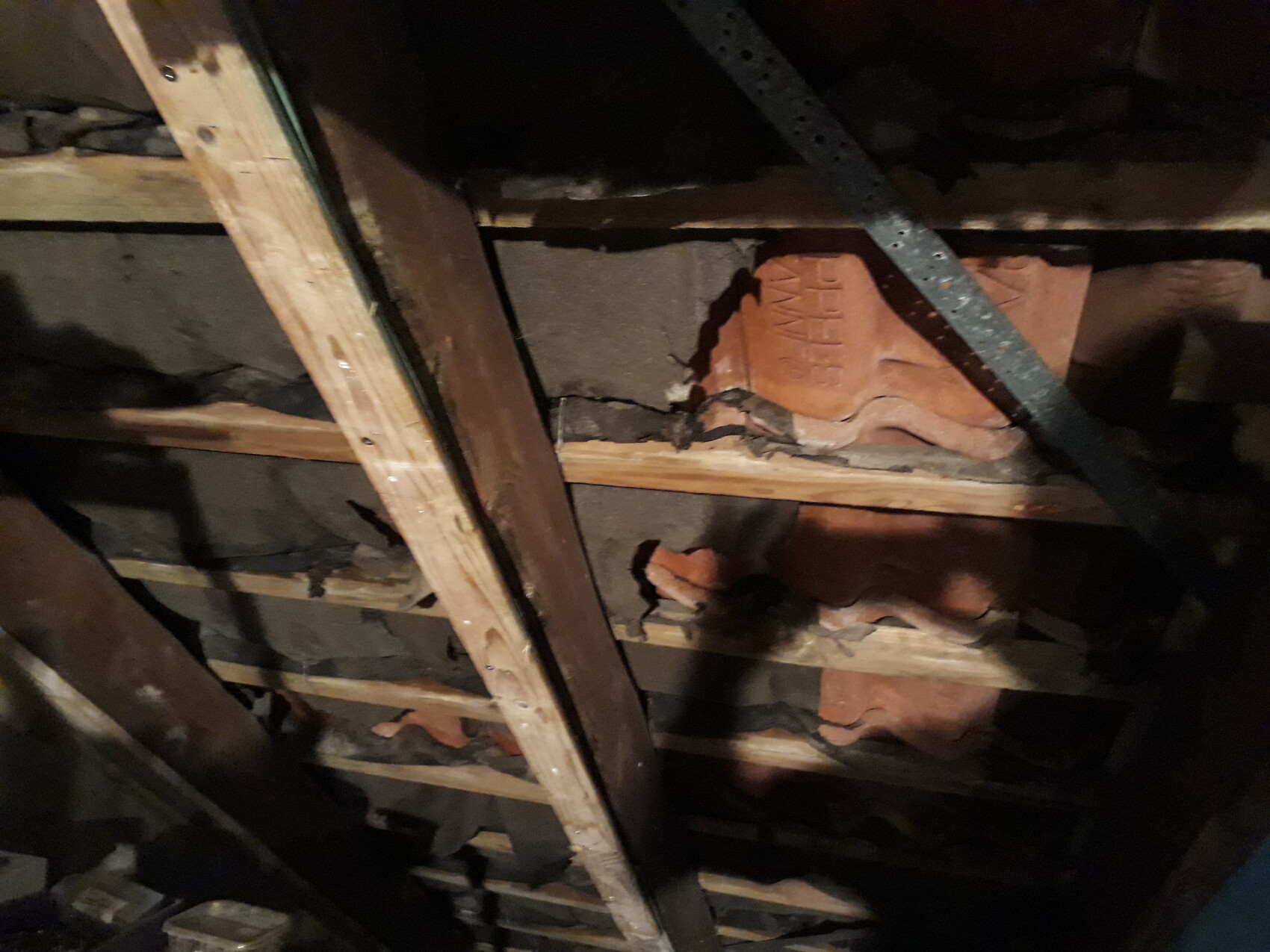
I have purchased a terraced house from 1991 with an uninsulated roof structure. When the roof tiles were originally installed, a kind of felt membrane was placed under and between the tiles. After more than 30 years, this felt has become cracked and is already peeling off in some areas. I have attached photos for reference.
Can anyone tell me what type of roof construction and felt membrane this might be?
Additionally, I would like to install insulation between the rafters. Is it possible to simply remove or cut out the felt beforehand to ensure that the ventilation layer beneath the roof tiles is not blocked?
These are so-called cardboard roof underlays—flexible sheets about 50x50cm (20x20 inches) in size, based on bitumen, which were commonly used in the 1960s and 1970s together with concrete roof tiles as an underlay. The cardboard underlay was folded around the batten, and the lower edge overlapped with the roof tile below. The respective roof tile then secured the cardboard sheet in place. During the first summer, the heat caused the material to soften slightly, allowing it to closely conform to the tiles and providing protection against driving rain.
If you remove the "cardboard," the protection against driving rain is lost. Insulation between the rafters can therefore only be installed with intact cardboard underlays and a ventilation layer or with another type of underlay. Concrete roof tiles do not have the profile of clay tiles and are not watertight against driving rain without an underlay.
Edit: I just noticed these are clay tiles. If they have the appropriate shape, they can also be used without the cardboard underlays. Check the type and consult the manufacturer’s specifications.
If you remove the "cardboard," the protection against driving rain is lost. Insulation between the rafters can therefore only be installed with intact cardboard underlays and a ventilation layer or with another type of underlay. Concrete roof tiles do not have the profile of clay tiles and are not watertight against driving rain without an underlay.
Edit: I just noticed these are clay tiles. If they have the appropriate shape, they can also be used without the cardboard underlays. Check the type and consult the manufacturer’s specifications.
Thank you for the responses. Is it possible to insulate a roof frame with bitumen felts just as easily with insulation between the rafters as with a standard roof frame? Or should the underlay membrane be installed directly beneath the bitumen felts?
@Grundaus The top floor ceiling is indeed insulated, but there is an additional 40m² (430 sq ft) of roof space above for two medium-sized rooms, including water and sewage connections for a small bathroom with a shower. It would be a shame not to make use of this potential. In fact, all the townhouse owners had the roof frame partially expanded by the builder at the time. Unfortunately, there are no documents available on how the expansion was carried out.
@Grundaus The top floor ceiling is indeed insulated, but there is an additional 40m² (430 sq ft) of roof space above for two medium-sized rooms, including water and sewage connections for a small bathroom with a shower. It would be a shame not to make use of this potential. In fact, all the townhouse owners had the roof frame partially expanded by the builder at the time. Unfortunately, there are no documents available on how the expansion was carried out.
Similar topics