
Good evening everyone,
I have a question here. Yes, I have already used Google probably a thousand times but haven’t found anything useful.
Let me start.
We bought a house built around 1960.
We want to insulate the ceiling of the top floor, either have it done professionally or possibly do it ourselves. I have a few things I would like to know about this.
About the construction
In the first section, the ceiling structure looks as follows:
- Drywall ceiling
\/
- Metal substructure for suspending
\/
- Vapor retarder
\/
- Attic (NOT WALKABLE and the roof is NOT INSULATED)
______________________________________________
In the second section, it is like this:
- Drywall ceiling
\/
- Wooden substructure
\/
- Wood wool boards or Heraklith (plastered)
\/
- Attic (NOT WALKABLE and the roof is NOT INSULATED)
Now the questions and problems.
As you have read, in the second section there is NO vapor retarder. Also, in the first section it must be assumed that the existing vapor retarder was probably not sealed properly at the wall connections (although I cannot say this for sure).
Now my question is, which insulation can we use if we insulate the top floor ceiling ourselves? We would basically need insulation that works without a vapor barrier.
My thought was to insulate with vapor open (breathable) materials.
For me, this means that if I buy vapor-open insulation and install it, then the water vapor should pass through the insulation and then escape through the roof tiles (since the roof is uninsulated).
I am not a professional, but is that roughly correct?
There is also capillary-active insulation, which I have heard absorbs some moisture and then releases it again. Do you know if there is perhaps a combination of both (capillary-active and vapor-open)?
Can you recommend insulation for this project?
Next year or the year after, we will have blown-in insulation installed in the ceiling of this floor, so if we insulate ourselves now, it would only be temporary, or if the DIY insulation works well, we might leave it as is.
But the same questions regarding vapor openness apply to the blown-in insulation.
Installing a vapor retarder afterwards is unfortunately no longer possible because the floors are already finished.
So here are the questions summarized:
1. Do I understand the concept of vapor openness correctly?
2. Do I understand capillary-active insulation correctly?
3. Which insulation could we use to insulate the top floor ceiling?
4. To remain vapor open, is it enough that, when the roof is replaced, only part of the roof slopes are insulated (basically starting from below up to the height of the floor ceiling insulation)?
5. Is the build-up in the “second section” okay with drywall > cavity > wood wool boards, or could condensation occur that might damage the drywall or the boards?
I hope you can help me a little with this.
Sorry for the long text; I hope the information is sufficient.
I have a question here. Yes, I have already used Google probably a thousand times but haven’t found anything useful.
Let me start.
We bought a house built around 1960.
We want to insulate the ceiling of the top floor, either have it done professionally or possibly do it ourselves. I have a few things I would like to know about this.
About the construction
In the first section, the ceiling structure looks as follows:
- Drywall ceiling
\/
- Metal substructure for suspending
\/
- Vapor retarder
\/
- Attic (NOT WALKABLE and the roof is NOT INSULATED)
______________________________________________
In the second section, it is like this:
- Drywall ceiling
\/
- Wooden substructure
\/
- Wood wool boards or Heraklith (plastered)
\/
- Attic (NOT WALKABLE and the roof is NOT INSULATED)
Now the questions and problems.
As you have read, in the second section there is NO vapor retarder. Also, in the first section it must be assumed that the existing vapor retarder was probably not sealed properly at the wall connections (although I cannot say this for sure).
Now my question is, which insulation can we use if we insulate the top floor ceiling ourselves? We would basically need insulation that works without a vapor barrier.
My thought was to insulate with vapor open (breathable) materials.
For me, this means that if I buy vapor-open insulation and install it, then the water vapor should pass through the insulation and then escape through the roof tiles (since the roof is uninsulated).
I am not a professional, but is that roughly correct?
There is also capillary-active insulation, which I have heard absorbs some moisture and then releases it again. Do you know if there is perhaps a combination of both (capillary-active and vapor-open)?
Can you recommend insulation for this project?
Next year or the year after, we will have blown-in insulation installed in the ceiling of this floor, so if we insulate ourselves now, it would only be temporary, or if the DIY insulation works well, we might leave it as is.
But the same questions regarding vapor openness apply to the blown-in insulation.
Installing a vapor retarder afterwards is unfortunately no longer possible because the floors are already finished.
So here are the questions summarized:
1. Do I understand the concept of vapor openness correctly?
2. Do I understand capillary-active insulation correctly?
3. Which insulation could we use to insulate the top floor ceiling?
4. To remain vapor open, is it enough that, when the roof is replaced, only part of the roof slopes are insulated (basically starting from below up to the height of the floor ceiling insulation)?
5. Is the build-up in the “second section” okay with drywall > cavity > wood wool boards, or could condensation occur that might damage the drywall or the boards?
I hope you can help me a little with this.
Sorry for the long text; I hope the information is sufficient.
kayshle schrieb:
We bought a house built around 1960.
We want to insulate the top floor ceiling, either by having it done or doing it ourselves. I understand so far.
kayshle schrieb:
In the first compartment ... what is the metal structure attached to, or what is above it? Nothing? Wooden beams? Concrete ceiling?
Is it not walkable because the space is too shallow? Or because you would break through, since there are only those few steel beams?
If there really are only the steel beams and the drywall panels: remove everything, also open up the sloped parts, fully insulate the rafters, possibly add insulation below the rafters as well, then reinstall drywall with a vapor barrier on the warm side.
General rule: vapor barrier is ALWAYS installed on the interior side of the insulation, then mineral wool insulation boards or mineral wool mats, and nothing on top of that.
There are capillary-active insulation materials, but that is the wrong application here and much too expensive, so best avoid them.
Doing a quick temporary insulation and planning to redo it in a year is nonsense. Do it right the first time. Both blown-in insulation and installing batts yourself have their pros and cons.
kayshle schrieb:
For me, if I buy vapor-permeable insulation and install it, then water vapor should basically be able to pass through the insulation and escape through the roof tiles (since the entire roof is uninsulated).Addendum: Be careful—relying on Google here can lead to dangerous half-knowledge and a risk of moisture damage!
Indoor air humidity can enter the insulation in vapor form from the inside without an interior vapor retarder (and it does), then continues to diffuse outward. If the temperature within the insulation drops below the dew point—which always happens in cold weather—the moisture condenses and the insulation becomes wet. With sufficient ventilation behind the cladding, this moisture can dry out again. However, this is not always the case, even in attics! In winter, everything at the top can become damp and start to develop mold.
Vapor-permeable materials only help by allowing moisture that has penetrated despite a vapor retarder to escape again. Nevertheless, moisture entry should be minimized as much as possible.
Hi, thanks in advance for the reply.
So, the construction is attached to the wooden joists of the ceiling between floors. Wire hangers (I hope that’s the correct term) are screwed directly into the wooden joists, and the metal profiles are basically suspended from these. Of course, there are also metal profiles fixed to the wall.
The construction consists of CD profiles and UD profiles.
The UD profiles are screwed to the wall, and the CD profiles rest inside them and are then supported by the wire hangers.
The attic is not accessible for walking since you would be stepping on the drywall or fiberboard panels, which wouldn’t be good.
Unfortunately, we can’t remove the ceiling anymore because the house, except for the insulation, is already finished.
So now we need a solution without a vapor barrier.
There has to be a way to work without a vapor barrier here.
I read somewhere that wood fiber insulation is relatively resistant to moisture—does anyone have experience with that?
We can’t be the only house that’s finished but can’t be insulated without having to tear everything out.
So, the construction is attached to the wooden joists of the ceiling between floors. Wire hangers (I hope that’s the correct term) are screwed directly into the wooden joists, and the metal profiles are basically suspended from these. Of course, there are also metal profiles fixed to the wall.
The construction consists of CD profiles and UD profiles.
The UD profiles are screwed to the wall, and the CD profiles rest inside them and are then supported by the wire hangers.
The attic is not accessible for walking since you would be stepping on the drywall or fiberboard panels, which wouldn’t be good.
Unfortunately, we can’t remove the ceiling anymore because the house, except for the insulation, is already finished.
So now we need a solution without a vapor barrier.
There has to be a way to work without a vapor barrier here.
I read somewhere that wood fiber insulation is relatively resistant to moisture—does anyone have experience with that?
We can’t be the only house that’s finished but can’t be insulated without having to tear everything out.
kayshle schrieb:
the structure is attached to the wooden beams of the floor ceilingAh, so it’s a wooden beam ceiling that has been suspended. And in part of the ceiling, additional Heraklith / wood wool cement boards were placed between the beams.
I would not recommend insulation without a vapor barrier here, but it’s easy to install one. Ideally, the vapor barrier foil should be placed between the drywall and the ceiling beams. However, that’s not possible since the boards are already installed. You can also lay a vapor barrier foil from above, between and over the beams. Mineral wool or batt insulation can then be fitted into the cavities, and depending on thickness (in total, it should be at least 140mm (5.5 inches), preferably 200-240mm (8-9.5 inches)) a complete layer can be added on top.
You can also install OSB boards on the beams, then the vapor barrier foil, and finally the insulation.
But insulation in the roof should NOT be done without a vapor barrier.
There are some insulation materials that retain their performance even when damp (such as sheep wool), but these are significantly more expensive and can still develop mold.
If the attic is not used at all, not even for storing rarely used items that could rot, I would say it doesn’t really matter whether you install a vapor barrier or not.
If the roof itself is completely uninsulated, the ventilation is more than sufficient to remove all vapors, even those from a sauna, for example.
You can also simulate this yourself using a U-value calculator; there are no issues with the dew point in the insulation.
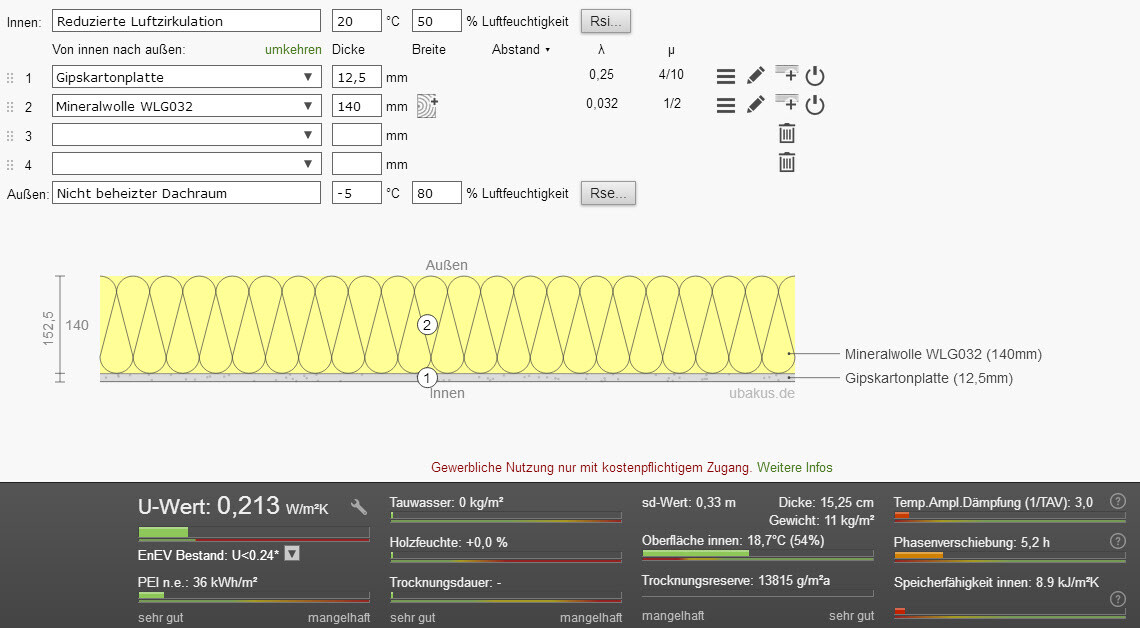
If the roof itself is completely uninsulated, the ventilation is more than sufficient to remove all vapors, even those from a sauna, for example.
You can also simulate this yourself using a U-value calculator; there are no issues with the dew point in the insulation.
Similar topics