
Hello everyone,
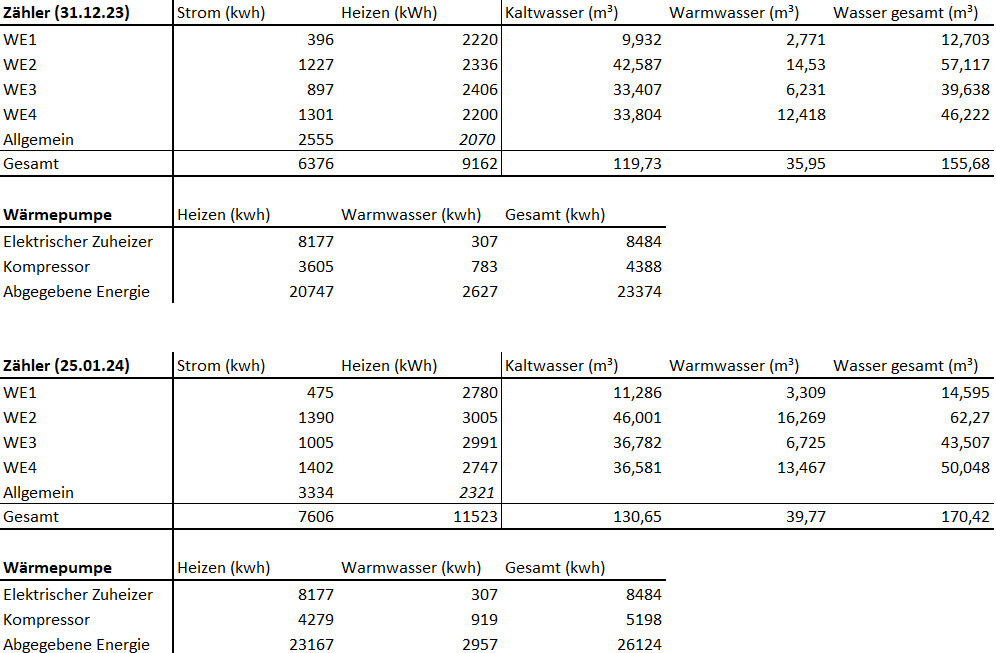
I hope this topic is posted in the right section or generally appropriate for this forum. I am a new property manager and have a problem with the billing of electricity, water, and heating electricity. I have attached an image listing all the values. The building consists of 4 residential units (Unit 1 to Unit 4).
Can someone explain how to calculate the costs for each individual unit? Calculating the total water consumption cost is not an issue, but for example, electricity is needed to heat the water. However, there is no specific price per cubic meter for hot water. How should I calculate the electricity costs for heating the hot water for each unit?
Additionally, there is a general electricity meter connected to the heat pump, which supplies, for example, the corridor lighting or the bicycle storage room lighting.
How does this work for the electricity consumption of the electric auxiliary heater and compressor? This consumption is not reflected on the general electricity meter, which I would have expected. I am a bit confused here and might be missing something. Hopefully, someone can help me.
Thank you very much and best regards
I hope this topic is posted in the right section or generally appropriate for this forum. I am a new property manager and have a problem with the billing of electricity, water, and heating electricity. I have attached an image listing all the values. The building consists of 4 residential units (Unit 1 to Unit 4).
Can someone explain how to calculate the costs for each individual unit? Calculating the total water consumption cost is not an issue, but for example, electricity is needed to heat the water. However, there is no specific price per cubic meter for hot water. How should I calculate the electricity costs for heating the hot water for each unit?
Additionally, there is a general electricity meter connected to the heat pump, which supplies, for example, the corridor lighting or the bicycle storage room lighting.
How does this work for the electricity consumption of the electric auxiliary heater and compressor? This consumption is not reflected on the general electricity meter, which I would have expected. I am a bit confused here and might be missing something. Hopefully, someone can help me.
Thank you very much and best regards
H
HilfeHilfe26 Jan 2024 05:16Hello, there are common legal standards regarding this. We have agreed with the co-owners on 18% of the heat pump being used for heating the hot water.

Where do the different heating values come from?
I suspect that the values for the heat pump originate from the heat pump itself and refer to thermal energy. However, many heat pumps also have an internal electricity meter...
The values for the individual residential units come from separate electricity meters, but if there is only one heat pump connected to a single meter, how do separate heating values come about if the heat pump is connected to just one meter?
From my perspective, splitting would only be possible if there were a separate heat meter installed for each residential unit, but then the values for the residential units would have to be higher (since it is thermal energy) than the total reading at the heat pump’s electricity meter.
It is obviously problematic if the common electricity usage is recorded on the same meter as the heat pump. In that case, you can only allocate the common electricity consumption proportionally to the heat consumption of the units, which certainly does not seem reasonable (whether it is legally allowed, I don’t know).
By the way, a high share of energy consumption from the electric auxiliary heater is an indication of poor heat pump settings.
How I would handle it, assuming that the separate heating data for each residential unit are correct:
Take the total electricity bill. Subtract the basic fees and distribute these either according to the ownership shares or per unit (depending on the condominium agreement). Do the same with the common electricity, if it can somehow be separated.
Then calculate the direct electricity usage per unit multiplied by the price per kWh and subtract that from the total.
Finally, allocate the remaining amount proportionally according to the heating share.
But much depends on where exactly the respective values come from...
I suspect that the values for the heat pump originate from the heat pump itself and refer to thermal energy. However, many heat pumps also have an internal electricity meter...
The values for the individual residential units come from separate electricity meters, but if there is only one heat pump connected to a single meter, how do separate heating values come about if the heat pump is connected to just one meter?
From my perspective, splitting would only be possible if there were a separate heat meter installed for each residential unit, but then the values for the residential units would have to be higher (since it is thermal energy) than the total reading at the heat pump’s electricity meter.
It is obviously problematic if the common electricity usage is recorded on the same meter as the heat pump. In that case, you can only allocate the common electricity consumption proportionally to the heat consumption of the units, which certainly does not seem reasonable (whether it is legally allowed, I don’t know).
By the way, a high share of energy consumption from the electric auxiliary heater is an indication of poor heat pump settings.
How I would handle it, assuming that the separate heating data for each residential unit are correct:
Take the total electricity bill. Subtract the basic fees and distribute these either according to the ownership shares or per unit (depending on the condominium agreement). Do the same with the common electricity, if it can somehow be separated.
Then calculate the direct electricity usage per unit multiplied by the price per kWh and subtract that from the total.
Finally, allocate the remaining amount proportionally according to the heating share.
But much depends on where exactly the respective values come from...
Tolentino schrieb:
From my perspective, splitting would only be possible if there is a separate heat meter for each residential unit, but then the values at the units would have to be higher (since heat energy) than the total at the heat pump’s electricity meter.Thank you very much in advance for your help.
The different heating values actually come from separate heat meters. The rest comes from the respective electricity meters and water meters of each residential unit. What do you mean by saying that the values would have to be higher then? There is a main heat meter at the heat pump that sums up the separate heat meters (I have checked this). In addition, there is also a meter on the heat pump labeled “hot water,” so presumably for domestic hot water. What should I do with this meter, or do I need it for billing?
It would probably help me a lot if someone could provide an example calculation for one residential unit. Also, what should I do with the hot water quantities in cubic meters? Do I need to account for them somehow as well?
Hmm, the whole thing seems somewhat confusing.
If the general value from the table with the residential units comes from the heat pump, where do the values in the heat pump table come from?
Are the values under heating coming from the heat meters of the residential units?
You need to make sure what is electricity consumption and what is heat quantity (both in kWh).
Normally, a heat pump should have a higher heat quantity than electricity consumption.
If the general value from the table with the residential units comes from the heat pump, where do the values in the heat pump table come from?
Are the values under heating coming from the heat meters of the residential units?
You need to make sure what is electricity consumption and what is heat quantity (both in kWh).
Normally, a heat pump should have a higher heat quantity than electricity consumption.
Similar topics