
ᐅ Commissioning of a 9.3 kWp system combined with an air-to-water heat pump and mechanical ventilation with heat recovery
Created on: 22 Mar 2020 12:43
C
Chris_Colt
Hello everyone!
Our house is almost finished on the outside, and the photovoltaic system was installed last week. Now, as part of the electrician’s work, we are trying to figure out the most efficient way to connect everything profitably.
Here are the key details:
South-facing orientation with 9.3 kWp (kilowatt peak), expected annual yield around 9,000 kWh (kilowatt hours)
No battery storage
We want to use as much electricity ourselves as possible and feed the surplus into the grid.
A Viessmann air-to-water heat pump and a mechanical ventilation system with heat recovery will be installed.
Now, my question is: What makes the most sense? Should everything run through a single meter? Two separate meters? Or like shown in the pictures attached?
Best regards
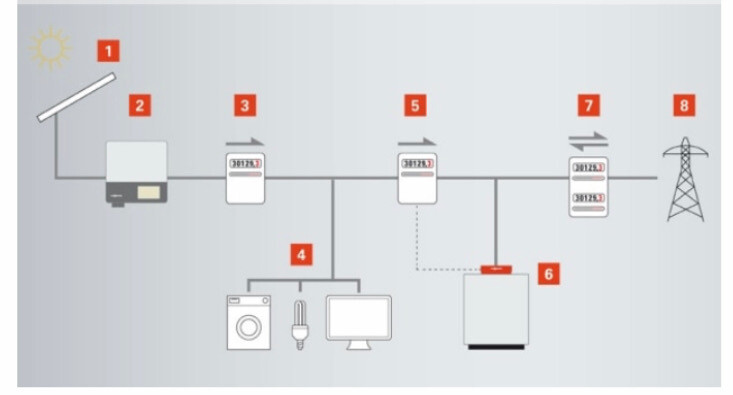
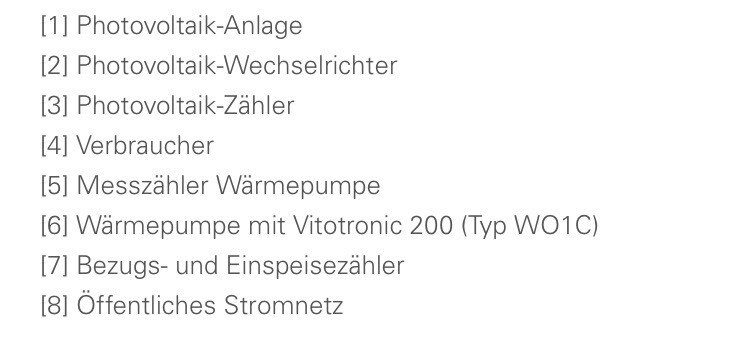
Our house is almost finished on the outside, and the photovoltaic system was installed last week. Now, as part of the electrician’s work, we are trying to figure out the most efficient way to connect everything profitably.
Here are the key details:
South-facing orientation with 9.3 kWp (kilowatt peak), expected annual yield around 9,000 kWh (kilowatt hours)
No battery storage
We want to use as much electricity ourselves as possible and feed the surplus into the grid.
A Viessmann air-to-water heat pump and a mechanical ventilation system with heat recovery will be installed.
Now, my question is: What makes the most sense? Should everything run through a single meter? Two separate meters? Or like shown in the pictures attached?
Best regards
C
Chris_Colt23 Mar 2020 18:34Do you have an intermediate meter on the air-to-water heat pump for BAFA funding purposes?

Chris_Colt schrieb:
Do you have a submeter installed on the air-to-water heat pump for BAFA funding purposes?I’m following the discussion ✌ Which funding exactly and for what purpose?
C
Chris_Colt29 Mar 2020 11:00lin0r87 schrieb:
Reading along ✌
Which subsidy and for what exactly?Before starting construction, we applied for the subsidy for our air-to-water heat pump, which is listed with BAFA, and we received approval for 1500€ (about $1,600)!
For this, a power consumption and heat meter is required, either built into the unit or installed externally.
Hi,
The electricity meter for the subsidy can be a standard DIN rail meter. It is advisable to install this and a heat meter regardless of the subsidy. Otherwise, how else can you determine the efficiency of the heat pump? I wouldn’t rely on the heat pump’s own readings, as many models calculate values during operation that often don’t reflect actual real-world performance.
The electricity meter for the heat pump tariff is provided either by the default metering point operator (usually the distribution network operator) or by a contracted metering point operator. To use photovoltaic electricity for the heat pump, a so-called cascade metering setup is required. Not all metering operators offer this. Additionally, the second meter incurs extra costs that are not offset by lower electricity prices because new buildings generally require little electricity for the heat pump due to the usually low heating demand.
Your photovoltaic system will cover about 20%-30% of the heating demand. For hot water, it will cover significantly more. The remaining approximately 60%-70% of the electricity must then be purchased. It is doubtful that enough electricity is generated for cascade metering to be cost-effective. A second meter without cascade metering is certainly more expensive than simply using your own photovoltaic electricity.
Best regards,
gnika77
The electricity meter for the subsidy can be a standard DIN rail meter. It is advisable to install this and a heat meter regardless of the subsidy. Otherwise, how else can you determine the efficiency of the heat pump? I wouldn’t rely on the heat pump’s own readings, as many models calculate values during operation that often don’t reflect actual real-world performance.
The electricity meter for the heat pump tariff is provided either by the default metering point operator (usually the distribution network operator) or by a contracted metering point operator. To use photovoltaic electricity for the heat pump, a so-called cascade metering setup is required. Not all metering operators offer this. Additionally, the second meter incurs extra costs that are not offset by lower electricity prices because new buildings generally require little electricity for the heat pump due to the usually low heating demand.
Your photovoltaic system will cover about 20%-30% of the heating demand. For hot water, it will cover significantly more. The remaining approximately 60%-70% of the electricity must then be purchased. It is doubtful that enough electricity is generated for cascade metering to be cost-effective. A second meter without cascade metering is certainly more expensive than simply using your own photovoltaic electricity.
Best regards,
gnika77
Similar topics