
ᐅ Electrical Planning for New Construction – Experiences and Feedback
Created on: 1 Aug 2021 20:15
J
jspawn1
Hello,
I am currently working on the electrical planning for our new build. To be honest, I have never dealt with these matters before, so I would really appreciate your opinions on the placement and number of power outlets, as well as any comments on what might be missing or unclear in the drawing.
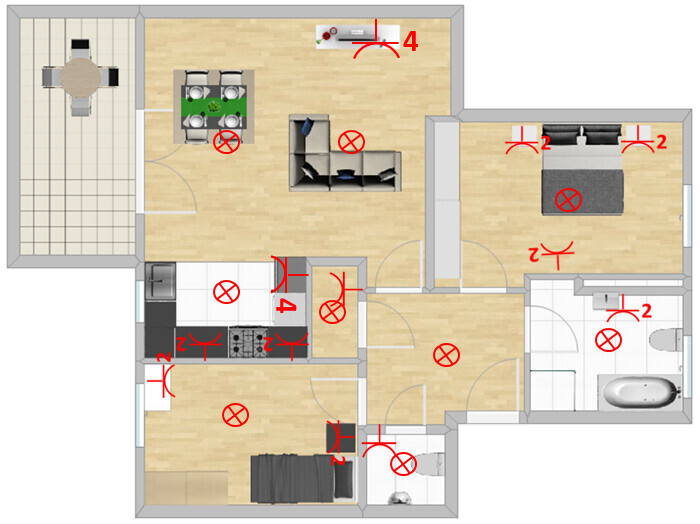
Thank you very much!
I am currently working on the electrical planning for our new build. To be honest, I have never dealt with these matters before, so I would really appreciate your opinions on the placement and number of power outlets, as well as any comments on what might be missing or unclear in the drawing.
Thank you very much!
Always have a double wall outlet installed for LAN.
Where is everything centralized? I am still missing the location where the LAN and TV cables terminate centrally. Of course, you will also need power there for devices like routers, switches, ONT, etc.
Another thing to clarify with your electrician is how to organize the central location for LAN and TV. Should everything be mounted on the wall, use a multimedia distribution panel, or a small network cabinet?
Regarding TV, how is this handled in your building? Is there a central satellite system or cable connection? Alternatively, you could skip the TV outlets and rely on IPTV. I believe traditional TV will be used less and less.
Where is everything centralized? I am still missing the location where the LAN and TV cables terminate centrally. Of course, you will also need power there for devices like routers, switches, ONT, etc.
Another thing to clarify with your electrician is how to organize the central location for LAN and TV. Should everything be mounted on the wall, use a multimedia distribution panel, or a small network cabinet?
Regarding TV, how is this handled in your building? Is there a central satellite system or cable connection? Alternatively, you could skip the TV outlets and rely on IPTV. I believe traditional TV will be used less and less.
M
motorradsilke3 Aug 2021 03:50K1300S schrieb:
I always find it easiest to set some basic rules and then apply them, for example, a double outlet in every corner, an outlet under every light switch. If you keep that in mind and then mark the light switches as well, you’re almost done.Our electrician suggested the same to us. I found it impractical, and after planning, I realized it wouldn’t have worked well for us either. What’s the use of an outlet in the corner if the desk or sofa will be placed in the middle of the wall, while a cabinet stands in the corner? Then I just end up running extension cords to the needed spots. I think it makes more sense to position outlets according to the actual furniture layout.

No one is stopping you from taking your current furniture arrangement into account as well, but I would still recommend establishing a practical standard. You simply don’t know how the space will be used in ten years, so you shouldn’t base decisions only on the present setup. Additionally, a good electrical installation is an important factor for potential resale, even if that seems unlikely right now. Last but not least, outlets are relatively inexpensive, even with high-end electricians or general contractors, so it’s not worth spending much time deciding on them. It’s better to have them than to need them later.

I agree completely with motorradsilke.
Placing electrical outlets in the corners is only done by those who are too lazy to properly plan.
The positions of doors, windows, etc., already determine most of the furniture placement.
In the bedroom, at the bedside tables, have one switch for the main light, one switch for a night light, and an outlet with two USB ports.
For the night light, I would prefer one or two pendant lamps above the bedside table or a wall lamp.
A bedside lamp just takes up space. I would do the same in the children’s room.
Are there any mirrors? Should they be illuminated?
If yes, prepare one fixture point plus a switch.
Possibly prepare wiring for a shower toilet 😉
Placing electrical outlets in the corners is only done by those who are too lazy to properly plan.
The positions of doors, windows, etc., already determine most of the furniture placement.
In the bedroom, at the bedside tables, have one switch for the main light, one switch for a night light, and an outlet with two USB ports.
For the night light, I would prefer one or two pendant lamps above the bedside table or a wall lamp.
A bedside lamp just takes up space. I would do the same in the children’s room.
Are there any mirrors? Should they be illuminated?
If yes, prepare one fixture point plus a switch.
Possibly prepare wiring for a shower toilet 😉

motorradsilke schrieb:
I think it makes more sense to position the power outlets according to the actual furniture layout.and still take into account the basic electrical setup of the room. Otherwise, it might not be possible to use the room without furniture for the next 100 years. And a child’s room can become a sewing room, guest room, care room, snoring room, home theater, etc. bauenmk20207 Aug 2021 08:35
AMNE3IA schrieb:
I completely agree with motorradsilke.
Placing outlets only in the corners is a sign of not putting enough thought into the planning.
The positions of doors, windows, etc., usually determine most furniture placements anyway.
In the bedroom, next to the bedside tables, I recommend one switch for the main light, one switch for a night light, and an outlet with two USB ports.
For a night light, I would rather prefer one or two pendant lights above the bedside table or a wall lamp.
A bedside lamp just takes up space. I would apply the same approach in a child’s room.
Are there mirrors? Should they be illuminated?
Then prepare one outlet and switch for this purpose.
Consider preparing wiring for a shower toilet 😉 * A bedside lamp with a touch-sensitive body (3-level dimmable) stands on a raised bedside table with "two" tiers. If you have a higher bed (box spring bed), the bedside table should be taller as well. This way, you have space on top for the bedside lamp and a lower tier for children’s books for reading, etc.
* I find USB outlets practical but not essential. They also add a significant cost.
* Outlets in the corner are practical—even if a piece of furniture is placed in front of them! Back panels of furniture can be cut out, allowing you to connect electrical devices discreetly.
Similar topics