
ᐅ Laying New Lawn After Building a House: Essential Steps
Created on: 12 Dec 2020 19:50
H
Harry im Club
Hello everyone,
Our future house is located on a meadow, but the grass growing there is rather coarse now (I believe it was previously pasture land). What is the best approach after the house is completed? Does the old topsoil need to be replaced, or can new grass simply be sown on the existing soil? If so, how do you remove the old grass?
Is this something that can easily be done as a DIY project, or will I need an excavator, low-loader, and more manpower?
Good luck
Our future house is located on a meadow, but the grass growing there is rather coarse now (I believe it was previously pasture land). What is the best approach after the house is completed? Does the old topsoil need to be replaced, or can new grass simply be sown on the existing soil? If so, how do you remove the old grass?
Is this something that can easily be done as a DIY project, or will I need an excavator, low-loader, and more manpower?
Good luck
P
Pinkiponk13 Dec 2020 19:40seat88 schrieb:
Wheel loaders, excavators, or other equipment certainly make the work much easier.And they make it much more enjoyable for people who are (probably) not professional excavator operators. I have been dreaming of a ride-on lawn mower for a long time.B
BBaumeister18 Dec 2020 14:16Ultimately, it depends on the size of the area. In our case, the situation was as follows:
The soil consisted of clay and stones and had also been compacted due to construction work. The lawn area is 400 sqm (4,306 sq ft).
I had a total of 15 cm (6 inches) of new topsoil added. Check if your soil is good by simply digging a little with a spade. In my opinion, the soil should be fine and reusable.
My tip: Make it fertile. I was lucky because a nearby compost facility didn’t know what to do with the material. I got 10 cubic meters (353 cubic feet) of compost for a flat delivery fee of 40 €, which I spread evenly using a wheelbarrow.
Rent a motorized tiller with a gasoline engine and till the entire area. You will also work the compost in during this step. If the soil is clayey or the location is shady, mix in some coarse sand (known as screed sand) to prevent waterlogging.
Buy a large rake and smooth and crumble the soil well. If this is too difficult, a gasoline-powered scarifier works better.
Turf is not necessary if you do the following: evenly spread grass seed, then cover it with a very thin layer of lawn soil—just enough to barely cover the seed. After that, press everything firmly down with a lawn roller and NEVER let the area dry out.
I followed these steps in May 2019 and had a wonderfully beautiful lawn by mid-June. It was a bit thin if you stood directly on it at first, but that disappeared very quickly.
Since the lawn was new anyway, I also buried a pop-up sprinkler at each corner of the lawn and ran the pipes under the turf surface. Also, think about how the lawn will be used. There are so-called wear-resistant lawns or play and sports lawns, which tolerate playing children, energetic dogs, and occasional garden parties while still looking good if mowed regularly.
The soil consisted of clay and stones and had also been compacted due to construction work. The lawn area is 400 sqm (4,306 sq ft).
I had a total of 15 cm (6 inches) of new topsoil added. Check if your soil is good by simply digging a little with a spade. In my opinion, the soil should be fine and reusable.
My tip: Make it fertile. I was lucky because a nearby compost facility didn’t know what to do with the material. I got 10 cubic meters (353 cubic feet) of compost for a flat delivery fee of 40 €, which I spread evenly using a wheelbarrow.
Rent a motorized tiller with a gasoline engine and till the entire area. You will also work the compost in during this step. If the soil is clayey or the location is shady, mix in some coarse sand (known as screed sand) to prevent waterlogging.
Buy a large rake and smooth and crumble the soil well. If this is too difficult, a gasoline-powered scarifier works better.
Turf is not necessary if you do the following: evenly spread grass seed, then cover it with a very thin layer of lawn soil—just enough to barely cover the seed. After that, press everything firmly down with a lawn roller and NEVER let the area dry out.
I followed these steps in May 2019 and had a wonderfully beautiful lawn by mid-June. It was a bit thin if you stood directly on it at first, but that disappeared very quickly.
Since the lawn was new anyway, I also buried a pop-up sprinkler at each corner of the lawn and ran the pipes under the turf surface. Also, think about how the lawn will be used. There are so-called wear-resistant lawns or play and sports lawns, which tolerate playing children, energetic dogs, and occasional garden parties while still looking good if mowed regularly.
B
BBaumeister18 Dec 2020 14:25As an additional note, the costs:
- Compost: 40 €
- Grass seed: 70 €
- Topsoil (probably not necessary in your case): 60 cubic meters at 20 € = 1,200 €
- Rent for motorized tiller: 40 €
- Lawn soil for covering: 80 bags at 8 € = 480 €
400 square meters (approximately 4,300 square feet) of turf would probably have been significantly more expensive.
- Compost: 40 €
- Grass seed: 70 €
- Topsoil (probably not necessary in your case): 60 cubic meters at 20 € = 1,200 €
- Rent for motorized tiller: 40 €
- Lawn soil for covering: 80 bags at 8 € = 480 €
400 square meters (approximately 4,300 square feet) of turf would probably have been significantly more expensive.
Plow the meadow using a motorized tiller.
It’s best to do this now. In spring, when the weeds start to sprout, kill everything at once with glyphosate. Now harrow the area, using a large rake to level the ground and break up the soil finely. Sow grass seeds and roll the soil in late April. Make sure it gets enough water to germinate. You will have a nice young lawn by June.
It’s best to do this now. In spring, when the weeds start to sprout, kill everything at once with glyphosate. Now harrow the area, using a large rake to level the ground and break up the soil finely. Sow grass seeds and roll the soil in late April. Make sure it gets enough water to germinate. You will have a nice young lawn by June.
W
WilderSueden18 Dec 2020 21:07BBaumeister schrieb:
Since the lawn was being redone anyway, I buried a pop-up sprinkler at each corner of the lawn area and ran the pipes underneath the lawn. Really cool idea. It just went straight onto my to-do list.
For our lawn seed, we chose Lord Super Lawn from a master gardener. It’s popular for commercial use because it germinates well, grows dense, and produces an attractive lawn, even with plenty of fine-leaved plants. However, the lawn requires nutrients and good soil, so after the first mowing we applied an NPMgK fertilizer. Nitrogen provides nourishment, phosphorus and potassium support soil life, which quickly attracts earthworms and other beneficial organisms. Magnesium is important for leaf greenness.
We mow with a mulching mower, so the lawn essentially feeds itself. This also allows for more sparing fertilization compared to the recommendations on the packages. After three years, our lawn can definitely hold its own compared to lawns with turf rolls. It is free of thistles, without dandelions and daisies, and I keep clover growth trimmed down.

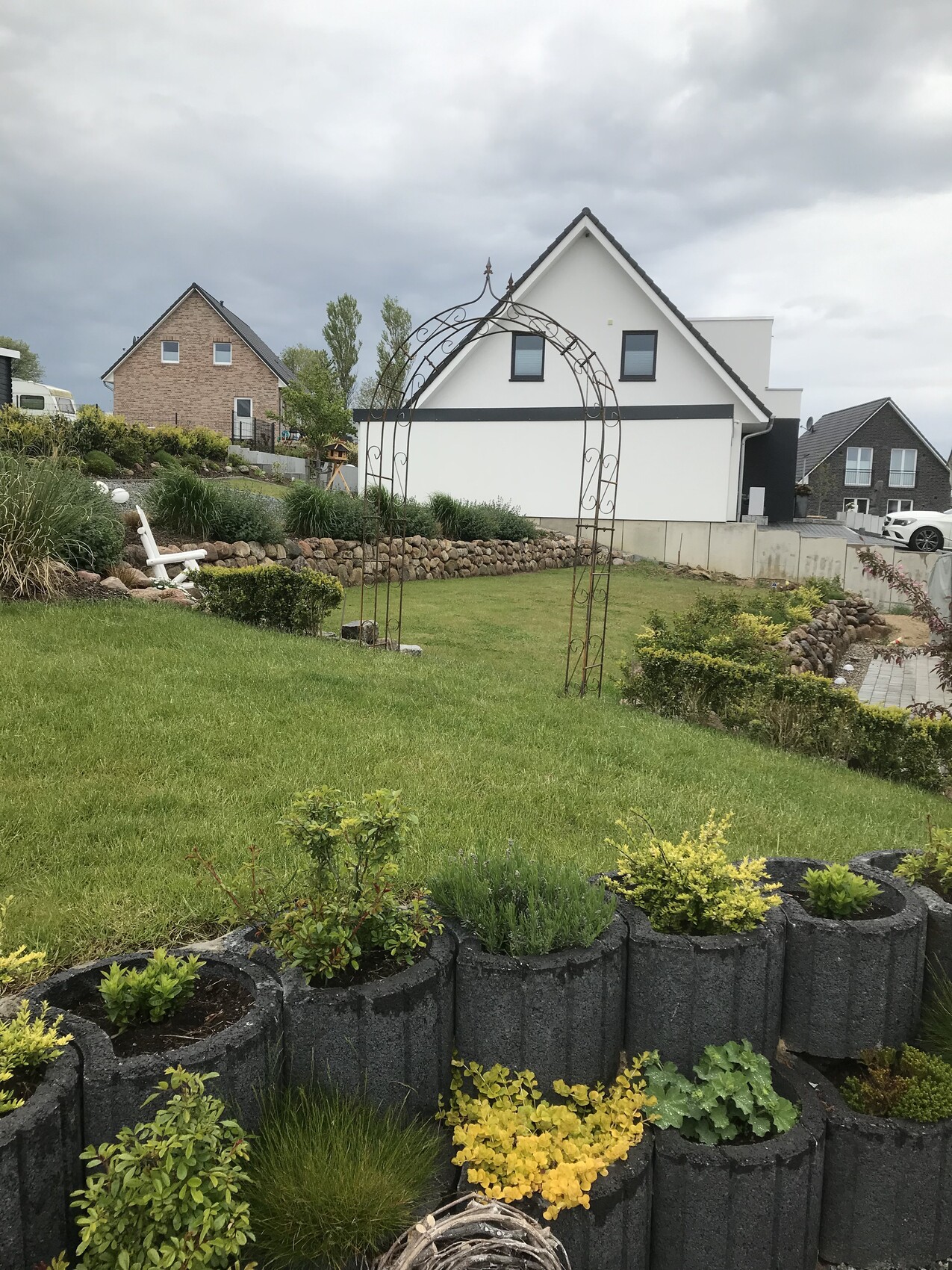
We mow with a mulching mower, so the lawn essentially feeds itself. This also allows for more sparing fertilization compared to the recommendations on the packages. After three years, our lawn can definitely hold its own compared to lawns with turf rolls. It is free of thistles, without dandelions and daisies, and I keep clover growth trimmed down.
Similar topics