
Hello,
I didn’t find anything in the search. My architect initially planned to use cellular glass gravel under the slab-on-grade (without a basement) on strip foundations. However, he now suggests that, for cost reasons, this could be omitted and instead the insulation installed below the screed, since the clay soil beneath shouldn’t freeze in winter.
This would save me about 5,000 euros (approximately $5,000). From his perspective, this is acceptable, but he asked me if I think it’s okay. I’ve been researching for two days now but haven’t found any useful information.
What do you think?
I didn’t find anything in the search. My architect initially planned to use cellular glass gravel under the slab-on-grade (without a basement) on strip foundations. However, he now suggests that, for cost reasons, this could be omitted and instead the insulation installed below the screed, since the clay soil beneath shouldn’t freeze in winter.
This would save me about 5,000 euros (approximately $5,000). From his perspective, this is acceptable, but he asked me if I think it’s okay. I’ve been researching for two days now but haven’t found any useful information.
What do you think?
S
Sebastian7929 Mar 2016 10:32You don’t actually have a low temperature there because you have insulation in place.
You’re making a mistake by looking at the layers as isolated from each other.
You’re making a mistake by looking at the layers as isolated from each other.
E
elVincent29 Mar 2016 23:38But if I consider the profile from the inside to the outside, the temperature inside the insulation drops from room temperature to the slab temperature (not exactly, but approximately). The slab itself is exposed to the ground temperature from below, as there is no insulation underneath. The thermal resistance (i.e., the first potential temperature change) only begins within the insulation layer.
I sketched this in a U-value calculator (I hope attaching the graphic is allowed):
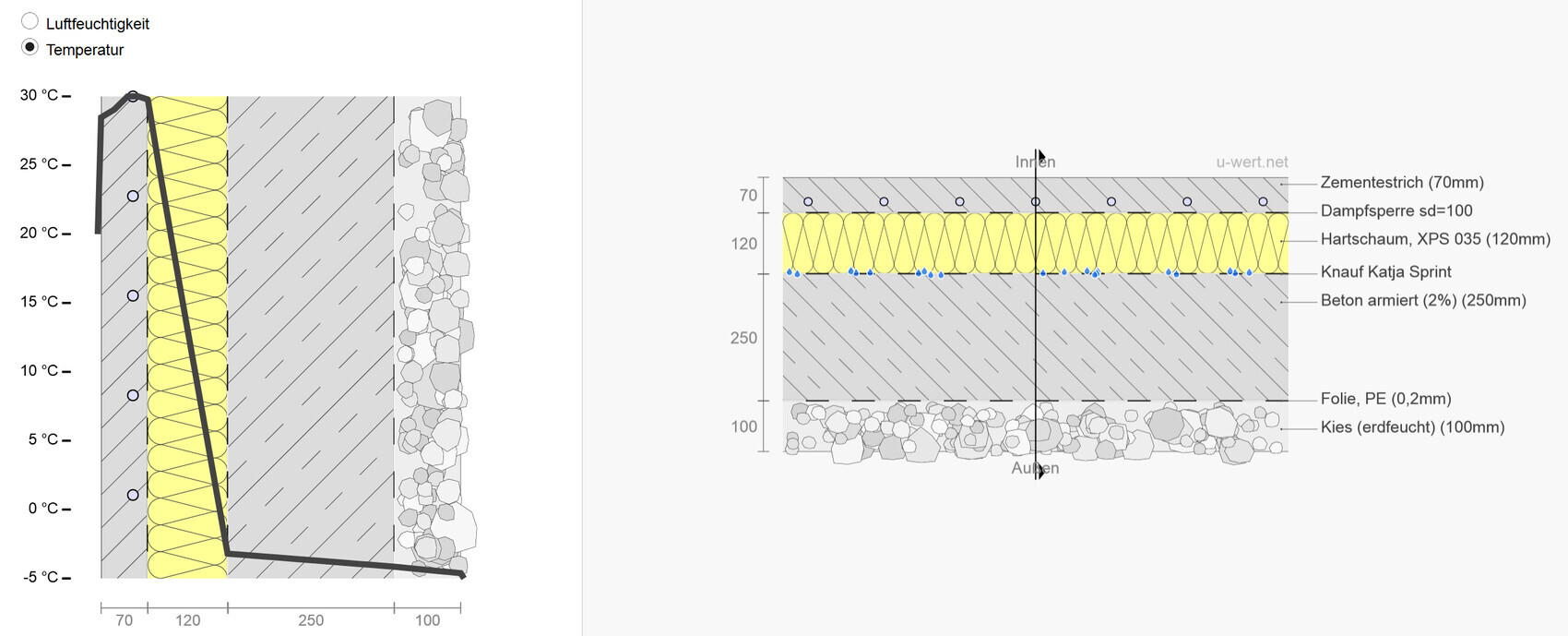
I sketched this in a U-value calculator (I hope attaching the graphic is allowed):
S
Sebastian7930 Mar 2016 01:53And where does the condensate go?
By the way, it never freezes for me – at least with basement construction.
By the way, it never freezes for me – at least with basement construction.
B
Bieber081530 Mar 2016 06:50@elVincent: The insulation is sealed against moisture at the top with a vapor barrier and at the bottom with "Knauf Katja Sprint" (waterproofing membrane). Any moisture present during installation can be ignored, as it should be near zero and is not a factor.
S
Sebastian7930 Mar 2016 07:28No, he means that condensation forms because of temperature differences – but that can’t happen because no warm air can settle on the surface of the ground slab.
That’s his mistake in reasoning...
That’s his mistake in reasoning...
E
elVincent30 Mar 2016 20:40The condensate is the droplets shown in the image on the right (by the way, I didn’t add those, it was the U-value calculator).
I’m not making a logical error here; I’m simply questioning the issue. The answer to my original question about how the floor construction should be designed is that a vapor barrier above the insulation is necessary to prevent indoor moisture from reaching the surface of the concrete slab. Only then can condensation truly be avoided. This must be installed very carefully.
Considering the entire effort involved, I believe perimeter insulation beneath the concrete slab is ultimately simpler and less prone to errors.
I’m not making a logical error here; I’m simply questioning the issue. The answer to my original question about how the floor construction should be designed is that a vapor barrier above the insulation is necessary to prevent indoor moisture from reaching the surface of the concrete slab. Only then can condensation truly be avoided. This must be installed very carefully.
Considering the entire effort involved, I believe perimeter insulation beneath the concrete slab is ultimately simpler and less prone to errors.
Similar topics