
Hello,
The on-site quality inspector noticed that the ring beam only has 5cm (2 inches) of insulation. He said this creates a thermal bridge.
I have attached a picture for you to see.
The suggestion was now to increase it to 8cm (3 inches) and use insulation with a higher thermal conductivity class. I communicated this to the general contractor, who wanted to discuss it with the structural engineer.
I would never have noticed this myself, and if it is true, then the quality inspection has already paid off.
What do you think?
Thanks for your feedback.
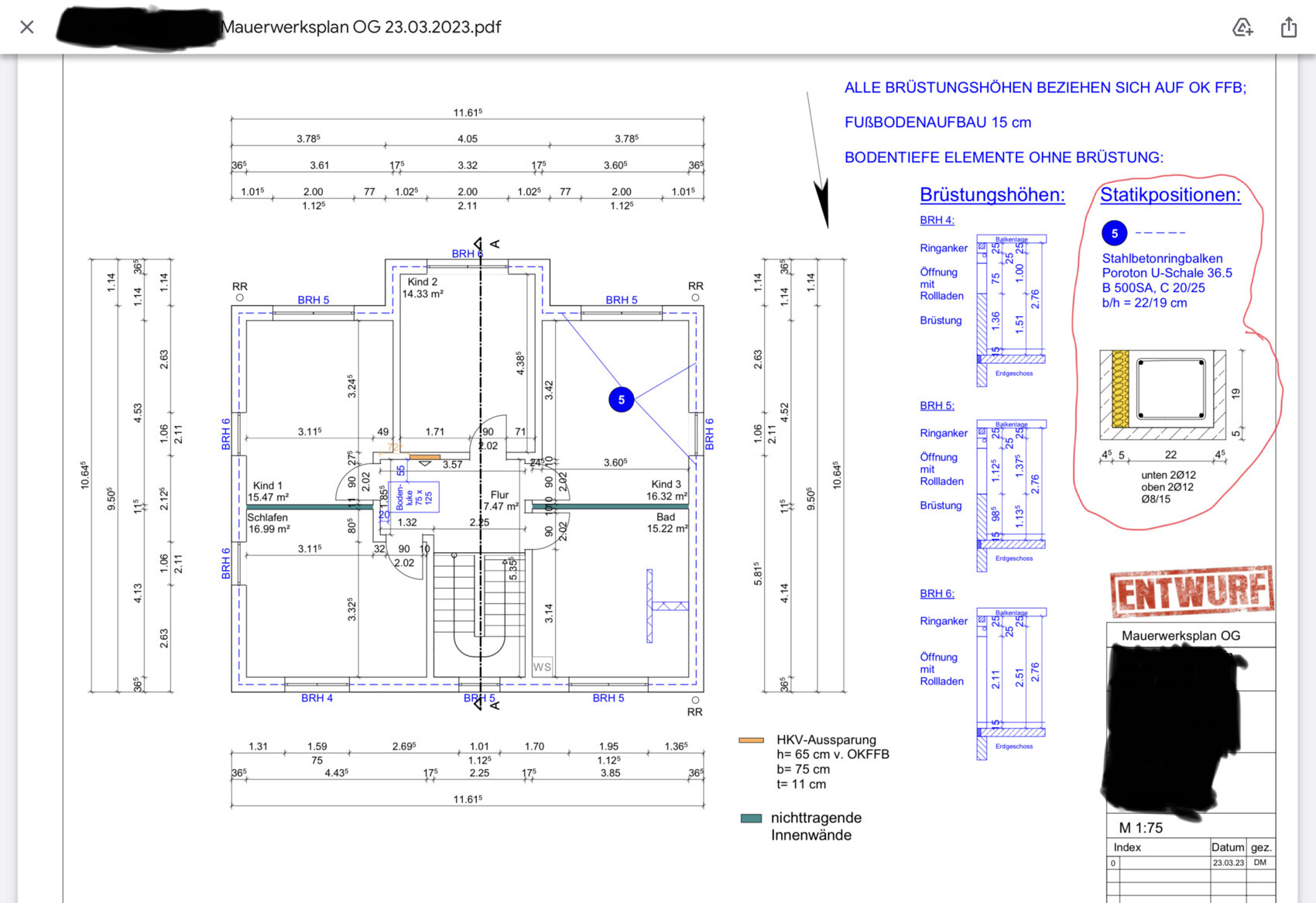
The on-site quality inspector noticed that the ring beam only has 5cm (2 inches) of insulation. He said this creates a thermal bridge.
I have attached a picture for you to see.
The suggestion was now to increase it to 8cm (3 inches) and use insulation with a higher thermal conductivity class. I communicated this to the general contractor, who wanted to discuss it with the structural engineer.
I would never have noticed this myself, and if it is true, then the quality inspection has already paid off.
What do you think?
Thanks for your feedback.
In der Ruine schrieb:
I have lived in various prefabricated concrete buildings for 20 years and drilled into exterior walls as well. I've never encountered anything like aerated concrete there. Are you sure?There have been different construction methods. Either a double-wall system with insulation in between. In that case, no lightweight concrete was used, but an insulating layer was included, or lightweight concrete on the inside and an additional layer of concrete panels on the outside for protection against rain and snow. Solid concrete or reinforced concrete as a single wall was only used for bunkers. There, the wall primarily does not serve thermal insulation purposes—except against extreme heat.
dertill schrieb:
Purely by calculation, you would achieve better results with Resol panels and 8cm (3 inches), but for me, at least regarding the insulation thickness, a sufficiently oversized ring beam would be more important.I'm not entirely sure what you mean. Are you suggesting I should simply go for 8cm (3 inches) insulation with a thermal conductivity of 0.035 W/(m·K)?
 In der Ruine31 May 2023 09:02
dertill schrieb:
Either double-layered with insulation in between. In that case, no lightweight concrete was used,You are noticeably right. I just looked it up and found a schematic layout.Gregor_K schrieb:
I'm not entirely sure what you mean. Do you suggest I should simply use 8cm (3 inches) insulation with a thermal conductivity of 0.035 W/(m·K)? Actually, it’s the other way around.
The structural calculation of the house was done based on the existing ring beam. If you increase the insulation from 5 cm (2 inches) to 8 cm (3 inches), something has to give. Either part of the Poroton bricks is reduced (which would only have a minor effect on the wall’s U-value at that spot) or the ring beam becomes 3 cm (1 inch) narrower. The latter would have a greater impact on energy performance but also on structural integrity.
Therefore, if you want to improve insulation, I would suggest switching from XPS insulation with a thermal conductivity of 0.035 W/(m·K) to resol foam with 0.022 W/(m·K). This would not require changing the Poroton bricks and would leave the ring beam’s structural properties unaffected.
U-value = 1 / ( (1 / Lambda) * thickness )
XPS 5 cm (2 inches): 1 / (1 / 0.035 * 0.05 m) = 0.7 W/m²K
XPS 8 cm (3 inches): 1 / (1 / 0.035 * 0.08 m) = 0.44 W/m²K
Resol 5 cm (2 inches): 1 / (1 / 0.022 * 0.05 m) = 0.44 W/m²K
Resol 8 cm (3 inches): 1 / (1 / 0.022 * 0.08 m) = 0.28 W/m²K
Additionally, you have to consider the thermal resistance of the Poroton bricks, plus the heat transfer resistances on the inside and outside surfaces. That means the 5 cm (2 inches) resol option results in a U-value of around 0.25 to 0.3 W/m²K at this point, and 8 cm (3 inches) would probably be somewhat lower.
However, a 0.05 W/m²K difference over an area of about 10 m² (108 square feet) has no noticeable effect on the overall heating demand of the house.
dertill schrieb:
Exactly the other way around.
The structural design of the house was calculated based on the existing ring beam. If you increase the insulation thickness from 5 cm (2 inches) to 8 cm (3 inches), something has to give. Either part of the Poroton bricks (which would have only a minor effect on the wall’s U-value at this point) or the ring beam would have to be reduced by 3 cm (1 inch). The latter would have a bigger impact on energy performance but also on the structure.
Therefore, if this is desired, I would rather recommend switching from XPS with a thermal conductivity of 0.035 W/mK to resol foam with 0.022 W/mK. This would not require any changes to the Poroton bricks, and the structural integrity regarding the ring beam would remain unaffected.
U-value = 1 / (1 / Lambda * d)
XPS 5 cm (2 inches): 1 / (1 / 0.035 * 0.05 m) = 0.7 W/m²K
XPS 8 cm (3 inches): 1 / (1 / 0.035 * 0.08 m) = 0.44 W/m²K
Resol 5 cm (2 inches): 1 / (1 / 0.022 * 0.05 m) = 0.44 W/m²K
Resol 8 cm (3 inches): 1 / (1 / 0.022 * 0.08 m) = 0.28 W/m²K
Additionally, there is the thermal resistance of the Poroton bricks plus the internal and external surface heat transfer resistances, so with the 5 cm (2 inches) Resol option you end up with a U-value around 0.25 to 0.3 W/m²K at this location, and probably even a bit lower with 8 cm (3 inches).
However, a difference of 0.05 W/m²K over an area of about 10 m² (108 ft²) will not have a noticeable effect on the overall heat demand of the house. That’s exactly what we will do now! So just increase the insulation to Resol foam at 5 cm (2 inches) thickness, changing from 0.035 to 0.022 W/mK. Thank you very much!
Similar topics