
Hello everyone,
Today, during the blower door test, we realized that we apparently installed the vapor barrier incorrectly. A brief background: we built a two-story house with a hipped roof and a 35° (35-degree) roof pitch. The heating and ventilation system is located in the attic. Therefore, we installed 24mm (1 inch) insulation and an Isover vapor barrier on both the wooden beam ceiling of the upper floor and in the attic.
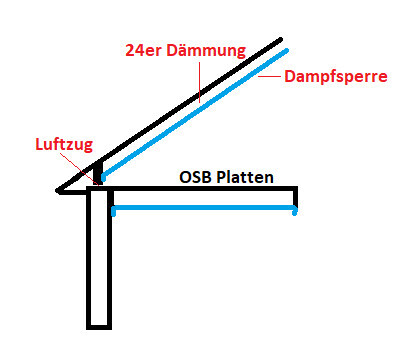
Now to the issue. We attached the vapor barrier in the attic to the bottom chord of the roof truss. This rests directly on the ring beam. During the blower door test, it was noticed that air was flowing between the bottom chord and the ring beam into the attic. I have since learned that the vapor barrier should have been sealed all the way to the masonry.
What is the best way to proceed? Would it possibly be sufficient to seal and caulk the bottom chord with silicone? The attic is only used as storage space and houses the heating/ventilation equipment. Or should I cut a 30cm (12 inch) strip of the vapor barrier and connect the bottom chord to the masonry?
I quickly made a sketch for better illustration. I would appreciate your advice.
Today, during the blower door test, we realized that we apparently installed the vapor barrier incorrectly. A brief background: we built a two-story house with a hipped roof and a 35° (35-degree) roof pitch. The heating and ventilation system is located in the attic. Therefore, we installed 24mm (1 inch) insulation and an Isover vapor barrier on both the wooden beam ceiling of the upper floor and in the attic.
Now to the issue. We attached the vapor barrier in the attic to the bottom chord of the roof truss. This rests directly on the ring beam. During the blower door test, it was noticed that air was flowing between the bottom chord and the ring beam into the attic. I have since learned that the vapor barrier should have been sealed all the way to the masonry.
What is the best way to proceed? Would it possibly be sufficient to seal and caulk the bottom chord with silicone? The attic is only used as storage space and houses the heating/ventilation equipment. Or should I cut a 30cm (12 inch) strip of the vapor barrier and connect the bottom chord to the masonry?
I quickly made a sketch for better illustration. I would appreciate your advice.
Adhering a vapor barrier membrane to the concrete floor can be done, for example, with pro clima Orcon F. The adhesive tape pro clima tescon vana is very suitable for all smooth, non-mineral surfaces. Instead of using a strip of vapor barrier membrane, the joint between the beam and the concrete can also be directly sealed with Orcon F, for example – but this then becomes a gamble on how much the beams might potentially "bend" over the next 50 years and possibly cause the sealing joint to fail.