
Hello everyone,
Today, during the blower door test, we realized that we apparently installed the vapor barrier incorrectly. A brief background: we built a two-story house with a hipped roof and a 35° (35-degree) roof pitch. The heating and ventilation system is located in the attic. Therefore, we installed 24mm (1 inch) insulation and an Isover vapor barrier on both the wooden beam ceiling of the upper floor and in the attic.
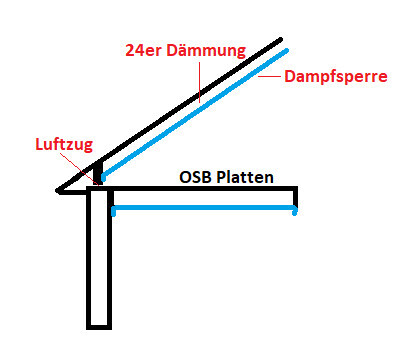
Now to the issue. We attached the vapor barrier in the attic to the bottom chord of the roof truss. This rests directly on the ring beam. During the blower door test, it was noticed that air was flowing between the bottom chord and the ring beam into the attic. I have since learned that the vapor barrier should have been sealed all the way to the masonry.
What is the best way to proceed? Would it possibly be sufficient to seal and caulk the bottom chord with silicone? The attic is only used as storage space and houses the heating/ventilation equipment. Or should I cut a 30cm (12 inch) strip of the vapor barrier and connect the bottom chord to the masonry?
I quickly made a sketch for better illustration. I would appreciate your advice.
Today, during the blower door test, we realized that we apparently installed the vapor barrier incorrectly. A brief background: we built a two-story house with a hipped roof and a 35° (35-degree) roof pitch. The heating and ventilation system is located in the attic. Therefore, we installed 24mm (1 inch) insulation and an Isover vapor barrier on both the wooden beam ceiling of the upper floor and in the attic.
Now to the issue. We attached the vapor barrier in the attic to the bottom chord of the roof truss. This rests directly on the ring beam. During the blower door test, it was noticed that air was flowing between the bottom chord and the ring beam into the attic. I have since learned that the vapor barrier should have been sealed all the way to the masonry.
What is the best way to proceed? Would it possibly be sufficient to seal and caulk the bottom chord with silicone? The attic is only used as storage space and houses the heating/ventilation equipment. Or should I cut a 30cm (12 inch) strip of the vapor barrier and connect the bottom chord to the masonry?
I quickly made a sketch for better illustration. I would appreciate your advice.
Have you already sealed the upper floor (OG) against the attic floor (DG)? And there is still a draft in the attic? Then there must be another issue, or how should the sketch be interpreted? Otherwise, without knowing any further conditions, the second option (new strip) would be the correct approach.
Exactly, the intermediate ceiling is also insulated. The roof had to be insulated due to the heating system. We also wanted to insulate the upper floor additionally for soundproofing purposes (all done as DIY). It certainly doesn’t hurt to have both insulated.
If we now extend the vapor retarder down to the ring beam, the problem should be solved, right? I was kind of hoping that the much simpler solution here (sealing with silicone) might also work. But we’d rather do it properly once and for all.
Just to be sure: we did a blower door test once with the attic staircase closed. Everything was fine then. In a further test with the hatch open, a draft was noticeable between the ring beam and the foot purlin.
If we now extend the vapor retarder down to the ring beam, the problem should be solved, right? I was kind of hoping that the much simpler solution here (sealing with silicone) might also work. But we’d rather do it properly once and for all.
Just to be sure: we did a blower door test once with the attic staircase closed. Everything was fine then. In a further test with the hatch open, a draft was noticeable between the ring beam and the foot purlin.
Mat91 schrieb:
It certainly won’t hurt to insulate both. If the area is not heated and not ventilated, it can definitely cause damage. It’s certainly not beneficial for the timber structure. Make sure to install a temperature and humidity meter with a logging function.
Mat91 schrieb:
Everything was fine there. During another test with the hatch open, you could feel a draft between the ring beam and the ledger. Ah, okay, that doesn’t sound so bad then. Silicone is not permanently airtight.
Similar topics