
Hello everyone.
A quick overview of the system.
Air-to-water heat pump Elco with underfloor heating, 9.93 kWh (kilowatt-hours) photovoltaic system, and central ventilation with heat recovery.
I have now removed the electric actuators for the hydraulic balancing and plan to run the system this way over the winter. I want to make the balancing adjustments using the "float valves." In which direction should they be turned to increase or decrease flow? Is there anything I should be aware of?
Currently, the settings are as they were for the hydraulic balancing.
The heating curve is set to 2 out of 10, and the reference outdoor temperature is set to 12°C (54°F).
So at the moment, heating only runs at night.
The delay time is set to 5 minutes. After this time window, the heating switches off if the temperature is above 12°C (54°F) and switches on if below 12°C (54°F). Would you recommend changing this value?
A quick overview of the system.
Air-to-water heat pump Elco with underfloor heating, 9.93 kWh (kilowatt-hours) photovoltaic system, and central ventilation with heat recovery.
I have now removed the electric actuators for the hydraulic balancing and plan to run the system this way over the winter. I want to make the balancing adjustments using the "float valves." In which direction should they be turned to increase or decrease flow? Is there anything I should be aware of?
Currently, the settings are as they were for the hydraulic balancing.
The heating curve is set to 2 out of 10, and the reference outdoor temperature is set to 12°C (54°F).
So at the moment, heating only runs at night.
The delay time is set to 5 minutes. After this time window, the heating switches off if the temperature is above 12°C (54°F) and switches on if below 12°C (54°F). Would you recommend changing this value?
Mycraft schrieb:
That's why I say it. Definitely do not make any drastic adjustments. The system is now most likely more or less balanced. Therefore, if any adjustments are necessary, they should be minimal.I would personally doubt that and, as the owner, I would definitely want to verify it myself. I’m not sure whether, due to some very short pipe lengths, there might still be a hydraulic short circuit or if there are other "invisible" issues.

Tx-25 schrieb:
Currently, the settings are configured as for a hydraulic balancing.
The heating curve is set to 2 out of 10 and the reference outdoor temperature is at 12.
So heating only occurs at night at the moment.The original post states that the curve is flat and heating happens only at night. There is no mention of any areas being too cold. So it seems the system is properly balanced. Otherwise, there would be other issues. I would recommend keeping things simple and avoid overanalyzing to prevent confusing the original poster.Actually, I’m a bit uncertain now.
So, I’ll leave the settings as they are for the time being, until it gets colder. Then I’ll start adjusting from the values set by the hydraulic balancing.
But if I only increase or decrease the temperature in individual rooms based on these values, I won’t be able to tell if the heating curve needs to be adjusted, right?
What should I do with the very short circuit? Should I just leave it unchanged to avoid errors?
At 16 meters (52 feet), it’s just the circuit in the upstairs hallway. All the other circuits are significantly longer, though their lengths vary a lot.
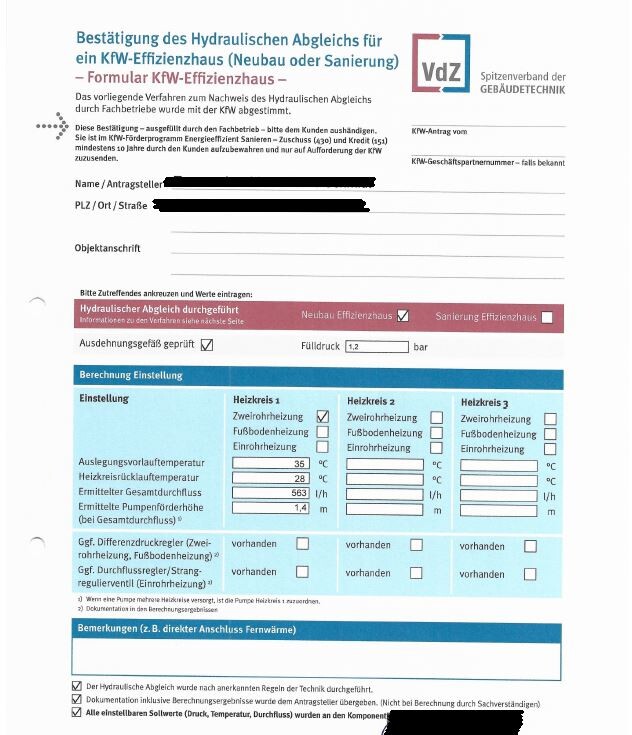
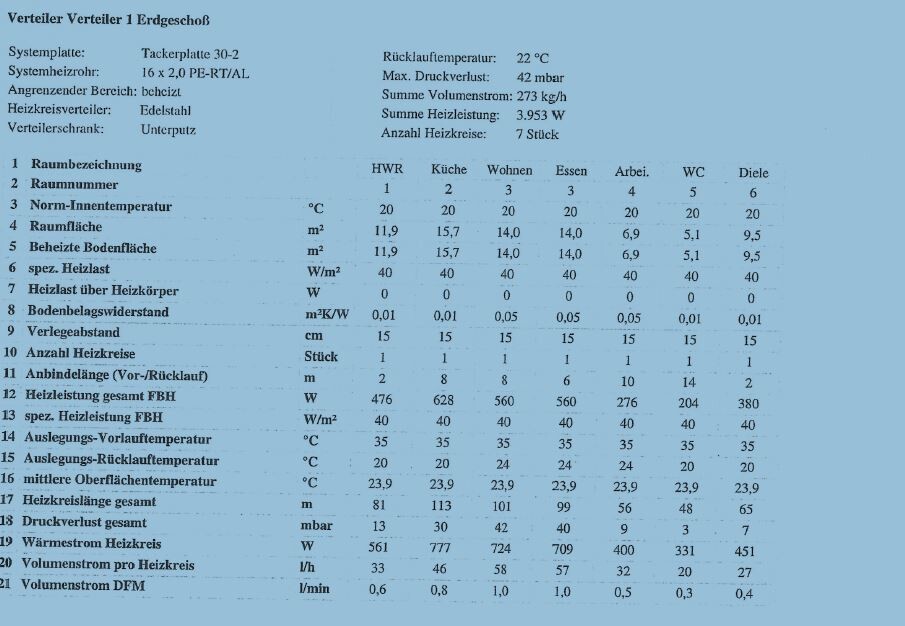
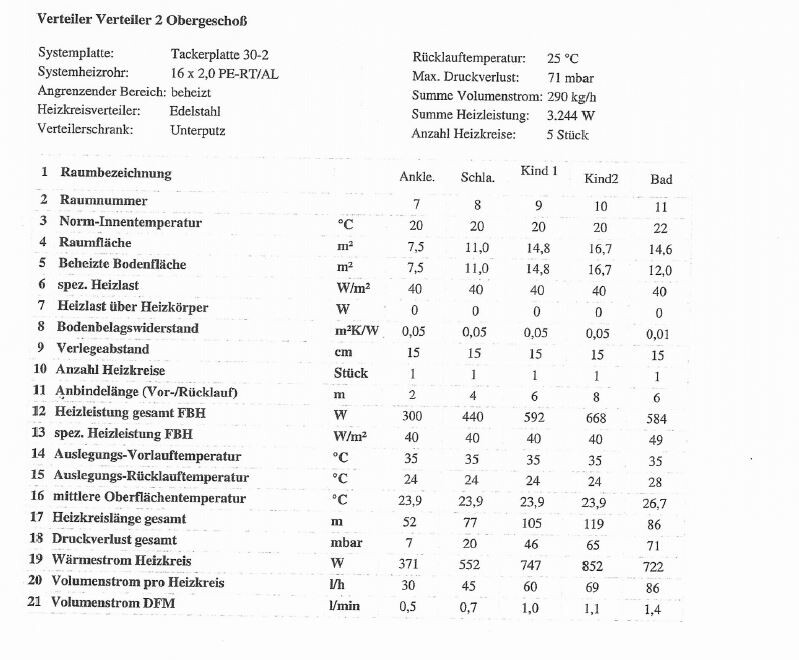
I’ve attached a picture of the hydraulic balancing and the heating load calculation.
However, there’s not much to see there.
I’ve read the explanation in the neighboring forum. But I’m not sure how best to apply it to my situation now.
So, I’ll leave the settings as they are for the time being, until it gets colder. Then I’ll start adjusting from the values set by the hydraulic balancing.
But if I only increase or decrease the temperature in individual rooms based on these values, I won’t be able to tell if the heating curve needs to be adjusted, right?
What should I do with the very short circuit? Should I just leave it unchanged to avoid errors?
At 16 meters (52 feet), it’s just the circuit in the upstairs hallway. All the other circuits are significantly longer, though their lengths vary a lot.
I’ve attached a picture of the hydraulic balancing and the heating load calculation.
However, there’s not much to see there.
I’ve read the explanation in the neighboring forum. But I’m not sure how best to apply it to my situation now.
tomtom79 schrieb:
Thermal short circuits can fortunately be measured.
I sent him a guide for thermal balancing. I think it’s great that you’re providing such detailed support.
And yes, the curve is flat, and it’s not obviously too cold at the moment. But that’s not necessarily the case if the system is hydraulically misadjusted and an early compressor failure occurs.
I do NOT want to cause uncertainty and actually appreciate it when a heating technician has done a good job. That just rarely happens. An extreme case here seems to be @Bookstar.
So there’s no rush, but it’s always better to have it checked.