
ᐅ Replacing the Heating System in an Older Home: Which Option Is Best?
Created on: 4 May 2020 14:51
T
tiborb
Hello everyone,
I need your advice on choosing the heating system for the planned replacement of our heating installation.
Facts:
- Semi-detached house with two separate living units, built in 1972, purchased by us in 2014
- Approx. 220 sqm (2370 sq ft) of heated space, 186 sqm (2002 sq ft) of living area, 95 sqm (1023 sq ft) on the ground floor, 91 sqm (979 sq ft) on the upper floor
- Building envelope insulated with 10 cm (4 inches)
- New triple-glazed windows, conservatories with full glazing on both ground and upper floors
- Roof not insulated
- Heating distribution: (We are currently planning to replace the old tube radiators with low-temperature radiators)
- Replacement of old oil heating from 1989 (low temperature), oil tank with 6000 liters (1585 gallons) steel tank, current consumption about 2500 liters (660 gallons) per year
- No gas connection available
- Additional planned project: photovoltaic system with about 8 – 9.9 kWp on the south side of the roof with a 10 kWh battery storage
- Ideally BAFA subsidy of 40% – 45% per system utilized
There have been many considerations regarding the options for the new heating system:
Option 1: Gas hybrid with solar thermal system of 8.5 sqm (91 sq ft) and 600-liter (160-gallon) water buffer tank
(Offers from Buderus or BOSCH systems)
Option 2: Gas hybrid with 400-liter (105-gallon) water tank and small supplementary air-water heat pump (possibly combined with the rooftop photovoltaic system)
(Offers from WOLF systems)
Option 3: Air-water heat pump with integrated domestic hot water preparation in the indoor unit and outdoor unit (possibly combined with the rooftop photovoltaic system)
(Offers from Vaillant systems)
Each option has its pros and cons, but I am also interested in your opinions and experiences. In particular, I am uncertain about the noise level of the outdoor units of the heat pumps. How loud are they really?
Or maybe some of you are currently planning a replacement with a similar setup. I would be glad to hear your experiences with these systems and which you would recommend for my situation.
Thank you very much for your help!!!
Best regards,
Chippy
I need your advice on choosing the heating system for the planned replacement of our heating installation.
Facts:
- Semi-detached house with two separate living units, built in 1972, purchased by us in 2014
- Approx. 220 sqm (2370 sq ft) of heated space, 186 sqm (2002 sq ft) of living area, 95 sqm (1023 sq ft) on the ground floor, 91 sqm (979 sq ft) on the upper floor
- Building envelope insulated with 10 cm (4 inches)
- New triple-glazed windows, conservatories with full glazing on both ground and upper floors
- Roof not insulated
- Heating distribution: (We are currently planning to replace the old tube radiators with low-temperature radiators)
- Basement: One old tube radiator and about 40 sqm (430 sq ft) of underfloor heating (old system – probably pipes will be reused)
- Ground floor: Underfloor heating with 9 loops, installed in 2014, conservatory still with old underfloor heating system like in the basement
- Upper floor: Six old tube radiators
- Replacement of old oil heating from 1989 (low temperature), oil tank with 6000 liters (1585 gallons) steel tank, current consumption about 2500 liters (660 gallons) per year
- No gas connection available
- Additional planned project: photovoltaic system with about 8 – 9.9 kWp on the south side of the roof with a 10 kWh battery storage
- Ideally BAFA subsidy of 40% – 45% per system utilized
There have been many considerations regarding the options for the new heating system:
Option 1: Gas hybrid with solar thermal system of 8.5 sqm (91 sq ft) and 600-liter (160-gallon) water buffer tank
(Offers from Buderus or BOSCH systems)
Option 2: Gas hybrid with 400-liter (105-gallon) water tank and small supplementary air-water heat pump (possibly combined with the rooftop photovoltaic system)
(Offers from WOLF systems)
Option 3: Air-water heat pump with integrated domestic hot water preparation in the indoor unit and outdoor unit (possibly combined with the rooftop photovoltaic system)
(Offers from Vaillant systems)
Each option has its pros and cons, but I am also interested in your opinions and experiences. In particular, I am uncertain about the noise level of the outdoor units of the heat pumps. How loud are they really?
Or maybe some of you are currently planning a replacement with a similar setup. I would be glad to hear your experiences with these systems and which you would recommend for my situation.
Thank you very much for your help!!!
Best regards,
Chippy
Of the 8 offers so far from four different companies in and around Munich, the price has always been between 1400 and 1500 EUR per kWp. This looks very much like price collusion in this region. I should mention that I need a meter cabinet modification to the "single-meter variant."
N
nordanney17 Jun 2020 22:53tiborb schrieb:
This looks to me like price fixing in this region.Then just google clen solar... At least with mine, it includes a meter for self-consumption.Back to the topic of heat pumps:
I ran a seasonal performance factor calculator myself:
This time with a planned 40°C (104°F) supply temperature start-up, since we generally have underfloor heating throughout the house, except on the first floor. However, there is a ceramic stove there, which we could use additionally during very cold winters. Alternatively, we could raise the heat pump’s supply temperature for those days. But winters have been quite mild here in the south in recent years.

My standard total heating load calculation:
I entered the values myself. For the windows, we are generally below a U-value of 1.0, but our winter garden has double-glazed windows. The top floor ceiling is currently not insulated. The bottom floor ceiling has underfloor heating installed and insulation above the concrete slab. The exterior walls have 10cm (4 inches) of thermal insulation on solid brickwork. The basement can be partially heated with underfloor heating.
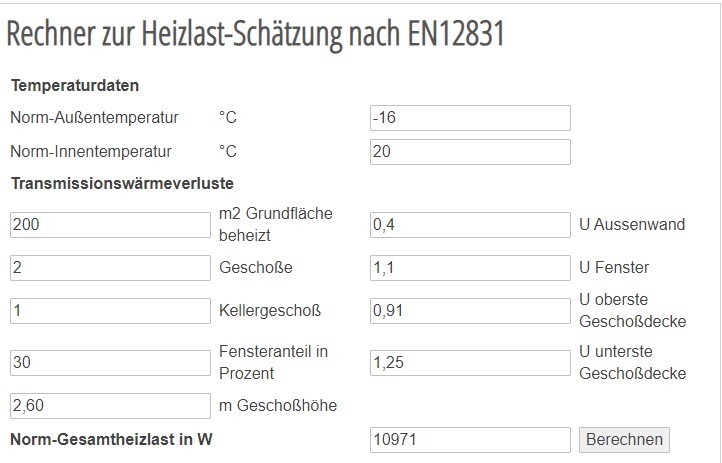
The company calculated the following:
Heated floor area 200 m² (2153 ft²)
Standard heating load 21.86 W/m² (6.7 BTU/h·ft²)
Total heat generator output 11 kW (37,500 BTU/h)
Building heating load 11 kW (37,500 BTU/h)
Heat pump coverage ratio 100%
Heat pump capacity share 78.36%
Seasonal performance factor (SPF) heating 3.9 without backup heater and 3.9 with backup heater
SPF domestic hot water 4.0 without backup heater and 4.0 with backup heater
Seasonal performance factor according to VDI 4650 -> 3.9
Supply temperature 55°C (131°F)
Hot water storage 50°C (122°F)
The company states their COP for the air-to-water heat pump as follows:
It is supposed to be a larger heat pump with over 8 kW (27,000 BTU/h) output, meaning two stacked outdoor units.
Performance coefficient COP A-7/W35 -> 2.71
Performance coefficient COP A2/W35 -> 4.28
Performance coefficient COP A7/W35 -> 5.61
Note:
We are possibly planning to install a photovoltaic system with 8.16 kWp and a 9.6 kWh battery on our south-facing roof.
Calculated grid feed-in approximately 9262 kWh per year.
Currently, our electricity consumption is around 3000 kWh (3,000 kWh), likely increasing to 4500 kWh (4,500 kWh) later.
Heat pump electricity consumption:
To estimate electricity consumption, you would divide the heating load by the seasonal performance factor and multiply by 2000 (heating hours), resulting in:
11 kW / seasonal performance factor 4.5 x 2000 = 4888 kWh, meaning around 1000 USD (84 USD/month) annual electricity cost for the air-to-water heat pump at a heat pump tariff of 20 cents per kWh.
I also visited a reference customer who lives in a KfW55 house (but with tubular radiators?). They operate a slightly smaller system from the same provider for a 130 m² (1400 ft²) area all year round with about 55°C (131°F) supply temperature and reported approximately 4000 kWh electricity consumption annually.
---
Questions:
1.) Do you think this calculation is realistic? With a seasonal performance factor of 4.5 for an air-to-water heat pump at only 40°C (104°F) supply temperature?
2.) Would you recommend the heat pump to me now based on the updated calculation?
3.) If the electricity costs are not economical, would combining it with the mentioned photovoltaic system make it reasonable and profitable again?
4.) Is it allowed here to ask for experiences with air-to-water heat pump models as long as no prices or advertising are mentioned?
Thank you for your feedback.
I ran a seasonal performance factor calculator myself:
This time with a planned 40°C (104°F) supply temperature start-up, since we generally have underfloor heating throughout the house, except on the first floor. However, there is a ceramic stove there, which we could use additionally during very cold winters. Alternatively, we could raise the heat pump’s supply temperature for those days. But winters have been quite mild here in the south in recent years.
My standard total heating load calculation:
I entered the values myself. For the windows, we are generally below a U-value of 1.0, but our winter garden has double-glazed windows. The top floor ceiling is currently not insulated. The bottom floor ceiling has underfloor heating installed and insulation above the concrete slab. The exterior walls have 10cm (4 inches) of thermal insulation on solid brickwork. The basement can be partially heated with underfloor heating.
The company calculated the following:
Heated floor area 200 m² (2153 ft²)
Standard heating load 21.86 W/m² (6.7 BTU/h·ft²)
Total heat generator output 11 kW (37,500 BTU/h)
Building heating load 11 kW (37,500 BTU/h)
Heat pump coverage ratio 100%
Heat pump capacity share 78.36%
Seasonal performance factor (SPF) heating 3.9 without backup heater and 3.9 with backup heater
SPF domestic hot water 4.0 without backup heater and 4.0 with backup heater
Seasonal performance factor according to VDI 4650 -> 3.9
Supply temperature 55°C (131°F)
Hot water storage 50°C (122°F)
The company states their COP for the air-to-water heat pump as follows:
It is supposed to be a larger heat pump with over 8 kW (27,000 BTU/h) output, meaning two stacked outdoor units.
Performance coefficient COP A-7/W35 -> 2.71
Performance coefficient COP A2/W35 -> 4.28
Performance coefficient COP A7/W35 -> 5.61
Note:
We are possibly planning to install a photovoltaic system with 8.16 kWp and a 9.6 kWh battery on our south-facing roof.
Calculated grid feed-in approximately 9262 kWh per year.
Currently, our electricity consumption is around 3000 kWh (3,000 kWh), likely increasing to 4500 kWh (4,500 kWh) later.
Heat pump electricity consumption:
To estimate electricity consumption, you would divide the heating load by the seasonal performance factor and multiply by 2000 (heating hours), resulting in:
11 kW / seasonal performance factor 4.5 x 2000 = 4888 kWh, meaning around 1000 USD (84 USD/month) annual electricity cost for the air-to-water heat pump at a heat pump tariff of 20 cents per kWh.
I also visited a reference customer who lives in a KfW55 house (but with tubular radiators?). They operate a slightly smaller system from the same provider for a 130 m² (1400 ft²) area all year round with about 55°C (131°F) supply temperature and reported approximately 4000 kWh electricity consumption annually.
---
Questions:
1.) Do you think this calculation is realistic? With a seasonal performance factor of 4.5 for an air-to-water heat pump at only 40°C (104°F) supply temperature?
2.) Would you recommend the heat pump to me now based on the updated calculation?
3.) If the electricity costs are not economical, would combining it with the mentioned photovoltaic system make it reasonable and profitable again?
4.) Is it allowed here to ask for experiences with air-to-water heat pump models as long as no prices or advertising are mentioned?
Thank you for your feedback.
N
nordanney13 Jul 2020 13:13tiborb schrieb:
I recently visited a reference customer who has a KFW55 house (but with tubular radiators?). They run the slightly smaller system from the provider for about 130m2 (1400 sq ft) all year round with a supply temperature of around 55°C (131°F) and consumed approximately 4000 kWh of electricity per year. Disastrous!!!
tiborb schrieb:
1.) Do you think the calculation is realistic? With an annual performance factor of 4.5 for an air-to-water heat pump at only 40°C (104°F) supply temperature? That might be a bit optimistic. Would you manage with just 40°C (104°F) supply temperature?
tiborb schrieb:
3.) If the electricity costs make it uneconomical, would the combination mentioned above with a photovoltaic system make it sensible and profitable again? Again – photovoltaic systems have nothing to do with heat pumps and do not suddenly make an uneconomical heat pump profitable. You need to understand this clearly. Consider both systems separately!
tiborb schrieb:
4.) Is it allowed to ask for experiences with air-to-water heat pump models here, as long as no prices or advertisements are mentioned? Yes
Hi, yes, I would definitely try to manage with a supply temperature of 40°C (104°F) at first, since in the basement and ground floor I only need 30 to 35°C (86 to 95°F) supply temperature anyway because of the underfloor heating. We will have to see how well the new low-temperature radiators on the first floor can emit enough heat. Generally, we heat from the bottom up, with some heating on the first floor as well. This is also based on the experience of the previous occupant of the first floor, who said he hardly ever had to use heating. On the south side, we have large window areas (conservatory and big windows).
What do you think about the heating company’s statement that with the Vaillant VWL 125/6 A heat pump and the COP calculation, no electric backup heater will be needed?
The heat pump has a maximum heating capacity of 8.63 kW.
We have about 200 square meters (2,150 sq ft) of living area to heat.
The building’s heating load is about 11 kW.
The annual performance factor of the air-to-water heat pump is said to be 3.9.
What do you think about the heating company’s statement that with the Vaillant VWL 125/6 A heat pump and the COP calculation, no electric backup heater will be needed?
The heat pump has a maximum heating capacity of 8.63 kW.
We have about 200 square meters (2,150 sq ft) of living area to heat.
The building’s heating load is about 11 kW.
The annual performance factor of the air-to-water heat pump is said to be 3.9.
| Heating capacity / Electrical power / COP at A-7/W35 | 11.8 / 4.92 / 2.4 kW | ||||
| Heating capacity / Electrical power / COP at A2/W35 | 5.9 / 1.28 / 4.6 kW | ||||
| Heating capacity / Electrical power / COP at A7/W35 | 8.5 / 1.57 / 5.4 kW | ||||
| Heating capacity / Electrical power / COP at A10/W35 | 8.8 / 1.54 / 5.7 kW |
Similar topics