
ᐅ Replacing the Heating System in an Older Home: Which Option Is Best?
Created on: 4 May 2020 14:51
T
tiborb
Hello everyone,
I need your advice on choosing the heating system for the planned replacement of our heating installation.
Facts:
- Semi-detached house with two separate living units, built in 1972, purchased by us in 2014
- Approx. 220 sqm (2370 sq ft) of heated space, 186 sqm (2002 sq ft) of living area, 95 sqm (1023 sq ft) on the ground floor, 91 sqm (979 sq ft) on the upper floor
- Building envelope insulated with 10 cm (4 inches)
- New triple-glazed windows, conservatories with full glazing on both ground and upper floors
- Roof not insulated
- Heating distribution: (We are currently planning to replace the old tube radiators with low-temperature radiators)
- Replacement of old oil heating from 1989 (low temperature), oil tank with 6000 liters (1585 gallons) steel tank, current consumption about 2500 liters (660 gallons) per year
- No gas connection available
- Additional planned project: photovoltaic system with about 8 – 9.9 kWp on the south side of the roof with a 10 kWh battery storage
- Ideally BAFA subsidy of 40% – 45% per system utilized
There have been many considerations regarding the options for the new heating system:
Option 1: Gas hybrid with solar thermal system of 8.5 sqm (91 sq ft) and 600-liter (160-gallon) water buffer tank
(Offers from Buderus or BOSCH systems)
Option 2: Gas hybrid with 400-liter (105-gallon) water tank and small supplementary air-water heat pump (possibly combined with the rooftop photovoltaic system)
(Offers from WOLF systems)
Option 3: Air-water heat pump with integrated domestic hot water preparation in the indoor unit and outdoor unit (possibly combined with the rooftop photovoltaic system)
(Offers from Vaillant systems)
Each option has its pros and cons, but I am also interested in your opinions and experiences. In particular, I am uncertain about the noise level of the outdoor units of the heat pumps. How loud are they really?
Or maybe some of you are currently planning a replacement with a similar setup. I would be glad to hear your experiences with these systems and which you would recommend for my situation.
Thank you very much for your help!!!
Best regards,
Chippy
I need your advice on choosing the heating system for the planned replacement of our heating installation.
Facts:
- Semi-detached house with two separate living units, built in 1972, purchased by us in 2014
- Approx. 220 sqm (2370 sq ft) of heated space, 186 sqm (2002 sq ft) of living area, 95 sqm (1023 sq ft) on the ground floor, 91 sqm (979 sq ft) on the upper floor
- Building envelope insulated with 10 cm (4 inches)
- New triple-glazed windows, conservatories with full glazing on both ground and upper floors
- Roof not insulated
- Heating distribution: (We are currently planning to replace the old tube radiators with low-temperature radiators)
- Basement: One old tube radiator and about 40 sqm (430 sq ft) of underfloor heating (old system – probably pipes will be reused)
- Ground floor: Underfloor heating with 9 loops, installed in 2014, conservatory still with old underfloor heating system like in the basement
- Upper floor: Six old tube radiators
- Replacement of old oil heating from 1989 (low temperature), oil tank with 6000 liters (1585 gallons) steel tank, current consumption about 2500 liters (660 gallons) per year
- No gas connection available
- Additional planned project: photovoltaic system with about 8 – 9.9 kWp on the south side of the roof with a 10 kWh battery storage
- Ideally BAFA subsidy of 40% – 45% per system utilized
There have been many considerations regarding the options for the new heating system:
Option 1: Gas hybrid with solar thermal system of 8.5 sqm (91 sq ft) and 600-liter (160-gallon) water buffer tank
(Offers from Buderus or BOSCH systems)
Option 2: Gas hybrid with 400-liter (105-gallon) water tank and small supplementary air-water heat pump (possibly combined with the rooftop photovoltaic system)
(Offers from WOLF systems)
Option 3: Air-water heat pump with integrated domestic hot water preparation in the indoor unit and outdoor unit (possibly combined with the rooftop photovoltaic system)
(Offers from Vaillant systems)
Each option has its pros and cons, but I am also interested in your opinions and experiences. In particular, I am uncertain about the noise level of the outdoor units of the heat pumps. How loud are they really?
Or maybe some of you are currently planning a replacement with a similar setup. I would be glad to hear your experiences with these systems and which you would recommend for my situation.
Thank you very much for your help!!!
Best regards,
Chippy
nordanney schrieb:
...
Who will be using the apartment and how?The idea is good, but we want to use the apartment ourselves, with possible short-term rentals occasionally. We planned to remove the old oil heating system, as we also want to convert the oil tank room into a usable cellar.
So far, we have been considering installing low-temperature radiators on the first floor to keep the supply temperature at a maximum of 55°C (131°F). We have been hesitant to convert the first floor to underfloor heating because we would have to replace all floor coverings, etc. The living area is approximately 91 m² (980 sq ft). What would be the approximate cost of converting to underfloor heating and replacing the floor coverings? The new radiators cost about 2,100 EUR after subsidies.
Of course, we could consider running the supply temperature at a maximum of 40°C (104°F) on the first floor to see if we actually need it warmer. The past winters here in Munich have mostly been mild. Additionally, there is a tiled stove installed on the first floor (which we would need to reactivate since it must be taken out of use in 2020).
We were also offered another hybrid option with a gas heater and a small heat pump. This option would also qualify for subsidies.
N
nordanney15 Jun 2020 16:40tiborb schrieb:
What would the approximate cost be for converting to underfloor heating and floor coverings? The new radiators cost us about 2,100 EUR after subsidy. This cannot be answered precisely. It depends on the build-up height of the floor (whether everything is removed and underfloor heating plus screed installed, possibly using a thin-layer method or milling grooves), your preferences for floor coverings (laminate at €4.99, tiles at €40, or luxury parquet at €120), as well as any DIY work you can do yourself (removing the old floor or laying heating pipes can be done very cheaply by yourself, for example).
Well, that’s great, then the heating company can contractually guarantee that for you and assure you a two-year cancellation right if the annual performance factor is not met.
If you’re not interested in researching thoroughly yourself, my advice is: smallest gas boiler, 200-liter (53-gallon) storage tank, and that’s it. Nothing complicated to set up, no hassle with the technology, and it will keep you warm.
You should realize yourself that 24 kW is too much for an estimated heating load of 11 kW.
There are excellent manufacturers that offer boilers with 11 or 15 kW and a low modulation limit.
If you’re not interested in researching thoroughly yourself, my advice is: smallest gas boiler, 200-liter (53-gallon) storage tank, and that’s it. Nothing complicated to set up, no hassle with the technology, and it will keep you warm.
You should realize yourself that 24 kW is too much for an estimated heating load of 11 kW.
There are excellent manufacturers that offer boilers with 11 or 15 kW and a low modulation limit.
N
nordanney17 Jun 2020 16:13tiborb schrieb:
The photovoltaic system is expected to cost around 19,000 EUR net, including storage and subsidies. I now have a current offer without storage (which the solar technician even advised against).
Net price is 11,700 EUR for 9.9 kWp – without subsidies, but including all necessary services and work. Just for comparison.
Yes, what puzzles me is the calculation of the standard heating load by the heating company (with heat pump offer):
Standard heating load 21.86 W/m2 corresponds to 200m2 (2152 ft2)
-> 4371.45 W
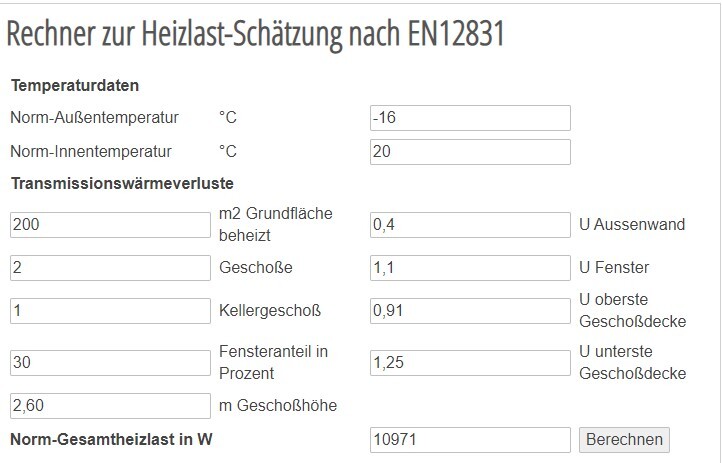
I did some further research myself and found an online calculator for estimating the heating load. When I enter my data there, I get a total standard heating load of about 11,000 W.
Furthermore, the company calculates the hot water heating power for 7 people in the household, assuming 37.5 L (10 gallons) per person per day, an annual efficiency of 0.4, and 4 hours of daily full usage
-> 6697.35 W
Total heat generator capacity
-> 11,068.79 W (11 kW heating load of the building)
That means, based on my self-calculated total standard heating load, I would expect a total heat generator capacity of about 17,700 W, roughly 18 kW.
That is 18 kW / 3.5 × 2000 = 10,285 kWh electricity consumption for the heat pump (in the worst case scenario with a seasonal performance factor of 3.5). With a heat pump electricity tariff, that would be about 2,500 EUR electricity cost per year.
About 1,200 EUR net per kWp is not bad, right? Which region do you live in? In the Munich area we often see different prices (at least that’s what I’ve noticed).
Thanks
Standard heating load 21.86 W/m2 corresponds to 200m2 (2152 ft2)
-> 4371.45 W
I did some further research myself and found an online calculator for estimating the heating load. When I enter my data there, I get a total standard heating load of about 11,000 W.
Furthermore, the company calculates the hot water heating power for 7 people in the household, assuming 37.5 L (10 gallons) per person per day, an annual efficiency of 0.4, and 4 hours of daily full usage
-> 6697.35 W
Total heat generator capacity
-> 11,068.79 W (11 kW heating load of the building)
That means, based on my self-calculated total standard heating load, I would expect a total heat generator capacity of about 17,700 W, roughly 18 kW.
That is 18 kW / 3.5 × 2000 = 10,285 kWh electricity consumption for the heat pump (in the worst case scenario with a seasonal performance factor of 3.5). With a heat pump electricity tariff, that would be about 2,500 EUR electricity cost per year.
nordanney schrieb:
I now have a current offer without a storage tank (which even the solar installer advised against).
Net 11,700 EUR for 9.9 kWp – without subsidies, but including all necessary services and work. Just for comparison.
About 1,200 EUR net per kWp is not bad, right? Which region do you live in? In the Munich area we often see different prices (at least that’s what I’ve noticed).
Thanks
N
nordanney17 Jun 2020 16:44tiborb schrieb:
Prices are often different here in the Munich area (I have noticed).That is a reasonable price. It would be the second system from this solar installer. The region doesn’t matter. The price applies equally to Brandenburg, the Rhineland (where I live), and also Munich. It is a smaller company from 08280 Aue-Bad Schlema that operates throughout Germany.Similar topics