
E
Exilpfälzer14 Mar 2014 16:09Hello,
I am facing a very unfortunate situation with my new build. The shell is basically finished, the windows and front door are installed, the plumbing rough-in is complete, and the electrician has also mostly finished. Now the plasterer was supposed to come and do the interior plastering. The plan was that I would fill all the chases myself in week 8, and the plasterer would start the interior plastering in week 9.
During this work, I first noticed on the ground floor that in the areas where the electrician had cut chases into the 11.5cm (4.5 inch) walls, the top row of bricks had come loose. I informed the construction company about this, after which the site manager and his foreman came and concluded that the electrician had loosened the bricks with his Hilti. They also said that once the plasterer applies the plaster, the bricks will hold. Later, the electrician told me over the phone that the bricks were already loose beforehand, and a second person had to hold the brick while he cut the chase. Well, I thought, never mind—it’s only three bricks. I then made narrow chases myself and filled them with mortar. Bricks are firm, everything fine.
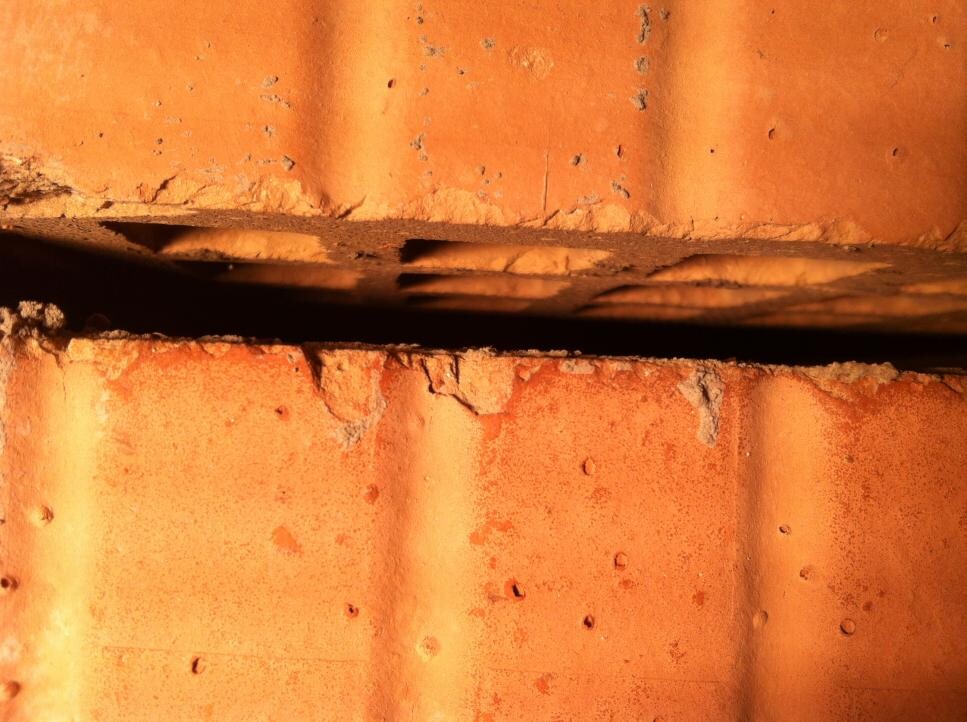
When I reached the upper floor with my work, a similar but worse issue came up with the 11.5cm (4.5 inch) walls. Not only the bricks where the chases were cut were loose, but also the first and second neighboring bricks. Since the upper floor has a timber beam ceiling instead of a concrete floor, I was able to lift the bricks and found that the adhesive beneath the top row of bricks was almost nonexistent. My amateur assumption is that the adhesive had already started setting while the last row was laid. It is likely the ground floor has a similar cause. On one side of the wall, no adhesive is visible in the joints, while on the other side the adhesive appears to have run out.
The unpleasant thing about this situation is that both the electrician and the construction company are blaming each other. Neither is willing to take responsibility for this faulty workmanship. The architect says the masonry should have held. An expert, without seeing the site, says that the electrician merely exposed the defect, and that the cause was sloppy work by the construction company. However, it is the electrician’s duty to report the defect and stop his work so the construction company can fix it.
So both parties share responsibility for this mess.
The plasterer said, “If I can’t start in week 9, I’ll go to the next site and won’t be able to start here for four weeks.” However, it is possible to embed mesh at the affected areas to give the plaster extra stability. So, that was agreed and done. The additional costs amount to €750.00 net, which I do not want to pay.
My final question is: Are there any VOB (German Construction Contract Procedures) guidelines that apply in such a case and could help convince both tradespeople to cover the additional costs and thus fulfill their warranty obligations?
Thank you.
I am facing a very unfortunate situation with my new build. The shell is basically finished, the windows and front door are installed, the plumbing rough-in is complete, and the electrician has also mostly finished. Now the plasterer was supposed to come and do the interior plastering. The plan was that I would fill all the chases myself in week 8, and the plasterer would start the interior plastering in week 9.
During this work, I first noticed on the ground floor that in the areas where the electrician had cut chases into the 11.5cm (4.5 inch) walls, the top row of bricks had come loose. I informed the construction company about this, after which the site manager and his foreman came and concluded that the electrician had loosened the bricks with his Hilti. They also said that once the plasterer applies the plaster, the bricks will hold. Later, the electrician told me over the phone that the bricks were already loose beforehand, and a second person had to hold the brick while he cut the chase. Well, I thought, never mind—it’s only three bricks. I then made narrow chases myself and filled them with mortar. Bricks are firm, everything fine.
When I reached the upper floor with my work, a similar but worse issue came up with the 11.5cm (4.5 inch) walls. Not only the bricks where the chases were cut were loose, but also the first and second neighboring bricks. Since the upper floor has a timber beam ceiling instead of a concrete floor, I was able to lift the bricks and found that the adhesive beneath the top row of bricks was almost nonexistent. My amateur assumption is that the adhesive had already started setting while the last row was laid. It is likely the ground floor has a similar cause. On one side of the wall, no adhesive is visible in the joints, while on the other side the adhesive appears to have run out.
The unpleasant thing about this situation is that both the electrician and the construction company are blaming each other. Neither is willing to take responsibility for this faulty workmanship. The architect says the masonry should have held. An expert, without seeing the site, says that the electrician merely exposed the defect, and that the cause was sloppy work by the construction company. However, it is the electrician’s duty to report the defect and stop his work so the construction company can fix it.
So both parties share responsibility for this mess.
The plasterer said, “If I can’t start in week 9, I’ll go to the next site and won’t be able to start here for four weeks.” However, it is possible to embed mesh at the affected areas to give the plaster extra stability. So, that was agreed and done. The additional costs amount to €750.00 net, which I do not want to pay.
My final question is: Are there any VOB (German Construction Contract Procedures) guidelines that apply in such a case and could help convince both tradespeople to cover the additional costs and thus fulfill their warranty obligations?
Thank you.
J
JanWichmann14 Mar 2014 16:35Hi,
Since I work as an electrician, I am very familiar with the issue of loose bricks in the top row. When we encounter this, we inform the bricklayer and they fix it again. Otherwise, the plasterer smooths it over, and it holds without any problems. Additional reinforcing mesh has never been used so far.
Since I work as an electrician, I am very familiar with the issue of loose bricks in the top row. When we encounter this, we inform the bricklayer and they fix it again. Otherwise, the plasterer smooths it over, and it holds without any problems. Additional reinforcing mesh has never been used so far.

B
Bauexperte18 Mar 2014 10:33Hello,
A DIN standard won’t help you much because it is not just about one DIN; listing all relevant standards here would go too far. In my opinion, a discussion based on DIN standards will not help you either, as it won’t change the different points of view. Since we are already in week 12, I assume that now it is realistically only a matter of who bears the cost.
What remains at the end of the day is that primarily the structural builder carried out their work negligently. In my view, there is only one option: photograph the affected areas and formally complain in writing to the contractor, setting a deadline; you have partly done this already. It doesn’t matter to you who is to blame from whose perspective: you are entitled to a defect-free handover of your single-family house. Your contractor should coordinate with their subcontractors; your contract partner is always the main contractor, not their team of tradespeople—unless, of course, you have awarded the contracts individually and directly.
If no agreement about covering the additional €750.00 costs is reached by the final payment, it depends on how wisely you negotiate.
Regards, Bauexperte
Exilpfälzer schrieb:Even more interesting than your question might be the answers to it...
So, the unpleasant thing about the situation is that both the electrician and the construction company are blaming each other. Neither is willing to take responsibility for this shoddy work. The architect says the masonry should have held. An expert says, without seeing it, that the electrician merely uncovered the fault. The cause was the carelessness of the construction company. However, the electrician is obliged to report this defect and stop their work so the construction company can make corrections.
So both parties share the blame for this mess.
The plasterer said: "If I can’t start in week 9, I will move to another site and can only start with you again in four weeks." But it is possible to embed reinforcing mesh in the affected areas to give the plaster extra stability. So, agreed and done. The additional cost is €750.00 net, which I do not want to pay.
My final question is: Are there any VOB guidelines that apply in such a case, which could help convince the two involved trades to cover the extra costs and thus fulfill their warranty obligations?
A DIN standard won’t help you much because it is not just about one DIN; listing all relevant standards here would go too far. In my opinion, a discussion based on DIN standards will not help you either, as it won’t change the different points of view. Since we are already in week 12, I assume that now it is realistically only a matter of who bears the cost.
What remains at the end of the day is that primarily the structural builder carried out their work negligently. In my view, there is only one option: photograph the affected areas and formally complain in writing to the contractor, setting a deadline; you have partly done this already. It doesn’t matter to you who is to blame from whose perspective: you are entitled to a defect-free handover of your single-family house. Your contractor should coordinate with their subcontractors; your contract partner is always the main contractor, not their team of tradespeople—unless, of course, you have awarded the contracts individually and directly.
If no agreement about covering the additional €750.00 costs is reached by the final payment, it depends on how wisely you negotiate.
Regards, Bauexperte
Similar topics